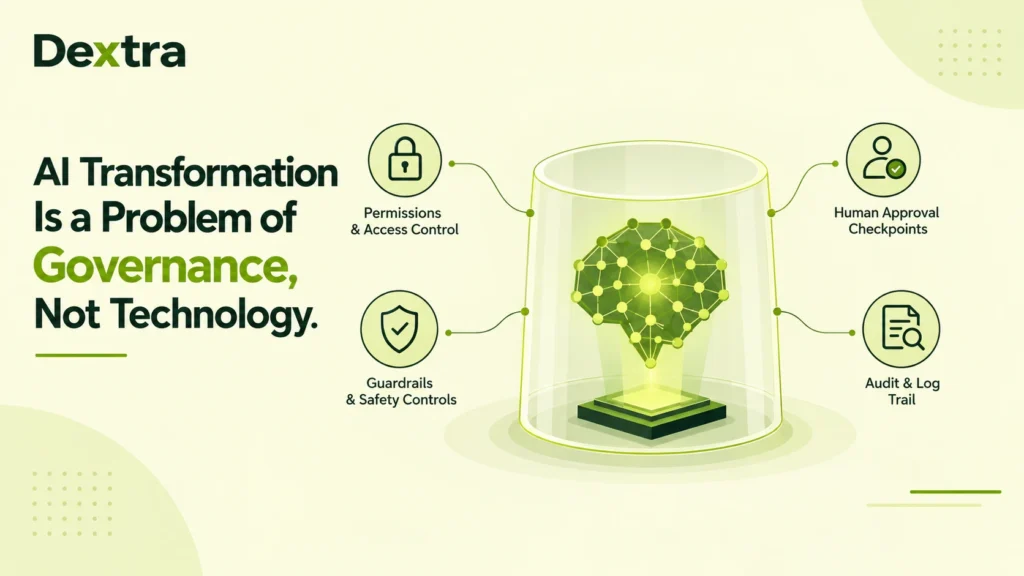
AI transformation is the process of integrating artificial intelligence into business operations, decision-making, and customer experiences to improve efficiency, solve complex problems, and create new business value. Yet, as organizations move from AI experimentation to enterprise-wide deployment, many of them struggle to manage data access, control automated actions, maintain oversight, and establish accountability across systems. That’s why AI transformation is a problem of governance, not technology.
This governance gap becomes more complex as AI systems move into production. Enterprises must manage the entire AI lifecycle, including data permissions, model versioning, agent capabilities, human approvals, runtime monitoring, and incident management. Frameworks such as ISO/IEC 42001 and the NIST AI Risk Management Framework provide structured approaches to these responsibilities. For example, an AI agent connected to a CRM should only access customer records within its authorized scope and require approval before making sensitive changes.
When these controls are missing, the impact extends beyond technology teams. As AI adoption spreads across departments and business workflows, fragmented ownership, shadow AI usage, unauthorized data access, and limited visibility into automated decisions can expose businesses to security incidents, compliance failures, and operational disruption. Effective governance helps enterprises protect business assets, manage risk, measure AI performance, and scale adoption without losing control.
Addressing these challenges requires a structured approach to AI governance. So, in this article, we’ll explore where enterprise AI governance breaks down, the risks and business costs of weak oversight, and the core pillars and frameworks needed to govern AI systems.
Why AI Transformation Is a Problem of Governance, Not Technology?
Here are the core reasons explaining why AI transformation is a problem of governance, not technology.
- Permissions, Not Parameters, Decide What AI Can Do: A model’s parameters influence its capabilities, but its permissions determine what it can access and execute. Effective AI transformation governance starts with controlling the scope of data, systems, and actions an organization grants to a model. Two companies can run the identical model at completely different levels of risk: one restricts it to read-only access in a sandbox, while the other allows it to modify production records. Applying least-privilege access and clearly defining permissions allows organizations to use powerful models without granting them unnecessary authority.
- Data Lineage and Context Matter More Than Model Size: Data lineage records where each piece of data came from, how it was transformed, and who is allowed to see it. A larger model grounded in unverified data simply produces confident errors faster. Provenance lets you trace a wrong answer back to its source, enforce permission-aware retrieval, and show auditors exactly what the system was allowed to read. A governed context layer ensures the model receives relevant, reliable, and permissioned information for each task. Ultimately, the quality and governance of the data pipeline, not the parameter count, determine how much you can trust the output.
- Continuous Evaluation and Version Control Are Essential Governance Controls: AI models can produce different outputs across runs, making a single successful test insufficient to establish reliability. Continuous evaluation, production monitoring, and runtime guardrails help detect unexpected behavior, while logging inputs, outputs, model versions, and relevant execution details supports investigation and reproducibility. Version pinning tracks which model and configuration are live, and a tested rollback mechanism allows teams to restore a previously validated version when an update degrades performance. Together, these controls make AI behavior traceable, failures easier to investigate, and production changes more manageable.
- Runtime Guardrails Beat Policy on Paper: One of the key AI governance challenges is enforcing policies when AI systems execute actions in production. A policy document states how an AI system should behave, while runtime guardrails enforce those requirements when the model acts. Input and output validation, allow and deny lists, action interception, kill switches, and rate limits help prevent unauthorized actions and contain failures before they affect customers or systems of record. Circuit breakers can interrupt execution when predefined failure conditions occur, while execution logs help teams investigate incidents and demonstrate that safeguards were applied. Effective governance requires enforcing rules at runtime, not just documenting them.
- Fine-Tuning Cannot Fix an Ungoverned Workflow: Fine-tuning adjusts a model’s behavior but does not establish workflow ownership, access permissions, logging, or human oversight. Teams often invest in fine-tuning to solve problems that actually stem from poor workflow design or inadequate governance. If a workflow lacks access controls, execution logs, and human checkpoints, a better-tuned model simply executes the ungoverned process more convincingly. Fix the workflow first.
- Model and Vendor Portability Is a Governance Requirement, Not a Preference: Portability allows organizations to switch models or vendors without rebuilding their governance controls. As models evolve and providers change their offerings, a governance layer tightly coupled to one provider can create unnecessary migration risks. An internal control plane with consistent guardrails, logging, and permissions across providers helps maintain governance while the underlying models change, reducing vendor lock-in and operational risk.
Where Enterprise AI Governance Commonly Breaks Down?
Below, we’ve mentioned five critical points where enterprise AI governance commonly breaks down and how they can be resolved.
1. No One Owns Incidents When AI Fails
An AI system runs across several teams, day to day, with no single person responsible for the moment it goes wrong. When an output harms a customer or corrupts a record, no one knows who investigates, who can pause the system, or who answers for it, so the response is slow and improvised. Without named incident ownership and a clear escalation path, responses become slow and improvised. Moreover, these same gaps also make it harder to learn from failures and prevent them from happening again.
2. Shadow AI Spreads Faster Than Oversight
Most businesses adopt whichever model or copilot solves on-going tasks, often through personal accounts or without approval to use corporate data. Over time, you compile dozens of ungoverned tools, inconsistent security practices, and sensitive information flowing through the systems that your security team has never reviewed. The problem can remain hidden until an incident exposes it, by which point the data may already be outside the organization’s control. Thus, governing what you can see has to start with surfacing what you cannot.
3. Data and Retrieval Are Ungoverned
An AI system is only as trustworthy as the data it reads, yet most businesses often connect it to whatever data sources are easiest to access. If retrieval pulls from outdated, duplicated, or permission-blind sources, the model can generate confident answers based on incorrect information or expose data a user should never have seen. Focusing on the model while overlooking the data pipeline leaves a critical governance gap. Therefore, reliable AI requires well-sourced retrieval systems that enforce access permissions and provide relevant, trustworthy context.
4. Human Oversight Is Applied by Habit, Not Risk
Some AI workflows require human approval at every step, while others allow actions to proceed without any review. Often, nobody has deliberately assessed which approach is appropriate for each task. This sometimes leads to unnecessary checks on low-risk activities while consequential decisions or actions may go unreviewed. The result can be slow and unsafe both at the same time.
This means human oversight should be deliberately designed around the potential impact of an action, with approval requirements proportional to its risk rather than determined by habit.
5. Governance Is Bolted On After the Build
Most businesses build and deploy an AI system first, treating governance as a review gate to clear before or after launch. Adding controls late in the process can require substantial rework, create brittle safeguards, and frustrate the teams responsible for implementation. Meanwhile, governance designed into the build from day one is faster and far cheaper than governance forced later.
What Ungoverned AI Actually Costs in 2026 [Security, Compliance, and Lost ROI]
The cost of weak AI governance rarely shows up as a single expense. It builds over time through pilots that never reach production, engineering work that has to be repeated, preventable security incidents, and business value that never materializes. These costs are easy to overlook because they are spread across budgets, teams, and projects.
Some 2026 estimates suggest that roughly 95% of enterprise generative AI pilots still show no measurable profit-and-loss impact, while the average enterprise data breach costs well over $4 million. These figures highlight the financial exposure organizations face when AI initiatives lack the right controls. The table below breaks down the major cost areas and their illustrative financial impact. You can replace these ranges with your own figures to estimate the potential cost to your organization.
| Cost area | What it looks like, and why it happens | Illustrative financial impact |
| Stalled pilots and sunk investment | Promising AI pilots often remain stuck in evaluation because governance gaps prevent teams from approving them for production. Meanwhile, licensing fees, cloud infrastructure, and months of engineering effort continue to consume budget without generating business value. Many enterprises face this problem across several pilots at once. | A typical enterprise may spend 250K-2M annually on pilots that never become deployed, value-generating systems. |
| Shadow AI and data exposure | Employees may paste sensitive company information into unapproved AI tools using personal accounts. This creates security and compliance risks that internal teams cannot properly monitor or contain until an incident exposes them. | A single AI-related data breach can cost 4M–5M when incident response, legal expenses, notifications, and remediation are included, before any regulatory fines. |
| Rework and firefighting | When governance is added after development, teams often have to rebuild agents, re-engineer data pipelines, and retrofit access permissions. Work that could have been addressed during the initial design becomes an expensive cycle of fixes and rework. | Retrofitting governance can add 20–40% to the original build cost, with similar costs recurring across systems that require remediation. |
| Regulatory and audit penalties | Without reliable logs and an evidence trail, organizations may struggle to demonstrate how an AI system behaved, what data it accessed, and whether appropriate controls were applied. This can turn a routine audit into a compliance problem and expose the business to enforcement under applicable regulations, including the EU AI Act. | For the most serious violations, penalties under the EU AI Act can reach €35 million or 7% of global annual turnover, whichever is higher. |
| Lost trust and stalled adoption | A visible AI failure can make customers, employees, and board members reluctant to trust subsequent initiatives. Even projects that could deliver meaningful value may face additional scrutiny or resistance, slowing adoption across the organization. | Difficult to quantify precisely, but potentially one of the largest costs because it limits the value the entire AI program can deliver. |
| Opportunity cost and slow time-to-value | While an organization remains caught in pilots, rework, and incident response, competitors with effective governance can move similar use cases into production. Over time, they can build a growing advantage by realizing business value sooner and scaling successful applications faster. | Delayed value can accumulate over months for each use case, potentially translating into millions of dollars in deferred revenue or unrealized savings on significant business workflows. |
The financial impact extends beyond the cost of individual projects. When governance gaps repeatedly delay deployment, create rework, and undermine trust, they limit the return on the entire AI investment. The real cost is not just what an organization spends on AI, but also the value it loses because it cannot deploy and scale AI reliably.
Core Pillars & Frameworks of AI Governance
An effective AI governance framework rests on four pillars: data governance, model and AI agent lifecycle oversight, human-in-the-loop oversight, and runtime enforcement. Together, they define what AI systems can access, how they are managed, who is accountable for their decisions, and how their actions are controlled in production.
These pillars align with established standards such as ISO/IEC 42001, which provides requirements for an AI management system, and the NIST AI Risk Management Framework (AI RMF), which helps organizations identify and manage AI-related risks. Their effectiveness depends on translating governance policies into controls that operate within AI systems.
To understand how these pillars work in practice, it helps to distinguish between two approaches to governance: one that defines rules and reviews compliance, and another that enforces those rules while AI systems operate.
- Policy-led governance establishes rules through policies, guidelines, committees, and periodic reviews. Compliance is typically assessed before or after deployment, which can leave gaps between documented requirements and actual system behavior.
- Runtime-enforced governance embeds rules into technical controls that restrict access, intercept unauthorized actions, and generate audit evidence during execution. These controls help ensure that AI systems operate within their assigned permissions.
Both approaches matter, but policies alone cannot ensure that an AI system follows its assigned permissions when executing tasks. The four pillars below help turn governance principles into operational controls.
Pillar #1: Data Governance and Sovereignty for AI
Data governance defines what information an AI system can access and how that information is managed and protected. Organizations must control data sources, protect sensitive information, and enforce permission-aware retrieval so users only receive information they are authorized to access. Data lineage and source validation help teams trace AI outputs to their origins, while data sovereignty controls keep information within required geographic or regulatory boundaries. Reliable AI depends on relevant, current, and authorized data.
Pillar #:2 Model and AI Agent Lifecycle Oversight
Lifecycle oversight governs how AI models and agents are deployed, evaluated, monitored, updated, and retired. Organizations should maintain an inventory of deployed systems, their versions, configurations, approved use cases, and evaluation history. Changes should be tested before production deployment, with ongoing performance monitoring and rollback procedures in place. These controls help teams investigate incidents, identify the model version responsible for an outcome, and manage changes without losing accountability.
Pillar #3: Human-in-the-Loop by Design
Human-in-the-loop governance defines where human review or approval is required within an AI workflow. Organizations should classify actions by risk and determine which can run automatically, which require logging and review, and which need explicit approval before execution. An AI assistant might generate a summary independently but require human authorization before issuing a refund or changing a contract. This approach addresses a key AI governance challenge by maintaining accountability without introducing unnecessary approval steps into low-risk workflows.
Pillar #4: Runtime Enforcement and Observability
Runtime enforcement applies governance rules during execution, while observability records and monitors system behavior. Controls such as input and output validation, least-privilege permissions, tool restrictions, and prompt-injection defenses help prevent unauthorized actions. Rate limits, circuit breakers, and kill switches help contain failures, while logs and traces capture model versions, tool calls, approval decisions, and execution outcomes. For agentic AI, clearly defined action tiers ensure that routine tasks can run automatically, designated activities are logged, and consequential actions require human approval.
The Biggest AI Governance Challenges and Gaps in 2026
As organizations expand their use of AI, governance often struggles to keep pace. The main challenges are not just about defining policies, but also about enforcing them, assigning accountability, and maintaining oversight as systems evolve. Below, we’ve mentioned seven common AI governance challenges and gaps that businesses face.
- Governance Does Not Scale With AI Adoption: Governance processes built for a handful of AI pilots often become bottlenecks when an organization expands to dozens of use cases. Businesses face long approval queues or bypass the process to meet deadlines. The underlying problem is that governance relies on one-off reviews instead of repeatable controls. Scalable governance uses predefined risk tiers and reusable safeguards, allowing new use cases to follow established controls without starting from scratch.
- Accountability for AI Decisions Remains Unclear: When an AI system makes a consequential decision, responsibility can be divided across the teams that build, deploy, and use it. Without a clearly accountable owner, incident response becomes slower and decisions are harder to challenge. This can also create legal and regulatory exposure, particularly for high-risk AI systems that require defined responsibilities. Organizations should assign decision rights and accountability before deployment, rather than waiting for an incident to expose the gap.
- Policies Exist, but Enforcement Is Missing: One of the central AI governance challenges in 2026 is the gap between documented policies and how AI is actually deployed. A policy has limited value if teams can bypass it whenever deadlines become urgent. The problem is not necessarily a lack of awareness, but the absence of controls that make compliance part of the deployment process. Organizations need clear approval gates and evidence that required safeguards are working, so deployment decisions rely on verifiable controls rather than self-attestation alone.
- Legacy Architecture Cannot Support Modern Governance Controls: Older systems may lack granular permissions, reliable data lineage, or integration layers that allow AI actions to be intercepted and controlled. In these environments, governance policies can demand safeguards that the underlying infrastructure cannot enforce. The gap therefore extends beyond AI itself to the data, identity, and integration systems on which it depends. Modernizing this infrastructure should be part of the AI program, rather than a separate initiative repeatedly pushed into the future.
- AI Evaluation Stops Too Early: Teams may validate a model against a benchmark or demonstration and assume it will perform just as well with live data and real users. Production environments introduce changing inputs, unexpected edge cases, and adversarial behavior that initial testing may miss. Evaluation should continue after launch through production monitoring, adversarial red-teaming, and regression tests that detect performance or quality issues before they affect customers. A continuous evaluation pipeline with alerts is more reliable than treating testing as a one-time pre-deployment checkpoint.
- Third-Party and Vendor AI Risks Go Unchecked: AI capabilities increasingly come embedded in existing SaaS products, even when organizations have little visibility into the underlying models, training data, or update schedules. Governance often focuses on internally developed systems while overlooking AI supplied by vendors. This creates blind spots across the software estate. Closing them requires vendor due diligence that examines model provenance, data handling, security controls, and change notifications, with these requirements built into procurement and ongoing vendor reviews.
- Compliance Mapping Becomes Outdated: Organizations may map their AI systems to applicable regulations once, document the results, and assume the work is complete. However, regulatory requirements, implementation timelines, and organizational AI use cases can change. The EU AI Act is one example of why compliance planning needs to account for evolving requirements. Treating compliance as an ongoing program, with a designated owner and regular reviews, helps organizations update their obligations as regulations and systems change. The goal is to make audit evidence readily available, rather than reconstructing it under pressure.
Business Value and Strategic Impact of AI Governance
Here are five core business values that AI governance results into, beyond just risk reduction.
1. Faster and Safer Scaling to Production
Effective AI governance helps organizations scale AI without sacrificing control. When enterprises know which actions are permitted, what approvals are required, and how activities must be logged, they can reuse established controls instead of reassessing every project from scratch. This reduces approval delays and helps promising pilots move into production. As governance becomes part of the system architecture, organizations can manage multiple AI initiatives simultaneously without relying on committees to review every operational decision.
2. Audit Readiness and Compliance by Default
Built-in governance makes compliance easier to demonstrate and maintain. When logging, approvals, and evidence collection are integrated into AI workflows, organizations can show how a system behaved and which controls were applied without reconstructing the details before an audit. This also makes it easier to respond to new regulatory requirements or enter regulated markets. Rather than treating compliance as a periodic exercise, businesses can make audit readiness an ongoing capability supported by reliable evidence.
3. Greater Stakeholder and Customer Trust
Governed AI gives stakeholders greater confidence in how AI systems operate and make decisions. Customers, employees, regulators, and boards increasingly expect organizations to explain what an AI system did, what information it used, and how its actions were controlled. This transparency becomes particularly valuable in sensitive, revenue-generating workflows where mistakes carry significant consequences. Organizations that can demonstrate effective controls are better positioned to expand AI into these areas, while those without adequate oversight may remain limited to lower-risk applications.
4. Sustainable and Compounding Return on Investment
A strong governance foundation allows AI investments to deliver value across multiple deployments. Without reusable controls, teams often rebuild workflows, repeat reviews, and abandon projects when they encounter implementation or approval barriers. With effective AI transformation governance, organizations can reuse approved architectures, data controls, evaluation processes, and monitoring mechanisms across new use cases. Over time, this reduces the effort required to deploy additional systems and helps successful applications scale. AI becomes a more sustainable business investment rather than a series of disconnected projects with recurring costs.
5. Faster Customer Security and Procurement Reviews
Strong AI governance can help shorten B2B sales cycles by making security and risk reviews easier to complete. Enterprise buyers increasingly assess how vendors handle data, manage AI-related risks, maintain audit trails, and control third-party models. Organizations with documented safeguards, clear data-handling practices, and evidence of model oversight can respond to these questions more efficiently. This reduces delays during procurement and gives buyers greater confidence in the solution. Governance therefore becomes more than an internal compliance function; it can support commercial opportunities by helping businesses clear security reviews and move deals forward.
Boards and Executives Roles in AI Governance
AI governance cannot sit with the IT team alone. It requires a clear AI governance strategy that establishes accountability across the organization, from the board that oversees risk to the teams that build and deploy AI systems. As AI begins making decisions and taking actions that affect customers, finances, and business operations, oversight becomes a matter of corporate responsibility, not just technical compliance. Each level must own specific decisions, and gaps in that accountability can leave the organization exposed.
| S. No. | Role and Level | Accountable for | The question they must answer | If this role is missing |
| 1 | Board of Directors | Risk appetite and oversight | How much autonomy are we willing to grant AI, and how do we know it is controlled? | The board may lack visibility into significant AI risks until a major incident occurs, leaving the organization unprepared to respond. |
| 2 | CEO and Executive Committee | Mandate, funding, and tone | Who is accountable, and is governance properly resourced? | AI governance may become an underfunded initiative without executive backing, clear ownership, or the resources needed to enforce controls. |
| 3 | Executive Sponsor or Chief AI Officer | Operating model and decision rights | How should AI policies and controls work consistently across business units? | Individual business units may develop conflicting rules and processes, leading to fragmented oversight and uncontrolled AI adoption. |
| 4 | AI Governance Lead | Risk tiers, controls, and AI inventory | Which controls does each AI use case actually require? | Governance policies may remain abstract because no one translates them into risk classifications, operational standards, and enforceable requirements. |
| 5 | Risk, Legal, and Security | Compliance, liability, and runtime defense | Are we meeting our obligations, and can we demonstrate compliance when required? | Legal, risk, and security teams may discover critical gaps only after an incident, when remediation is more difficult and costly. |
| 6 | Build and Delivery Team | Runtime enforcement inside the system | How is each rule enforced at the moment the AI acts? | Governance requirements may exist only in documentation, leaving the deployed system without the permissions, safeguards, and monitoring needed to enforce them. |
Five Questions Every Board Should Be Asking
Board oversight should go beyond reviewing AI policies or approving a governance framework. Directors need a clear picture of where AI is deployed, what authority it holds, and whether the organization can demonstrate control over its actions.
1. What AI is currently operating across our business?
Do we have an up-to-date inventory of internally developed systems, AI agents, and AI capabilities embedded in third-party software, including those adopted by individual teams?
2. What can our AI systems do without human approval?
Can they access sensitive data, modify business records, trigger transactions, or make customer-facing decisions? Are their permissions proportionate to the risks involved?
3. What would an AI failure cost us?
Have we incorporated AI risk management into our assessment of potential financial, operational, legal, regulatory, and reputational impacts? Do we know which systems require stronger safeguards?
4. Can we prove how our AI systems behaved?
Do we maintain reliable logs, version histories, approval records, and audit trails that allow us to investigate incidents and demonstrate that required controls were applied?
5. Who is accountable when something goes wrong?
Is there a clearly designated owner with the authority to investigate an incident, pause an AI system, coordinate remediation, and ensure the same failure does not recur?
These questions help boards assess whether AI governance is operating as a real management capability or exists mainly on paper. The objective is to ensure that AI autonomy grows alongside the organization’s ability to monitor, explain, and control its impact.
Compliance and Security in the Age of AI Governance
An effective AI compliance framework combines regulatory requirements, recognized standards, and technical controls. These frameworks complement one another, helping organizations manage AI risks, demonstrate accountability, and enforce safeguards in production. Let’s look at the key frameworks and controls businesses should understand.
- EU AI Act: A risk-based law that sets binding requirements for certain AI systems, particularly high-risk applications. Obligations vary by risk category and can include risk assessments, documentation, human oversight, and ongoing monitoring. Non-compliance can result in substantial fines, making it essential to track applicable requirements and implementation timelines.
- ISO/IEC 42001: An international standard for establishing and continually improving an AI management system. It helps organizations formalize AI governance through defined responsibilities, risk assessments, and continuous improvement processes. Certification can also provide evidence that AI risks are managed through a structured, repeatable approach.
- NIST AI Risk Management Framework: A voluntary framework organized around four functions: Govern, Map, Measure, and Manage. It helps organizations identify AI risks, evaluate their potential impact, and implement appropriate safeguards throughout the AI lifecycle. Its flexible structure makes it useful across industries and jurisdictions.
- OECD AI Principles: A foundation for responsible AI, emphasizing transparency, accountability, robustness, and human-centered values. These principles help organizations shape policies for trustworthy AI and responsible deployment. They provide useful direction for governance strategies, alongside the specific obligations imposed by applicable laws.
- Security as a Governance Control: Governance must be enforced while AI systems operate, not just documented in policies. Least-privilege access, prompt-injection defenses, data-exfiltration safeguards, and comprehensive logging help keep AI agents within authorized boundaries. Runtime monitoring, approval gates, and emergency shutdown mechanisms add further protection when systems interact with sensitive data or execute consequential actions.
How to Implement AI Governance in 90 Days?
Implementing AI governance requires more than defining policies. Organizations need a structured approach to identifying AI systems, assigning accountability, enforcing controls, and measuring results. This 90-day plan breaks the process into three phases, from establishing visibility to validating governance in production.
Phase 1: Establish Visibility and Accountability [Days 1–30 ]
Step 1: Inventory Every AI System in Use
Start by creating a central register of all AI systems across the organization, including models, copilots, APIs, AI agents, shadow AI tools used through personal accounts, and AI features embedded in existing SaaS products. Record each system’s purpose, data access, business dependencies, and accountable owner.
This inventory establishes the foundation for governance and often reveals more AI usage than leadership expects. Keep it updated as new tools and use cases emerge rather than treating it as a one-time audit.
Step 2: Assign Ownership and Decision Rights
Assign a clear owner for AI governance and define who is responsible for approving deployments, monitoring systems in production, managing incidents, and suspending unsafe systems. Establish accountability across the board, executive sponsors, governance teams, and delivery teams.
Clear decision rights prevent responsibility from becoming fragmented. They also ensure that every AI system has someone accountable for its operation, risk management, and ongoing oversight.
Phase 2: Define Risk and Enforce Controls [Days 31–60]
Step 3: Classify Every Use Case by Risk
Group AI use cases into risk tiers, such as low, medium, and high, based on their capabilities, data access, potential impact, and consequences of failure. An internal meeting summarizer may require minimal oversight, while an agent that transfers funds, modifies business records, or makes customer-facing decisions needs stronger safeguards.
Risk classification determines the level of testing, monitoring, human oversight, and enforcement each use case requires. This helps organizations avoid unnecessary controls for routine tasks while applying stricter measures to consequential activities.
Step 4: Translate Policies into Runtime Controls
Turn governance policies into technical controls that operate while AI systems execute tasks. Depending on the risk tier, these may include least-privilege permissions, restrictions on available tools and actions, input and output guardrails, data access controls, human approval gates, and comprehensive logging.
This is where governance moves beyond documentation. Map each control to relevant requirements from recognized frameworks, such as ISO/IEC 42001 or the NIST AI Risk Management Framework (AI RMF), to support consistent implementation and demonstrate how risks are being managed.
Phase 3: Validate, Measure, and Scale [Days 61–90]
Step 5: Pilot Governance on One High-Value Use Case
Select a business-critical workflow where AI can deliver measurable value, then implement the required controls and test them under real operating conditions. Keep human approval in place for actions that exceed the system’s authorized risk tier, and capture logs and traces to understand how the system behaves.
A successful pilot demonstrates that governance works in practice, not just on paper. It also creates a reusable implementation pattern that teams can adapt for other AI use cases.
Step 6: Measure Results and Expand Gradually
Evaluate the pilot across three dimensions:
- Operational performance: Track latency, resolution rates, reliability, and task completion.
- Risk and control effectiveness: Measure incidents detected, policy violations blocked, and adherence to approval requirements.
- Business impact: Assess value delivered, time saved, and improvements in workflow efficiency.
Use these results and the supporting audit trail to demonstrate how the system performed, where controls worked, and what needs improvement. Once the pilot meets its operational, risk, and business objectives, extend the approach to additional use cases.
After 90 Days: Make Governance an Ongoing Process
The first 90 days establish the foundation, but effective AI governance does not end with a successful pilot. Organizations need a continuous cycle of inventory updates, risk classification, control enforcement, and performance measurement as AI capabilities and business requirements evolve.
With each implementation, teams can reuse proven controls, evaluation methods, and monitoring practices. The goal is to make governance part of how AI is built, deployed, and operated, allowing the organization to scale AI adoption without losing visibility, accountability, or control.
How Dextra Labs Can Help You With AI Governance Implementation?
The challenge with AI governance is not just defining policies. It is enforcing them consistently across models, AI agents, and business workflows without slowing down delivery. This requires an underlying operating layer that brings together risk classification, runtime enforcement, agent-level permissions, and reliable audit trails.
Dextra Labs approaches this challenge from the engineering side. As a custom AI agent development company, we build governance controls directly into AI systems, from permission-aware retrieval and action restrictions to monitoring and logging. This helps organizations move beyond disconnected pilots toward AI systems that operate within clearly defined boundaries. Our approach is reflected in our AI Governance Consulting Services, where governance is integrated into system design and implementation rather than left to post-deployment reviews.
What Our AI Governance Implementation Covers
- AI Estate Mapping and Shadow AI Discovery: We build an inventory of AI models, agents, and embedded AI tools across your organization, including unsanctioned usage. This establishes what each system does, which data it accesses, and who is responsible for it. With a clear picture of your AI estate, governance decisions can be based on actual usage rather than assumptions.
- Risk Tiering and Decision Rights: We classify AI use cases according to their capabilities, data access, and potential impact, then define clear ownership and approval requirements. This establishes who can approve, monitor, or suspend each system and the level of oversight it needs. Low-risk workflows can continue with minimal friction, while consequential actions receive stronger controls.
- Governed Retrieval and Least-Privilege Permissions: We implement controls that determine which information an AI agent can retrieve and which actions it can perform. Permission-aware retrieval and least-privilege access restrict each agent to the data and capabilities it needs. This limits the potential impact of compromised prompts, model errors, or unauthorized actions.
- Runtime Guardrails, Logging, and Observability: We embed controls that validate inputs and outputs, intercept unauthorized actions, and capture execution traces. These safeguards help block policy violations as they occur while maintaining evidence of model behavior, tool calls, and approval decisions. This is where governance moves from documented policy to enforceable control.
- Model and Agent Lifecycle Oversight: We establish processes for tracking models and agents throughout their lifecycle, including version control, pre-deployment evaluations, production monitoring, drift detection, and rollback procedures. This makes it easier to identify which version produced an outcome, investigate unexpected behavior, and reverse changes that introduce risk.
- Regulatory and Standards Alignment: We map technical and operational controls to applicable requirements from frameworks such as the EU AI Act, ISO/IEC 42001, and the NIST AI Risk Management Framework (AI RMF). Each relevant obligation is connected to specific controls and supporting evidence. This helps organizations demonstrate compliance and keep their governance approach aligned as regulations and standards evolve.
- Implementation Cadence and Metrics: We establish a repeatable process for expanding governance across new AI use cases. This includes phased implementation, operational performance metrics, risk indicators, business outcomes, and regular reviews. Reusing proven controls and implementation patterns helps governance keep pace with AI adoption rather than becoming a bottleneck.
Overall, AI governance needs to be part of the underlying architecture, not an additional layer of documentation around it. Dextra Labs brings together AI engineering and governance expertise to help organizations build systems that remain manageable, accountable, and aligned with business requirements as they evolve. This makes responsible AI adoption a practical engineering outcome.
Conclusion
In summary, successful AI transformation depends on how well businesses govern the systems they build and deploy. From defining AI ownership and risk tiers to enforcing data permissions, runtime guardrails, and continuous monitoring, governance must be part of the entire AI lifecycle.
Frameworks such as ISO/IEC 42001 and the NIST AI Risk Management Framework provide a structured foundation, but effective implementation comes down to translating their principles into measurable technical controls.
For enterprises, the goal is simple: scale AI without losing control over data, decisions, security, or accountability. When governance becomes part of AI engineering, it enables businesses to adopt AI with greater confidence and turn their investments into sustainable value.
Frequently Asked Questions
Q1. Why is AI transformation a problem of governance and not technology?
AI transformation is a problem of governance because modern models are already capable enough for most enterprise work. What stalls deployment is unclear ownership, policies that are not enforced at runtime, ungoverned data, and no evidence trail. Fix the governance and the technology delivers.
Q2. What is the AI governance gap?
The AI governance gap is the distance between how fast an organization deploys AI and how well it controls it. Most enterprises hold formal AI policies yet cannot enforce them at the moment a model acts, which leaves capability running far ahead of accountability.
Q3. Why do most AI pilots fail to reach production?
Most AI pilots fail to reach production because no one owns the path to deployment and the controls needed to go live do not exist. The model works in a demo, but without defined ownership, risk classification, and runtime guardrails, it is never cleared for production.
Q4. What is AI governance paralysis?
AI governance paralysis is when the absence of clear rules freezes AI decisions entirely. Teams run endless pilots, nothing reaches production, and the organization neither captures value nor reduces risk. The cure is enforced controls that make safe deployment the default rather than a debate.
Q5. How is AI governance different from AI management?
AI governance decides what an AI system is allowed to do, who is accountable, and how that is enforced and proven. AI management decides which use cases to pursue and fund. Management chases value, while governance keeps that pursuit safe, compliant, and auditable.
Q6. Who should own AI governance in an enterprise?
AI governance should be owned across levels, not by IT alone. The board sets risk appetite, an executive sponsor such as a Chief AI Officer holds the mandate, a governance lead defines the controls, and the build team enforces them at runtime.
Q7. Does AI governance slow down innovation?
No, well-designed AI governance accelerates innovation. When teams know what is allowed, approved, and logged, they stop hesitating and ship on a shared foundation. Clear guardrails move organizations from stalled pilots to production faster, with fewer incidents along the way.
Q8. How should an enterprise start with AI governance?
An enterprise should start by inventorying every AI system in use, including shadow tools, then assigning clear ownership. Next, classify use cases by risk and translate each tier into runtime controls. Pilot on one high-value workflow, enforce the controls, measure, and expand.