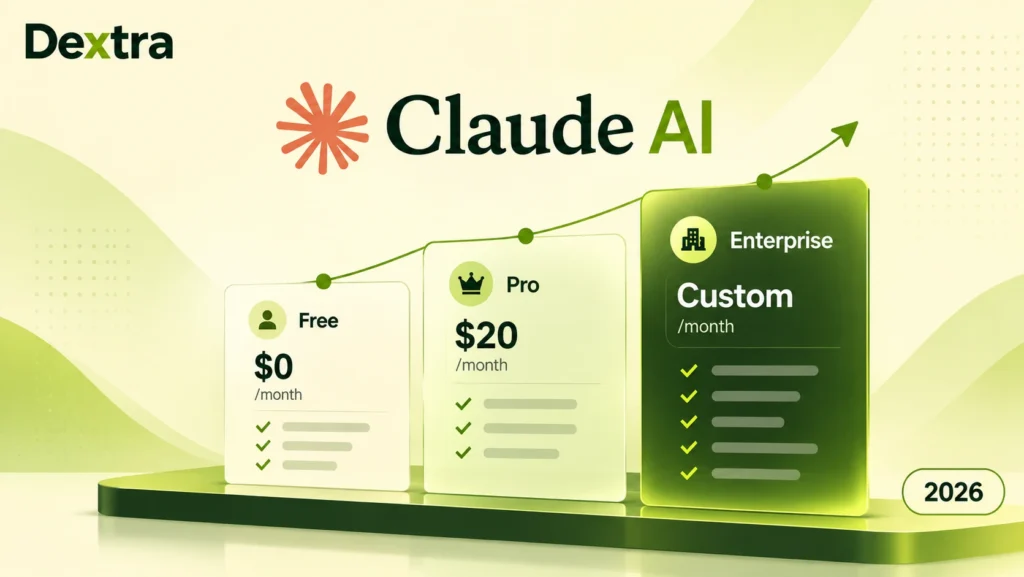
Claude AI ranges from completely free to hundreds of thousands of dollars a year, depending on whether you are a solo user exploring prompts or an enterprise deploying AI agents across business-critical workflows. The short answer of how much does claude ai cost varies with individual subscriptions starting at $0 and going up to $200 per month. Team plans start at $25 per seat. Enterprise pricing combines a per-seat fee with usage-based API charges.
And if you are building a product on Claude’s API, costs are determined by the model you select, the volume of tokens you process, and the complexity of each task. This guide breaks down every pricing layer, subscriptions, API rates, business deployment, and total cost of ownership, so you can estimate what Claude will actually cost for your specific use case.
How Much Does Claude AI Cost?
Claude AI offers a free plan, paid individual subscriptions, team and enterprise plans, and usage-based API pricing for developers. The monthly cost depends on whether you use Claude for personal productivity, equip a team with subscriptions, or integrate Claude into a business application through its API. Subscription and API billing are entirely separate, a Pro subscription does not include API access, and API credits do not include access to Claude’s web interface.
| Plan | Pricing | Best Suited For |
|---|---|---|
| Claude Free | $0 | Exploring Claude, occasional personal tasks |
| Claude Pro | $20/mo ($200/yr) | Individuals, professionals, developers using Claude Code |
| Claude Max 5x | $100/mo | Heavy daily users who need 5x Pro usage limits |
| Claude Max 20x | $200/mo | Power users, developers running sustained Claude Code sessions |
| Claude Team (Standard) | $25/seat/mo | Collaborative teams needing centralized admin and SSO |
| Claude Enterprise | Custom pricing | Organizations needing governance, SCIM, audit logs, and compliance controls |
| Claude API | Usage-based per model | Startups, product teams, and production AI applications |
Source: Anthropic’s official Claude pricing page
Claude AI Pricing Plans Explained:
Is Claude AI Free to Use?
Yes. Claude’s free tier provides access to Claude’s web, iOS, Android, and desktop apps at no cost. You can test prompts, upload documents, analyze images, and run basic tasks. However, free access comes with daily usage caps that reset every 24 hours. Once you hit the limit, you wait.
For occasional personal use and initial exploration, free is enough. For anything that touches a business workflow, regular coding, document analysis, content generation, or customer-facing tasks, you will hit the ceiling fast.
How Much Does Claude Pro Cost Per Month?
Claude Pro costs $20 per month, or $200 per year if billed annually. Pro significantly increases your usage limits and unlocks access to extended thinking models, Claude Code for terminal-based development, file creation, code execution, and unlimited projects.
Pro is the right tier for knowledge workers, analysts, and individual developers. It is not, however, a replacement for API access. If you are building an application that calls Claude programmatically, you need the API, Pro covers the interactive experience, not embedded workflows.
How Much Does Claude Max Cost?
Claude Max comes in two tiers:
- Max 5x: $100/month (five times the usage of Pro)
- Max 20x: $200/month (twenty times the usage of Pro)
Max is designed for developers running sustained Claude Code sessions, power users working through complex research or analysis, and anyone whose daily workload consistently exceeds Pro’s limits. A higher tier does not mean unlimited usage, it means a higher ceiling. If you are unsure whether you need Max, start with Pro and monitor how often you hit limits.
How Much Does Claude Team Cost?
Claude Team Standard costs $25 per seat per month (or $20/seat/month with annual billing, per earlier reports, verify on publication day). It includes centralized billing, workspace admin, SSO, and integrations with Microsoft 365 and Slack.
Here is what team pricing looks like at scale:
| Team Size | Monthly (Est.) | Annual (Est.) |
|---|---|---|
| 10 seats | $250/mo | $2,400–$3,000/yr |
| 25 seats | $625/mo | $6,000–$7,500/yr |
| 50 seats | $1,250/mo | $12,000–$15,000/yr |
Note: Team Premium tiers exist for organizations that need Claude Code access for all team members. Pricing for Premium starts higher, confirm current rates on claude.com/pricing.
How Much Does Claude Enterprise Cost?
Claude Enterprise uses custom pricing tailored to each organization. It includes everything in Team, plus expanded context windows, role-based access control, SCIM provisioning, audit logging, and data retention policies.
The key insight for enterprise buyers: the published seat price is not your complete AI budget. Enterprise costs also include API-rate usage charges on top of seat fees, SSO and security configuration, deployment architecture, employee training, and ongoing support. Any enterprise evaluation that looks only at the per-seat number is underestimating the real investment.
How Much Does It Cost to Use Claude AI Through the API?
If you are building an application, automating a workflow, or running AI agents, Claude’s API is where your costs live. API pricing is completely separate from subscriptions and is billed based on token consumption.
How Claude API Pricing Works
Claude’s API charges per million tokens, separately for input (the text and context you send to the model) and output (the response it generates). Different models carry different rates, and two built-in cost-reduction features can significantly lower your bill:
- Prompt caching: Cache reads cost roughly 10% of the base input price. Cache writes cost 1.25x the base rate but are amortized across repeated use of the same context.
- Batch API: 50% discount on both input and output tokens for workloads that can tolerate up to a 24-hour processing window.
Current Claude API Pricing (September 2026)
| Model | Input (per 1M tokens) | Output (per 1M tokens) | Cache Read (per 1M) |
|---|---|---|---|
| Claude Haiku 4.5 | $1.00 | $5.00 | $0.10 |
| Claude Sonnet 5 | $2.00 | $10.00 | $0.20 |
| Claude Opus 5 | $5.00 | $25.00 | $0.50 |
| Claude Fable 5.1 | $10.00 | $50.00 | $0.25 |
Source: Anthropic API documentation. Batch API applies a 50% discount on both token types.
What Affects Claude API Costs?
Seven factors determine your actual API spend:
- Model selection: Haiku at $1/$5 per million tokens versus Fable at $10/$50 represents a 10x cost difference for the same request volume.
- Average input and output token volume: A 500-token customer support reply costs a fraction of a 10,000-token document analysis.
- Context window usage: Sending full conversation history with every request multiplies input costs.
- Prompt caching hit rate: A 90% cache hit rate on repeated system prompts can reduce input costs by up to 90%.
- Request frequency: 10,000 daily requests versus 100 creates a 100x cost gap.
- Tool calls and agent loops: Agents that call tools, run code, and perform multi-step reasoning generate significantly more tokens per task.
- Development versus production traffic: Testing, evaluation runs, and retries all consume tokens that are easy to overlook in cost projections.
Claude API Cost Examples for Real Applications:
| 💬 Scenario 1: Startup Customer Support Assistant Model: Claude Sonnet 5 ($2 input / $10 output) Volume: 5,000 conversations/month, avg. 800 input tokens + 400 output tokens each Input cost: (5,000 × 800) / 1,000,000 × $2 = $8.00 Output cost: (5,000 × 400) / 1,000,000 × $10 = $20.00 Estimated monthly model cost: ~$28 (before caching savings) |
| 📄 Scenario 2: Enterprise Document Analysis System Model: Claude Sonnet 5 ($2 input / $10 output) Volume: 2,000 documents/month, avg. 6,000 input tokens + 2,000 output tokens each Prompt caching: 70% cache hit on repeated extraction templates (cache reads at $0.20/M) Input cost: 30% full-price + 70% cached ≈ $7.20 + $1.68 = $8.88 Output cost: (2,000 × 2,000) / 1,000,000 × $10 = $40.00 Estimated monthly model cost: ~$49 (with caching) |
| 🤖 Scenario 3: Claude-Powered AI Agent Model: Claude Sonnet 5 with tool calls Volume: 1,000 agent tasks/month, avg. 5 model calls per task, 3,000 input + 1,500 output tokens per call Total tokens: 15M input + 7.5M output per month Input cost: 15 × $2 = $30.00 Output cost: 7.5 × $10 = $75.00 Estimated monthly model cost: ~$105 (excluding infrastructure, retries, evaluation) |
Note: These estimates cover model inference costs only. Infrastructure, engineering, hosting, and operational costs are separate. If you are planning a multi-step agent workflow, explore Dextra Labs’ AI agent development services for end-to-end architecture and cost planning.
Claude API Cost Calculation Formula
| 🧮 Quick Formula Monthly API Cost = Input Token Cost + Output Token Cost + Other Billable Usage Input Cost = (Input Tokens ÷ 1,000,000) × Model Input Rate Output Cost = (Output Tokens ÷ 1,000,000) × Model Output Rate Subtract cached-input savings and batch discounts where applicable. |
Claude AI Subscription vs API Pricing: What’s the Difference?
This is the single most common source of confusion in Claude pricing. Subscriptions and API billing are different products serving different use cases.
| Consideration | Claude Subscription | Claude API |
|---|---|---|
| Primary use | Direct human interaction via web/desktop/mobile | Applications, agents, and automated workflows |
| Billing approach | Fixed monthly per-user or per-seat | Usage-based per token |
| Typical buyer | Individuals, managers, and teams | Product, engineering, and AI teams |
| Cost planning | Users × plan price × months | Tokens × model rate × request volume |
| Integration | Built-in features, connectors, Claude Code | Custom application integration via API |
A business using Claude through employee accounts has a fundamentally different cost model from a SaaS startup embedding Claude into its product. Plan accordingly, these two budgets should never be merged into a single line item.
How Much Does Claude AI Cost for a Business?
This is where pricing stops being about plan pages and starts being about architecture, workflows, and organizational decisions.
Claude AI Costs for Startups
Most startups encounter Claude through three entry points: coding and product development with Claude Code, AI features embedded in their product via the API, and internal automation like customer support assistants or document processors.
A realistic startup budget includes:
- API consumption: The model inference cost for your use case (see examples above).
- Engineering time: Integration, prompt engineering, evaluation pipelines, and monitoring.
- Infrastructure: Hosting, databases, vector stores (for RAG), observability, and CI/CD.
Start with one measurable use case. Estimate token volume from actual test data, not theoretical projections. Scale once you have validated cost-per-task, not just cost-per-token.
Claude AI Costs for SMEs and Growing Teams
Mid-sized teams typically balance subscription seats for daily users with API integrations for repeatable workflows. The cost equation shifts from pure model pricing to organizational questions: How many people need access? Which workflows justify custom integration versus interactive use? Who manages prompts, permissions, and quality?
Training and adoption costs are real here. A team of 25 with Claude Team subscriptions that nobody uses effectively is more expensive than a team of 10 with well-designed workflows and clear use cases.
Claude AI Costs for Large Enterprises
Enterprise deployment costs are shaped by architecture and workload, not headcount:
- Licensing and usage: Per-seat Enterprise subscription plus API consumption across multiple teams and applications.
- Identity and access management: SSO, SCIM, role-based access controls, and workspace governance.
- Data and integration architecture: Connecting Claude to internal knowledge bases, CRMs, ERPs, and existing workflows.
- Security and compliance: Data handling policies, audit logging, retention, and regulatory review.
- Evaluation and observability: Model evaluation, response quality monitoring, regression testing, and human-in-the-loop approval flows.
How Much Does It Cost to Build a Claude-Powered Application?
A Claude-powered application has at least six cost layers:
| Cost Layer | What It Covers | Typical Range |
|---|---|---|
| Claude API consumption | Token-based model inference | Varies by volume and model choice |
| Application development | Integration, UX, backend, prompt engineering | Engineering team cost × timeline |
| RAG and data pipelines | Vector databases, embedding, ingestion, retrieval | Infrastructure + engineering |
| Hosting and infrastructure | Compute, databases, storage, CDN, monitoring | Cloud provider pricing |
| Security and evaluation | Testing, red-teaming, compliance, access controls | Engineering + tooling |
| Maintenance and optimization | Prompt tuning, model upgrades, cost monitoring | Ongoing operational cost |
The table above serves as a budget framework, populate it with your actual estimates. For teams that need help scoping and building, Dextra Labs’ generative AI development services cover the full stack from prompt engineering to production deployment.
What Is the Total Cost of Implementing Claude AI?
Claude’s subscription or API bill is only one part of the total cost of ownership. The complete budget must account for the system built around the model.
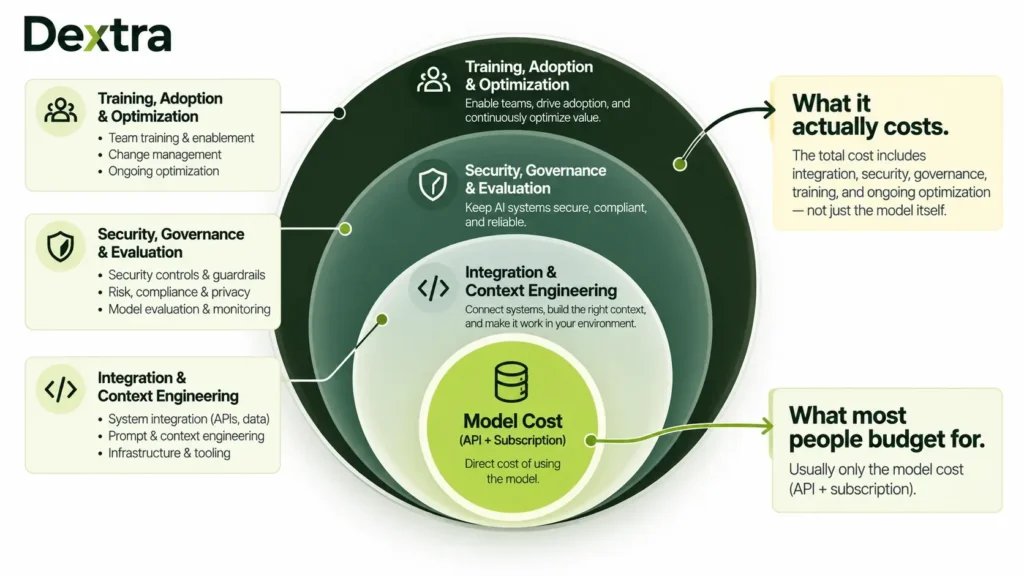
1. Licensing and Model Usage
This is the direct, visible cost: subscription fees for team members and API charges for applications. Calculate this first, it anchors the rest of the budget, but never treat it as the entire investment.
2. Integration and Context Engineering
Connecting Claude to enterprise knowledge, CRMs, internal APIs, and existing workflows requires significant engineering work. This includes building reusable Claude Skills, designing context files, configuring MCP integrations, and structuring prompts that deliver consistent, domain-specific results. Integration cost often exceeds model cost in the first year.
3. Security, Governance, and Evaluation
Access controls, data handling policies, model evaluation frameworks, human approval workflows, audit logging, and regulatory compliance all carry costs. For regulated industries, this layer can represent the largest single investment.
4. Employee Training and Adoption
Unused seats and poorly designed workflows undermine the value of any AI investment, even when the underlying model usage is inexpensive. Training, onboarding, workflow documentation, and change management are real line items.
5. Ongoing Optimization and Maintenance
Model selection evolves as new models ship. Prompts degrade as business requirements change. Usage patterns shift as adoption grows. Budget for continuous optimization, prompt refinement, caching strategies, model upgrades, usage monitoring, and regression testing.
| 💡 Key Takeaway Claude’s subscription or API bill is only one part of the total cost of ownership. The complete budget must account for integration, security, training, and ongoing optimization, the system built around the model. |
How to Reduce Claude AI Costs Without Sacrificing Quality
Eight practical strategies that apply to both API developers and enterprise buyers:
- 1. Match model capability to task complexity: Use Haiku for classification and routing. Use Sonnet for most production tasks. Reserve Opus and Fable for complex reasoning and research.
- 2. Measure input and output tokens per business task: Track cost-per-task, not just cost-per-request. A task that takes three calls to complete costs 3x what the single-request estimate suggests.
- 3. Use prompt caching aggressively: Cache reads cost 10% of the base input rate. Stable system prompts, extraction templates, and few-shot examples are high-value caching targets. For a deeper walkthrough on reducing token spend in development workflows, see our guide to Claude Code token optimization.
- 4. Remove unnecessary conversation history: Every token of context you send is billed at the input rate. Trim history to what the model actually needs.
- 5. Use structured outputs and tool calls efficiently: Well-designed tools reduce retry rates and token waste.
- 6. Set budgets, usage alerts, and organizational limits: Anthropic’s platform supports spend controls. Use them.
- 7. Evaluate response quality before switching to a cheaper model: A cheaper model that produces wrong answers is more expensive than a pricier model that gets it right the first time.
- 8. Track cost per successful task, not just cost per request: Factor in retries, evaluation, and human review time.
Is Claude AI Worth the Cost for Your Business?
There is no blanket answer. The right framework evaluates:
- Time saved per task: Measure hours reclaimed against the cost of Claude’s output.
- Cost per successfully completed workflow: Include model cost, engineering time, and human review.
- Accuracy and review requirements: An AI output that needs heavy editing may cost more than doing it manually.
- Implementation and maintenance investment: Factor in the full TCO, not just the API bill.
- Employee adoption rate: Technology that teams actually use delivers returns. Technology they ignore does not.
| 📊 Simple ROI Calculation Net Benefit = Measured Business Value − Total AI Costs Recommend a proof of concept with a baseline, defined success criteria, and a 30–60 day evaluation period before committing to a broad rollout. |
How Dextra Labs Helps Businesses Implement Claude AI Cost-Effectively
Dextra Labs is a Claude AI consulting and implementation partner. We help enterprises, startups, and growing teams go from pricing research to production deployment, with clear cost projections at every stage.
Claude AI Cost Assessment and Use-Case Discovery
We identify high-value workflows, estimate usage, define evaluation metrics, and produce a phased implementation roadmap. You know what Claude will cost before you commit.
Claude API Integration and Cost Optimization
Efficient prompts, intelligent model selection, caching strategies, tool integrations, and usage monitoring. We engineer cost out of the system without compromising output quality.
Claude Team and Enterprise Deployment
Role-based access, organizational rollout, SSO/SCIM configuration, governance frameworks, and structured employee onboarding. Deployment done right, not just switched on.
Custom Claude Skills and AI Agent Development
Purpose-built workflows and reusable context files that make Claude consistent and reliable for engineering, sales, customer support, finance, and operations teams.
From Proof of Concept to Production
We validate one workflow against measurable outcomes before expanding to multiple teams or business systems. Every engagement begins with a baseline, not a sales pitch.
Final Words:
The pricing page gives you the starting point, $0 for free, $20/month for Pro, $2 per million tokens on Sonnet 5. Those numbers are clear.
What is not clear until you plan it: integration, context engineering, security, training, and ongoing optimization. In most enterprise deployments, the model bill is the smallest line item. The system around it is the actual investment.
Start with one workflow. Measure cost per successful task, not cost per token. Separate your subscription budget from your API budget from your implementation budget. And build with the same rigor you would apply to any enterprise system.

🚀 Planning to Implement Claude AI in Your Business?
Estimate your Claude usage costs, identify the right deployment approach, and build a practical roadmap from experimentation to production.
👉 Explore Claude Consulting ServicesFrequently Asked Questions:
How much does Claude AI cost per month?
Monthly costs range from $20 (Pro) to $200 (Max 20x) for individuals, and $25+ per seat for teams. API costs are separate and depend on model choice, token volume, and request frequency. Business deployment adds integration, security, and maintenance expenses on top of the subscription or API bill.
Claude AI: How much does it cost for individual users?
Individual users can start free, upgrade to Pro at $20/month, or choose Max at $100/month (5x usage) or $200/month (20x usage). All paid plans include Claude Code, extended thinking, and access to the latest models. Check claude.com/pricing for current limits and feature comparisons.
How much does Claude AI cost for a business?
Business costs include team subscriptions ($25+ per seat/month), API usage for integrated applications, engineering and integration work, security and compliance configuration, employee training, and ongoing optimization. The subscription is the visible cost; the system around it is the actual investment.
How much does it cost to use Claude AI through the API?
API pricing is usage-based and model-specific. Haiku 4.5 starts at $1/$5 per million tokens (input/output). Sonnet 5 costs $2/$10. Opus 5 costs $5/$25. Fable 5.1 costs $10/$50. Prompt caching and batch API discounts can reduce costs by 50–90% for eligible workloads.
Is Claude API usage included in a Claude Pro subscription?
No, Claude Pro provides access to the interactive web, desktop, and mobile apps. API access is billed separately through Anthropic’s developer platform. These are different products with different billing systems.
Is Claude Enterprise pricing based on seats or usage?
Both, enterprise pricing combines a per-seat subscription fee with API-rate usage charges for integrated applications. Additional costs include governance features, SSO/SCIM configuration, and deployment support. Contact Anthropic directly for a custom enterprise quote.
Can a startup use Claude without a large AI budget?
Yes, start with a limited proof of concept using Claude Pro ($20/month) or a small API allocation. Track token usage on real tasks, choose the smallest model that meets quality requirements, and scale based on measured cost-per-task, not projected volume.
How can a company reduce Claude API costs?
Match model capability to task complexity, implement prompt caching for repeated context, trim unnecessary conversation history, use batch API for non-real-time workloads, set organizational spend limits, and track cost per successful task rather than cost per request.
Should a business hire a Claude AI consulting partner?
Consider expert help when your implementation involves complex integrations, security and compliance requirements, multi-team agent workflows, cost forecasting across multiple use cases, or organization-wide adoption. A consulting partner accelerates time to production and prevents costly architectural mistakes.