Generative AI is no longer competing for attention as an experimental technology initiative.
By 2026, the conversation inside many enterprises has shifted from “Where can we pilot GenAI?” to more difficult questions:
- Which AI use cases deserve long-term investment?
- Which pilots should be shut down?
- Where are AI systems producing measurable business value?
- How should AI agents be governed once they can access enterprise systems?
- What should the board actually see in an AI performance review?
That shift matters because GenAI spending is increasingly being treated as an operational and strategic investment, not simply an innovation budget.
The organizations making progress are moving beyond scattered tools and isolated proofs of concept. They are building repeatable capabilities around data access, model selection, orchestration, evaluation, security, governance, and workforce adoption. McKinsey’s State of AI 2025 highlights that generative AI adoption has nearly doubled in two years.
The Stanford AI Index 2025 shows global investment in GenAI reached $33.9B in 2024, up almost 19 percent year over year. Deloitte’s 2024 Enterprise report notes that nearly every large organization surveyed has moved beyond proofs of concept, and KPMG’s Boardroom Lens 2025 indicates boards are directly scrutinizing performance, security, and ROI.
The challenge for leadership in 2026 is therefore not simply adopting more AI.
It is deciding where AI creates economic value, how that value should be measured, and what infrastructure is required to scale successful use cases responsibly.
This guide examines the major GenAI investment priorities, production use cases, board-level metrics, and organizational capabilities shaping enterprise AI adoption in 2026.
Where Enterprise GenAI Budgets Are Going in 2026
In the early days of generative AI, much of the investment went into experimentation. Companies tested chatbots, copilots, and proof-of-concept applications to understand what the technology could do.
In 2026, the conversation is changing. The bigger question is no longer, “Should we experiment with GenAI?” It is, “What do we need to invest in to make AI work reliably at scale?”
As enterprises move beyond isolated pilots, GenAI budgets are increasingly being directed toward the infrastructure, data, workflows, governance, and people required to turn AI into a real business capability.
1. Production Infrastructure
Building an enterprise AI solution is about more than choosing a powerful model.
Companies are investing in the infrastructure needed to run AI applications reliably, including model access, inference infrastructure, APIs, model routing, vector retrieval, and agent orchestration.
For example, an enterprise application may need to choose between different models depending on the task, retrieve relevant information from internal knowledge systems, and coordinate multiple AI agents or tools. All of this requires a production-ready technical foundation.
The focus is shifting from simply accessing AI models to building the infrastructure needed to use them effectively in real business environments.
2. Enterprise Data Readiness
AI is only as useful as the information it can access.
Many enterprises are discovering that their biggest AI challenge is not the model itself, but the quality, organization, and accessibility of their data. Information may be spread across documents, databases, internal systems, and different business teams.
As a result, companies are investing more in:
- Data quality and preparation
- Metadata and data organization
- Access controls
- Retrieval pipelines
- Real-time data connections
- Enterprise knowledge systems
The goal is to ensure AI systems can find the right information, at the right time, without exposing information they should not be able to access.
3. AI Agents and Workflow Automation
Another major area of investment is AI that can do more than answer questions.
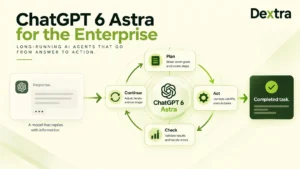
Enterprises are increasingly exploring AI agents that can retrieve information, take actions, coordinate workflows, update business systems, and escalate exceptions when human intervention is needed.
This is where GenAI starts moving closer to day-to-day operations.
Instead of simply asking an AI assistant for a summary, an employee might use an AI system that gathers information from multiple platforms, completes part of a workflow, updates the relevant system, and flags anything unusual for human review.
The opportunity is shifting from AI as a conversational tool to AI as an active participant in business workflows.
4. Evaluation, Monitoring and Governance
As AI systems take on more important tasks, enterprises need greater visibility and control.
A production AI system cannot simply be deployed and forgotten. Companies need ways to evaluate output quality, monitor performance, investigate failures, maintain audit trails, enforce policies, and respond to security incidents.
This is driving investment in areas such as:
- AI evaluations
- Observability and monitoring
- Audit trails
- Security controls
- Policy enforcement
- Red teaming
- AI incident management
The more AI is connected to sensitive data and business-critical systems, the more important these controls become.
5. Workforce Enablement
Technology alone does not transform an organization.
Even the best AI system will struggle to deliver value if employees do not understand how to use it or if existing workflows remain unchanged. That is why enterprises are also investing in the human side of AI adoption.
This includes:
- AI training
- Workflow redesign
- Internal adoption programs
- Change management
- New operating procedures
The goal is not simply to teach employees how to use another AI tool. It is to help teams understand how their work changes when AI becomes part of the process.
The Bigger Shift in Enterprise GenAI Spending
The pattern is clear: enterprise GenAI budgets are becoming broader and more operational.
Companies are moving beyond spending primarily on models and experimentation. They are investing in the full ecosystem required to make AI useful at scale, from infrastructure and data to autonomous workflows, governance, and workforce adoption.
In 2026, the biggest GenAI investments will increasingly be about building the systems around AI that make it reliable, secure, and valuable in everyday enterprise operations.
The GenAI Unit Economics Boards Should Understand
One of the biggest differences between traditional software and generative AI is how the cost structure works.
With a conventional SaaS product, costs are often relatively predictable. A company may pay a fixed subscription or calculate infrastructure costs based on a reasonably stable number of users or transactions.
GenAI systems can be different. The cost of delivering a single outcome may vary depending on what the AI has to do.
A seemingly simple request might involve multiple model calls, large volumes of tokens, document retrieval, tool usage, agent loops, API calls, and human review. As AI systems become more autonomous and handle increasingly complex workflows, those costs can add up quickly.
That means boards should look beyond a simple question such as, “How much are we spending on AI?”
A more useful question is:
What does one successful AI-assisted outcome actually cost?
The answer will vary by use case. For example, organizations may want to measure:
- Cost per resolved support case
- Cost per generated engineering artifact
- Cost per processed document
- Cost per successful workflow completion
- Cost per AI-assisted transaction
This creates a much clearer connection between AI spending and business value.
The Costs Behind a Single AI Outcome
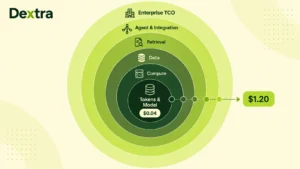
The model API bill is only one part of the equation. The total cost of an AI-assisted outcome can be influenced by:
- Tokens consumed
- Model selection
- Agent loops and repeated reasoning steps
- Retrieval and vector searches
- Tool calls
- External API usage
- Human review and exception handling
- Infrastructure and compute
There are also broader operational costs that may not appear in a simple model-pricing calculation, including integration, data preparation, governance, monitoring, security, and ongoing maintenance.
A Simple Way to Think About AI ROI
A useful starting point is:
AI ROI = Economic value created − Total cost of achieving that value
The important phrase here is total cost.
For an AI system, that can include:
- Model and API costs
- Integration work
- Infrastructure
- Data pipelines and retrieval systems
- Human review
- Governance and security
- Monitoring and observability
- Ongoing maintenance
An AI workflow may look highly efficient if the organization only measures the cost of the model call. But the economics can look very different once the full operating cost is included.
Why Successful Outcomes Matter More Than AI Activity
High AI usage does not automatically mean high AI value.
An organization could process millions of tokens, run thousands of agent workflows, or generate large volumes of AI output without producing a meaningful business return.
That is why boards should focus on the economics of successful outcomes, not just AI activity.
For example, if an AI system costs $2 to resolve a support case that would otherwise cost $8 to handle, the value is relatively easy to understand. But if the system resolves only a small percentage of cases successfully and the rest require expensive human intervention, the true unit economics need to reflect that.
The same principle applies to document processing, engineering automation, sales workflows, and AI-assisted transactions.
The Board-Level Question
Ultimately, boards do not need to understand every token, model call, or vector query.
They need visibility into a simpler question:
Are we creating more economic value from each AI-assisted outcome than it costs us to produce it?
As GenAI spending grows, organizations that understand this equation will be in a much stronger position to identify which AI initiatives should scale, which need optimization, and which are creating activity without creating enough value.
The future of AI ROI will not be measured only by what a model can do. It will increasingly be measured by what it costs to produce a successful outcome, and whether that outcome creates meaningful economic value.
Where Enterprises Are Finding the Most Measurable GenAI Value
The most valuable GenAI initiatives are not necessarily the ones with the most impressive demos. For enterprises, the real test is much simpler: can the use case produce a measurable improvement in cost, speed, quality, or revenue?
As organizations move beyond experimentation, GenAI investment is increasingly shifting toward workflows where outcomes can be tracked clearly. Here are some of the areas where enterprises are finding the strongest potential for measurable value.
1. Knowledge-Intensive Work
Many employees spend a significant amount of time finding, reading, comparing, and summarizing information. GenAI can help reduce that effort across activities such as:
- Research
- Analysis
- Summarization
- Enterprise search
- Document processing
The value is often measured through time saved, accuracy, and throughput. If a team can process more documents, find relevant information faster, or reduce the time required for research without compromising quality, the business impact becomes easier to quantify.
2. Software Engineering
Software development is another area where GenAI can support a wide range of repetitive and information-heavy tasks.
Common use cases include:
- Coding assistance
- Code review
- Testing
- Documentation
- Incident analysis
Here, enterprises can look at metrics such as development cycle time, defect rates, and engineering throughput. The objective is not simply to generate more code, but to understand whether AI is helping teams deliver reliable software faster.
3. Customer Operations
Customer service is particularly well suited to measurement because teams already track operational and service metrics.
GenAI can support:
- AI support agents
- Agent assist
- Knowledge retrieval
- Automated case handling
The key metrics may include resolution time, containment rate, customer satisfaction (CSAT), and cost per case.
For example, an AI system that handles routine cases successfully can create clear value if it reduces the cost and time required to resolve customer issues while maintaining service quality.
4. Revenue and Commercial Operations
GenAI is also finding applications closer to revenue generation.
Teams are using AI for:
- Sales research
- Proposal generation
- Lead qualification
- Account intelligence
The value here should be measured carefully. Useful metrics include conversion rates, sales productivity, and revenue contribution.
The goal is not to measure how many AI-generated proposals or research reports a team produces. It is to determine whether those activities help sales teams make better decisions, move faster, and ultimately improve commercial outcomes.
5. Risk and Compliance
In highly regulated or document-heavy environments, GenAI can help teams process and analyze large volumes of information.
Common applications include:
- Document review
- Policy analysis
- Compliance workflows
- Case investigation
The most relevant measures are often processing time, error rates, and cost avoidance.
For these use cases, however, speed alone is not enough. The economic value of automation must be balanced with the cost of errors, human oversight, and governance.
6. Agentic Workflows
One of the more significant areas of enterprise investment is the use of AI for multi-step workflows.
Rather than simply generating an answer, an AI system may be designed to:
- Coordinate multi-step operational processes
- Work across multiple enterprise systems
- Handle routine actions
- Identify and escalate exceptions
The most useful metrics here include workflow completion rate, human intervention rate, and error rate.
This is where enterprises can begin measuring whether AI is actually completing useful work—not just generating content or recommendations.
The Common Thread: Measurable Outcomes
Across all of these use cases, the strongest GenAI investments share one characteristic: they are connected to a clear economic or operational outcome.
A successful initiative should be able to answer questions such as:
- Are we completing work faster?
- Are we reducing costs?
- Is quality improving?
- Are employees becoming more productive?
- Is the workflow generating more revenue?
- Are fewer people required to handle routine work?
- Is AI completing the process successfully with minimal intervention?
The most valuable GenAI use cases are not defined by how advanced the technology appears. They are defined by whether the enterprise can measure a meaningful improvement in the way work gets done.
That is the shift enterprises are increasingly making: from investing in AI because it is innovative to investing in AI because it creates measurable economic value.
The Metrics Boards Now Expect for GenAI Adoption
KPMG’s board survey highlights a clear shift: leadership teams want detailed measurement frameworks, not generic dashboards.
Here are the metrics gaining the most traction.
Financial contribution
Boards require:
- Cost per outcome
- Cost per generated unit of work
- Contribution to margins
- Impact on revenue (e.g., upsell, retention, expansion)
In many enterprises, GenAI is now evaluated with the same rigor as ERP or CRM modernization initiatives.
Operational performance
CIOs are expected to report on:
- Reduction in cycle times
- Throughput generated by AI systems
- Time saved per function
- Case handling or ticket handling improvements
- Reduction in manual rework
These metrics show whether AI actually changes how work gets done.
Workforce productivity
Boards increasingly ask:
- How much of a team’s workload is supported by GenAI?
- Are employees actually using AI tools consistently?
- Has collaboration between teams improved?
Skill adoption and workflow incorporation are critical indicators.
Customer outcomes
Customer-side impact includes:
- CSAT improvements
- Faster response times
- Reduction in human escalations
- Personalization accuracy
These metrics connect AI to experience quality.
Governance, safety, and risk monitoring
Only 46 percent of enterprises have an AI governance policy; even fewer enforce it.
Boards want visibility into:
- Data access monitoring
- Policy compliance
- Model drift
- Error and hallucination rates
- Bias and fairness assessments
- Traceability and audit logs
Dextralabs helps companies establish governance systems that are practical, enforceable, and aligned with reporting obligations.
Environmental footprint
Stanford’s 2025 AI Index shows rising concern about the energy impact of large-scale GenAI workloads.
Boards are beginning to track:
- Energy cost
- Emissions intensity
- Efficiency of model selection (frontier vs. domain-specific)
These metrics will likely become standard by 2026.
What are the organizational bottlenecks Slowing GenAI Adoption?
The biggest constraints highlighted in McKinsey, Deloitte, and KPMG reports are not technological.
1. Skill shortages
Teams lack:
- AI solution architects
- Data engineers familiar with vector stores and streaming architectures
- Governance and risk specialists
- Prompt and systems designers for enterprise workflows
Skill gaps remain one of the highest-ranked barriers.
2. Cultural resistance
Managers often struggle to adopt AI-ready workflows.
Common issues:
- Inconsistent tool usage
- Fear of displacement
- Siloed decision-making
- Slow cross-functional alignment
3. Confusion over ownership
Companies are still defining whether AI should sit under:
- CIO
- CDO
- COO
- A cross-functional CoE
This creates delays in approvals and design.
4. Fragmented data foundations
Poor data readiness leads to:
- Weak model outputs
- Inconsistent retrieval performance
- Limited automation potential
Dextralabs helps organizations build the data backbone needed for reliable GenAI adoption.
Also Read: Agentic AI vs Generative AI Explained: The 2026 Blueprint for Future-Ready Organizations
How Enterprises Are Structuring Their GenAI Architecture for 2026?
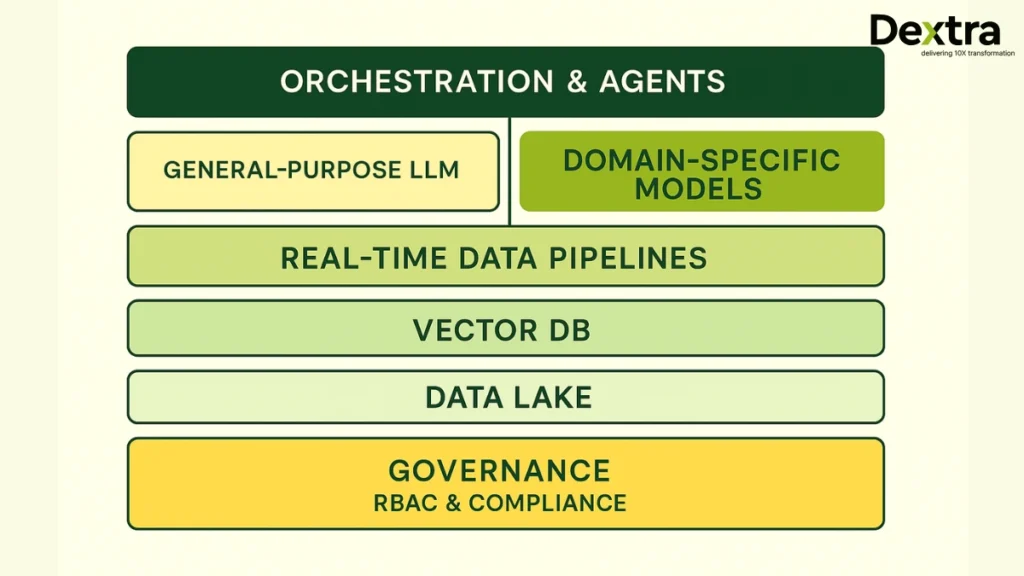
Enterprise generative AI is becoming much more than a chatbot connected to a large language model.
A production-ready AI system now needs to bring together multiple layers: the experience employees or customers interact with, the models that provide intelligence, the enterprise data that gives AI context, the systems it can take action in, and the controls that keep everything secure and reliable.
A useful way to understand the modern enterprise GenAI architecture is as a seven-layer stack.
Layer 1: Experience
This is the layer users actually see and interact with.
It can include:
- Internal copilots
- Customer-facing AI applications
- AI agents
The experience layer is where AI becomes useful to employees and customers. However, a good interface alone does not make an enterprise AI system. The value depends on everything happening underneath it.
Layer 2: Orchestration
Orchestration determines how the AI workflow actually runs.
This layer can include:
- Workflow engines
- Agent orchestration
- Model routing
- Tool calling
For a simple task, the system may need only one model call. For a more complex request, it may need to select the right model, retrieve information, call multiple tools, coordinate several steps, and determine when human intervention is required.
Orchestration is what turns individual AI capabilities into a functioning workflow.
Layer 3: Intelligence
This is the layer responsible for understanding, reasoning, generating, and processing information.
Modern enterprises may use a combination of:
- Frontier models
- Smaller, faster models
- Domain-specific models
- Multimodal models
The important shift is that enterprises are no longer necessarily building around a single model. Different tasks may require different levels of capability, speed, cost, privacy, or specialization.
The intelligence layer is therefore increasingly about choosing the right model for the right task.
Layer 4: Enterprise Knowledge
AI cannot reliably support enterprise work without access to relevant business context.
The enterprise knowledge layer connects AI systems with information sources such as:
- Retrieval-Augmented Generation (RAG)
- Knowledge graphs
- Structured databases
- Real-time data
This layer helps ground AI responses and decisions in actual enterprise information rather than relying solely on a model’s general knowledge.
For many organizations, this is where much of the real value lies. A powerful model becomes significantly more useful when it understands the company’s products, customers, policies, processes, and current business data.
Layer 5: Action Layer
Understanding information is useful. Taking the right action is where AI starts becoming part of the business workflow.
The action layer connects AI systems with:
- APIs
- Enterprise tools
- CRM platforms
- ERP systems
- Ticketing systems
- Internal business applications
This allows an AI system to move beyond answering a question. Depending on its permissions and workflow rules, it may retrieve customer information, create a ticket, update a record, trigger a process, or escalate an issue.
This is the layer that connects AI intelligence to real business outcomes.
Layer 6: Trust Layer
As AI gains access to enterprise knowledge and systems, security and control cannot be treated as an afterthought.
The trust layer includes:
- Identity management
- Role-based access control (RBAC)
- Policies
- Guardrails
- Audit capabilities
The purpose is to ensure that AI systems access only the information and tools they are authorized to use and operate within clearly defined boundaries.
For enterprise AI, the question is not simply “Can the agent do this?” It is also “Should this agent be allowed to do this?”
Layer 7: Evaluation and Operations
Finally, enterprise AI systems need to be continuously evaluated and monitored after deployment.
This layer includes:
- EvalOps
- AI observability
- Cost monitoring
- Reliability monitoring
Teams need visibility into whether the system is producing high-quality outputs, completing workflows successfully, staying within acceptable cost limits, and behaving reliably over time.
Unlike traditional software, AI performance can be probabilistic and can change as models, prompts, data, and workflows evolve. Continuous evaluation therefore becomes a core operational capability.
Why the Enterprise GenAI Stack Matters
The biggest mistake enterprises can make is thinking of GenAI as a single technology layer.
A model is only one component.
A useful enterprise AI system requires an experience for users, orchestration for complex workflows, intelligence for reasoning, knowledge for context, connections to systems of action, controls for trust, and operational capabilities for continuous evaluation.
The enterprise GenAI stack in 2026 is therefore not about choosing one model or one AI tool. It is about designing an integrated architecture where intelligence, enterprise data, actions, security, and operations work together.
For Dextra Labs, this framework also creates a strong architectural narrative: we don’t just build AI applications, we help enterprises design and connect the complete system required to move GenAI from experimentation into production.
A Practical 2026 Adoption Roadmap for Boards and CIOs
This roadmap reflects what high-performing enterprises follow.
Q1: Prioritize and assess
- Identify business units with measurable workflows
- Assess data readiness
- Build ROI and feasibility scoring
Q2: Establish standards and governance
- Safety protocols
- Auditability
- Access control
- Evaluation frameworks
Q3: Deploy production AI systems
Focus on:
- 3–5 high-impact workflows
- AI agents for operational tasks
- Integration with core systems
Q4: Scale horizontally
- Expand to more departments
- Build an AI center of excellence
- Create enterprise-wide adoption training
How Dextralabs Supports Board-Level, Enterprise-Grade GenAI Adoption?
Most enterprises do not struggle to find AI use cases. The challenge is turning a collection of promising experiments into a capability that can be deployed, governed, measured, and scaled across the organization.
That is where Dextra Labs fits in.
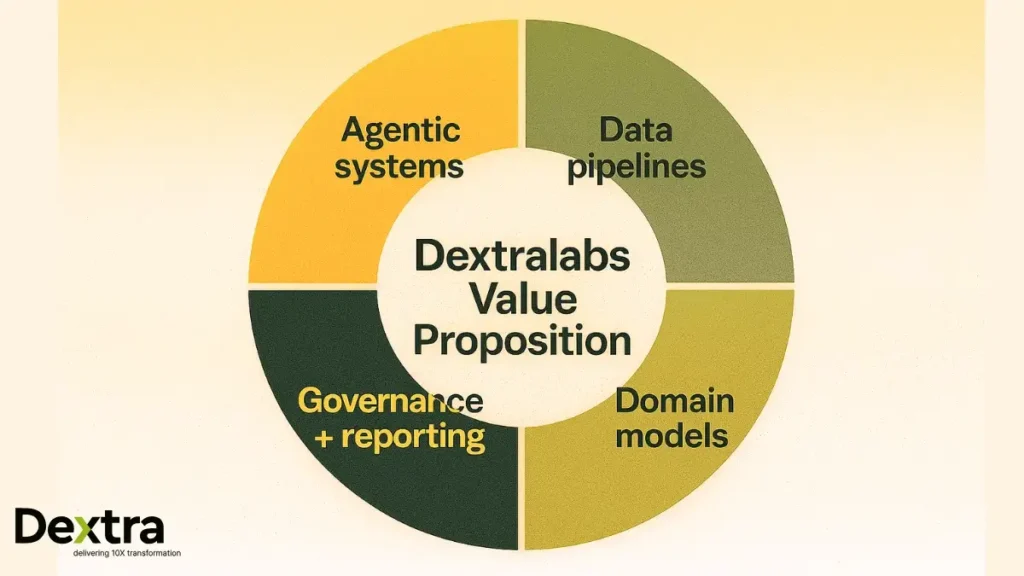
Rather than approaching AI as a series of disconnected projects, we help businesses build the underlying capability required to move from individual AI use cases to production-ready AI operations.
1. AI Opportunity Assessment
Every AI initiative should start with a clear business problem.
We work with teams to identify high-value workflows where AI can create measurable impact. This involves looking at process bottlenecks, repetitive work, knowledge-intensive tasks, operational costs, and opportunities for automation.
The goal is not to find the most exciting AI use case. It is to identify the one with the strongest potential business value.
2. AI Architecture
Once the opportunity is clear, the next step is designing the right technical foundation.
This can include decisions around:
- Model selection and routing
- Enterprise data and retrieval
- RAG architecture
- AI agents and orchestration
- APIs and enterprise integrations
- Security and access controls
The architecture should be designed around the specific workflow—not forced around a particular model or AI tool.
3. Production Deployment
A proof of concept is not the same as a production system.
Dextra Labs helps build and deploy secure GenAI applications and AI agents that can operate within real business environments. This includes connecting AI to enterprise knowledge, tools, workflows, and systems while defining the boundaries within which it can act.
The focus is on building AI systems that are useful beyond the demo stage.
4. Evaluation and Governance
Enterprise AI needs more than technical functionality. It also needs clear controls.
We help define how AI systems are evaluated for quality, reliability, and safety, along with the approval mechanisms required for higher-risk actions.
This can include:
- Quality evaluation
- Guardrails and safety controls
- Human approval workflows
- Access and permission controls
- Auditability and traceability
The objective is to help organizations move quickly without losing visibility or control.
5. Measurement
AI adoption alone is not a business outcome.
We help connect AI performance to meaningful business and operational KPIs, such as time saved, workflow completion, error rates, cost per outcome, productivity, or revenue contribution.
This gives leaders a clearer view of whether an AI initiative is actually creating value, and where it needs improvement.
6. Scaling
Once an AI workflow proves its value, the next challenge is avoiding the need to rebuild everything from scratch for the next use case.
Dextra Labs helps organizations create reusable AI infrastructure, patterns, and operating practices that can support multiple applications over time.
This may include reusable knowledge systems, agent frameworks, integration layers, evaluation processes, governance controls, and monitoring capabilities.
Conclusion
GenAI is no longer a discretionary experiment.
With budgets rising, use cases expanding, and boards demanding clearer outcomes, enterprises need mature systems, reliable data pipelines, and a governance foundation that minimizes risk.
2025 rewards companies that treat GenAI like a core operational capability, not an isolated initiative. Founders, CIOs, and boards that align investment, architecture, and governance will see measurable efficiency, faster execution, and more informed decision-making across their organizations.
Dextralabs supports this shift with engineering depth, responsible AI design, and measurable performance frameworks.
FAQs:
Q. What should a board expect in a GenAI quarterly review?
A complete quarterly review typically includes:
Business impact metrics (cycle-time, cost savings, revenue uplift)
Model and agent performance summaries
Governance exceptions and policy adherence
Infrastructure cost trends and optimization actions
Roadmap adjustments based on telemetry and new opportunities
Most organizations pair this with a risk review to maintain oversight.
Q. How does Dextralabs help enterprises reduce GenAI deployment risk?
Dextralabs supports leadership teams by:
Defining the business case, metrics, and governance upfront
Conducting data, architecture, and readiness assessments
Building production-grade RAG systems, agent workflows, and secure pipelines
Implementing executive-level reporting dashboards for ROI, risk, and performance
Training teams to handle day-to-day AI operations, not just pilot prototypes
The focus is on reliability, traceability, and clear linkage to business KPIs.
Q. What is the expected payback period for GenAI investments?
Payback periods vary by domain, but data from AmplifAI and McKinsey indicates that:
Customer operations and engineering productivity initiatives often pay back within 6–12 months
Risk, compliance, and supply chain improvements typically yield returns within 12–18 months
Large model training projects have longer payback windows, usually tied to strategic differentiation rather than immediate cost savings
Boards typically require a financial model before approving programs beyond 12 months.
Q. How can organizations prepare their workforce for GenAI adoption in 2026?
Workforce planning should cover:
Targeted upskilling for engineers and analysts
Clear SOPs for AI-assisted workflows
Incentives for early adoption
Defined escalation rules when AI outputs require human review
Deloitte’s research highlights workforce enablement as one of the strongest predictors of GenAI ROI.
Q. What’s the recommended architecture for scalable GenAI deployments?
A scalable architecture usually contains:
Hybrid model strategy (frontier + fine-tuned + domain models)
Retrieval-Augmented Generation (RAG) with verified sources
Orchestration layer for policy enforcement
Observability and evaluation pipelines (EvalOps)
Unified governance layer with audit trails
Dextralabs frequently implements a shared platform model so that multiple business units can build use cases without duplicating foundational work.
Q. How can we quantify productivity gains from GenAI?
The recommended approach is a combination of baselines, controlled A/B tests, and telemetry. Enterprises often calculate:
Time saved per user per workflow
Reduction in manual steps
Percent of tasks transitioned to automated or AI-assisted flows
McKinsey’s 2025 study shows companies that tracked productivity systematically saw clearer ROI and more confident board approvals.