
AI in Banking and Financial Services
Fraud stopped before the money leaves. Loans decided in minutes, not weeks. Compliance teams chasing real risk instead of false alarms.
That is what AI in banking looks like once it is running in production, with the controls your regulator expects built in from day one. Dextra Labs designs and builds AI for banks, credit unions, NBFCs and fintechs across the US, UK, Singapore, the UAE and India.
Annual value generative AI could add to banking, equal to 9 to 15% of operating profits · MCKINSEY
of UK financial services firms already use AI, another 10% planning within three years · BOE & FCA
Projected US fraud losses enabled by generative AI by 2027, up from $12.3B in 2023 · DELOITTE
Almost every bank now has AI somewhere. A fraud model here, a chatbot there, a generative AI pilot that impressed the executive committee last quarter. What most do not have yet is AI working across the institution, trusted by risk teams, wired into core systems and paying back in numbers that show up in the annual report.
That gap is where the real opportunity sits. Closing it takes more than picking a model. It takes clean data flows from the core banking system, governance that satisfies model risk and compliance, and use cases chosen for business value rather than demo appeal. The rest of this page lays out how AI in banking and financial services works in practice, where it delivers, and how to scale it safely.

- AI in banking covers four technologies that behave very differently: predictive machine learning, generative AI, AI agents and intelligent automation.
- The biggest returns come from fraud and financial crime, lending, customer service, compliance and back-office operations.
- Adoption is no longer the question. In the US, 49% of banks and 59% of credit unions already use generative AI. Getting it into production at scale is.
- Regulators in the US, UK, EU, Singapore, the UAE and India now expect board oversight, model inventories, explainable decisions and human review.
- Banks that scale AI treat it as an operating model with shared data, governance and reusable components, not a series of one-off projects.

What is AI in banking and financial services?
AI in banking is the use of machine learning, generative AI, AI agents and intelligent automation to make decisions and complete work that used to depend on people reading data, documents and screens. Across financial services more broadly, the same technologies price risk, stop fraud, serve customers and keep institutions on the right side of their regulators.
Artificial intelligence in banking covers a lot of ground, as does artificial intelligence in finance more generally, and that causes confusion when budgets are being set. A credit scoring model and a customer service agent are both “AI”, yet they need different data, carry different risks and go through different approvals. Separating the four types early saves a great deal of debate later.
Type of AI
What it does
Typical banking example
Where banks are today
Predictive AI & machine learning
Learns patterns from historical data and predicts an outcome
Credit scores, fraud scores, churn risk
Mature, in production for years
Generative AI & LLMs
Reads, summarizes and writes language
Drafting a credit memo, answering a policy question
Scaling quickly since 2023
AI agents & agentic AI
Plans and completes multi-step tasks using tools and systems
Preparing a full KYC review for an analyst to approve
Moving from pilots into production
Intelligent automation
Runs a defined process end to end, using RPA plus AI for messy inputs
Account opening, reconciliations
Mature, now gaining AI capabilities
Predictive AI and machine learning
This is the part of AI that banks have trusted the longest. AI and machine learning in banking, often shortened to AI ML in banking, have powered credit decisions, transaction monitoring and marketing models for well over a decade, because the problems are well defined and the history is rich. If you have years of repayment data and a clear question like “will this customer default?”, machine learning is still the sharpest tool available.
Generative AI and large language models
Most of what a bank knows lives in documents rather than databases: loan files, contracts, policies, call notes, emails. Generative AI is the first technology that can work with that material at scale. It reads a 60-page facility agreement, pulls out the covenants and drafts a summary a credit officer can check in minutes rather than hours.
AI agents and agentic AI
Agents take the next step. Instead of producing an answer, they carry out a piece of work: look up the customer, pull the transactions, check them against policy, draft the case note and route it for approval. Each step runs with the same permissions a member of staff would have, and every action is logged.
Intelligent automation
Robotic process automation has quietly run bank back offices for years. Its weakness was always unstructured input, a scanned form or a free-text email, which sent the work back to a person. Adding AI closes that gap, so whole processes can run end to end with people handling only genuine exceptions.

Why AI in banking matters more in 2026 than ever before
The impact of AI on banking has moved from strategy decks to operating results. McKinsey estimates that generative AI alone could add between $200 billion and $340 billion a year to the banking industry, equal to 9 to 15% of operating profits. That sits on top of the value traditional machine learning already delivers in credit, fraud and marketing.
The case for AI in financial services is no longer theoretical, and AI adoption in financial services is now broad. Cornerstone Advisors surveyed 416 senior executives at US banks and credit unions for its 2026 research and found generative AI already in use at 49% of banks and 59% of credit unions. More than 80% plan to increase technology spending this year, and over half have discussed agentic AI at board or executive level. In the UK, the Bank of England and FCA found 75% of financial services firms already using AI, with a further 10% planning to within three years.
Yet the same Cornerstone research found that many institutions keep falling short of their planned deployments. Banks using AI are common. Banks running it at scale are not.
From answering questions to doing the work
The first wave of AI in the banking industry answered questions: chatbots, search, dashboards. The current wave does work. A language model can read a loan file, compare it with credit policy and list what is missing. An agent can then request the missing documents, chase them and update the case. That shift from insight to action is why the most important AI trends in banking right now are about process redesign, not just new tools.
Why so many pilots never reach production
The reasons are rarely about the model. Data sits in a dozen systems and nobody budgeted for integration. The data science team builds something clever, then moves on, and no one owns it. Risk and compliance are brought in at the end and, reasonably, refuse to sign off on something they cannot explain. Or the use case was chosen because it demoed well, not because it moved a metric the business cares about. Every one of these is avoidable, and avoiding them is most of what separates a pilot from a production system.

How does AI in banking and finance work?
Whether it scores card payments or answers customers at midnight, every production AI system in a bank rests on the same five layers. Banks that get these layers right can add new use cases in weeks. Banks that skip them rebuild the plumbing every time.
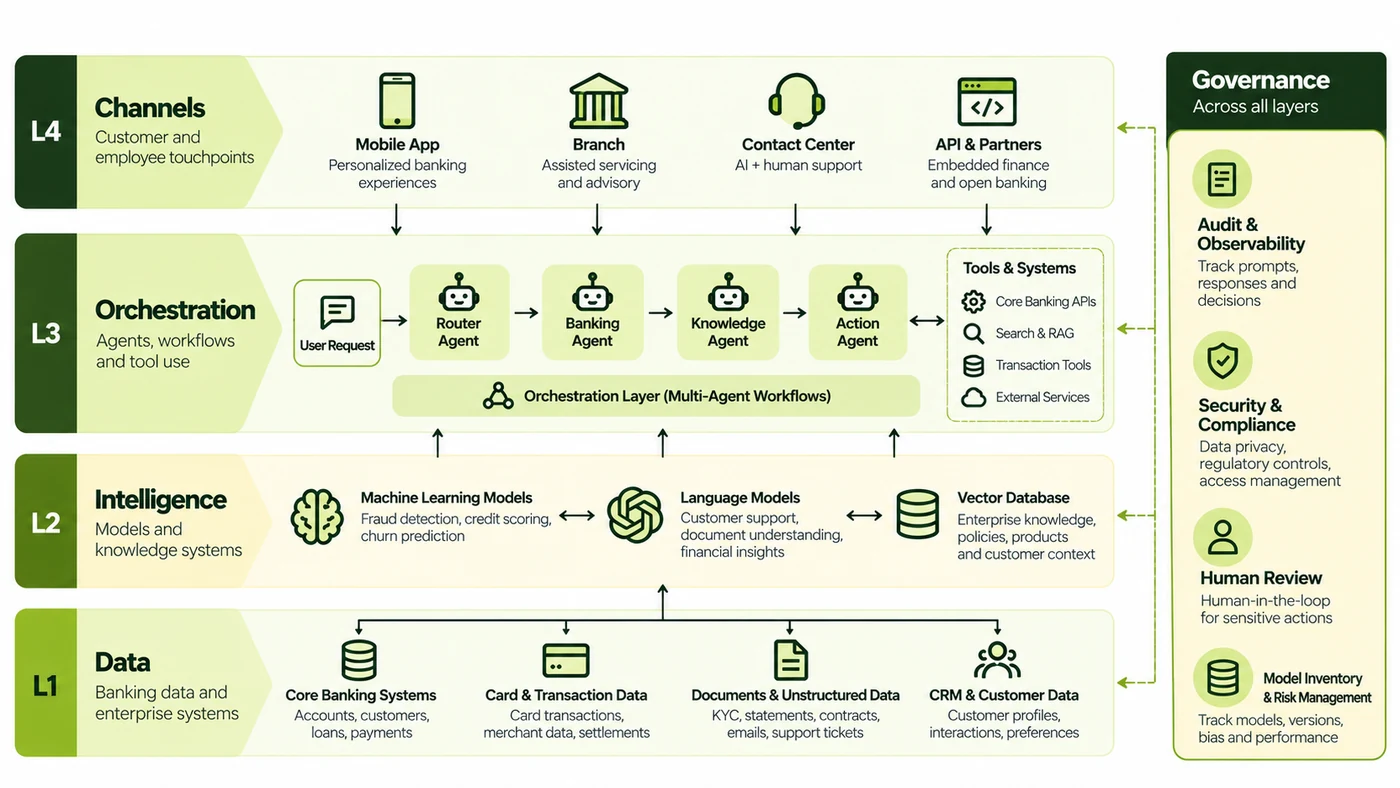
The five layers every production banking AI system shares, with governance running across all of them.
Data layer
AI is only as good as what it can see. In a bank that means the core banking system, whether Temenos, Infosys Finacle, FIS, Fiserv or Jack Henry, plus card and payment platforms, CRM, document stores and external sources such as bureau data and open banking feeds. Fraud and payments need real-time streams; monthly risk models can live on batch data. Most mature banks run both through a governed lakehouse so every model sees the same version of the customer.
Intelligence layer
This is where prediction and language understanding happen. Banks typically run classic machine learning models for scoring alongside large language models for documents and conversation. Sensitive workloads often run on private or in-region model deployments so customer data never leaves the bank's control or its jurisdiction. Retrieval augmented generation (RAG) keeps language models grounded in the bank's own policies and product terms, and it is how banks use AI to analyze unstructured data such as contracts and statements without retraining a model every time a document changes.
Orchestration layer
Orchestration turns intelligence into action. It decides which model runs when, which systems an agent may call and where a person has to approve before anything moves. In a well designed setup, every tool an agent can use is permissioned like a staff role and every step is written to an audit trail.
Governance layer
Governance is not a final checkpoint; it runs through every layer. It covers the model inventory, independent validation, bias testing, explainability for credit and fraud decisions, drift monitoring, guardrails against hallucination and prompt injection, and clearly defined human-in-the-loop points. At Dextra Labs we often add a context layer we call Org Brain beneath banking applications: department-scoped retrieval, governed prompt templates and access controls, so every AI tool draws on the same trusted knowledge without overexposing data.
Channel layer
Finally, AI reaches people through the mobile app, internet banking, branch tools, the contact center and partner APIs. The intelligence underneath should be shared, so a customer gets the same answer from the app at midnight as from their relationship manager the next morning.

How banks use AI across the front, middle and back office
How are banks using AI in practice, and how does AI help banks day to day? The clearest way to see it is through the three layers of the organization. The use of AI in banking looks quite different in each, and so do the metrics it moves.
The front office is where customers notice AI. The middle office is where most of the measurable value sits, because better models directly reduce losses and better triage frees specialists for the cases that matter. The back office is often the fastest payback of all: banks still push a surprising amount of work through PDFs, spreadsheets and email, and much of it can come off people's desks within a quarter.
Layer
Who uses it
Where AI earns its place
What improves
Front office
Digital channels, contact center, relationship managers, wealth advisors
Virtual assistants, voice agents, next-best-action, advisor copilots
Response time, satisfaction, product holding
Middle office
Credit, risk, financial crime, compliance
Credit decisioning, fraud detection, AML alert triage, regulatory monitoring
Losses, false positives, time to decision
Back office
Operations, payments, finance, IT
Document processing, reconciliations, regulatory reporting, IT copilots
Cost per transaction, straight-through processing, cycle time

AI use cases in banking and financial services
The AI use cases in banking below are the ones we see creating real value today, grouped into seven areas. Most also apply as AI use cases in financial services more widely, from payment firms and lenders to wealth managers. Many also work as AI use cases in finance teams outside banking, because good AI for finance relies on the same building blocks. Treat them as a menu rather than a checklist: the right starting point depends on your data, your risk appetite and where your costs actually sit.

Fraud, financial crime and security

Real-time fraud detection
Rule-based systems miss new attack patterns and block too many good customers. Machine learning scores every payment in milliseconds using device, behavior and network signals. With Deloitte projecting generative AI could push US fraud losses to $40 billion by 2027, banks increasingly pair scoring with AI agents for fraud detection that build the case on every flagged alert.

Transaction monitoring & AML triage
AML teams drown in alerts, most of them false positives. AI re-scores alerts by risk, links related activity across accounts and drafts the case narrative, so the same team clears far more alerts and spends time on activity that genuinely deserves a suspicious activity report.

Identity & synthetic fraud
Synthetic identities blend real and invented details and behave perfectly until they default. Graph analytics connects applications that share devices, phone numbers or behavior, exposing rings that look clean one application at a time.

Scams & account takeover
APP scams and deepfake voice calls trick genuine customers into sending money themselves. Behavioral biometrics notice when a session or payee looks out of character and trigger a warning or step-up check before the payment leaves.

Sanctions & PEP screening
Name screening produces endless near-matches, especially across transliterated names. AI resolves the obvious false matches, explains its reasoning and routes true hits to a person, shortening payment holds without weakening the control.

Customer onboarding and KYC

Digital onboarding & KYC automation
Account opening loses customers to slow document checks. Document AI extracts and verifies identity data, liveness checks confirm the applicant, and risk models decide which applications genuinely need a human. Onboarding feels instant for low-risk customers and gets stricter for high-risk ones.

Periodic KYC refresh & EDD
KYC reviews pile up because analysts spend hours collecting information that already exists. An agent gathers it, compares it with the existing profile and drafts the review, highlighting only what has changed since last time.

Business onboarding & ownership
Working out who really owns a company can take days of registry searches. Language models read filings and shareholder documents and assemble a draft ownership structure for an analyst to confirm.

Lending and credit

AI credit scoring & checks
Traditional scorecards struggle with thin-file customers. Models that combine bureau data with cash-flow and open banking or account aggregator data approve more good borrowers at the same risk, with reason codes on every decision for customers and fair lending rules alike.

Loan origination & approvals
Simple loans should not wait in the same queue as complex ones. Models and policy rules route low-risk applications to straight-through approval and pass the rest to underwriters with a ready summary, cutting time to decision from days to minutes.

Underwriting support
Underwriters spend more of their day reading documents than judging risk. AI reads statements and returns, checks them against policy and drafts the credit memo. Banks using AI agents to reduce underwriting delays let those agents chase missing documents too.

Statement & cash-flow analysis
Reading six months of statements by hand is slow and inconsistent. Models categorize every transaction, identify income and recurring obligations, flag red flags such as bounced payments and summarize affordability.

Collections & early warning
Most banks spot stress only after a missed payment. Early warning models pick up the signals weeks earlier and suggest the right response, from a friendly reminder to a restructuring conversation.

Customer experience and growth

Virtual assistants & conversational AI
Customers want answers at any hour. Conversational AI handles routine requests and hands over with full context when needed. The scale is real: Bank of America’s Erica has handled more than 3.2 billion interactions since 2018. The newer AI customer service agents for banking complete tasks such as card replacements, not just answer questions.

Voice agents in the contact center
Many customers still prefer to call, and rigid phone menus frustrate them. Voice agents understand natural speech, authenticate callers and resolve routine requests in several languages, which matters in markets such as India and the UAE.

Personalized offers & next-best-action
Generic offers get ignored. Models choose the most relevant product, message or action for each customer and the right moment to deliver it, lifting conversion while reducing message volume.

Churn prediction & retention
By the time a customer moves their salary account, it is too late. Churn models notice the early signs, smaller deposits, fewer logins, an unresolved complaint, and trigger retention while there is still something to save.

Relationship manager copilots
RMs cannot track every signal across a large book. A copilot surfaces the moments that matter, a client whose import volumes suggest a trade finance need, and prepares a briefing before each meeting.

Risk, compliance and regulatory reporting

Regulatory change & compliance monitoring
Banks answer to several regulators at once, and every new circular has to be mapped to policies and controls. Language models read the requirements, identify what is affected and draft the changes. An AI agent for compliance monitoring can watch communications and transactions continuously, so breaches surface as they happen.

Risk management & reporting
Risk teams often spend more time assembling data than analyzing it. AI pulls the data together, runs scenario analysis and drafts the commentary, giving risk managers more time to challenge the numbers.

Automated regulatory reporting
Regulatory returns involve repetitive data pulls and reconciliations. Automation assembles and validates the figures, flags unusual movements against prior periods and drafts the narrative for review.

Contract & document analysis
Loan agreements, ISDAs and vendor contracts hide obligations across hundreds of pages. Language models extract covenants, key dates and non-standard terms and compare them with the bank’s templates.

Operations and finance

Intelligent document processing
Trade finance, letters of credit and mortgages still run on paper and PDFs. Document AI classifies each document, extracts the data and checks it against rules, sending only exceptions to staff. Often the quickest AI win in a bank because the savings are direct.

Payments ops & reconciliation
Breaks between ledgers and payment systems eat hours of investigation. Matching models resolve most automatically and explain the rest, raising the auto-match rate and shrinking the end-of-day backlog.

Financial reporting
Monthly management packs take days to assemble. AI gathers the figures, checks them against prior periods and drafts the narrative, leaving finance teams to review and refine.

Knowledge assistants for staff
Staff waste hours searching policy manuals. An assistant grounded in approved internal documents answers their questions and cites the exact source, which also shortens training for new joiners.

Wealth, investment banking and markets

Advisory & portfolio management
Personal advice is too expensive to offer every client. AI builds and rebalances portfolios to each client’s goals, while advisor copilots prepare reviews and notes, so advisors spend time where judgment matters.

Research & sentiment analysis
No analyst can read every filing, earnings call and news story. Language models summarize and score sentiment across sources and alert teams to material changes, extending coverage without extending hours.

Pitch books & deal prep
Investment banking analysts spend long nights on first drafts. AI produces company profiles, comparable tables and draft pitch sections from approved data, which bankers then shape and check.
AI in banking examples at a glance
Area
Strong first use case
Main type of AI
Time to first release
Fraud & financial crime
AML alert triage
Machine learning + AI agent
3 to 6 months
Onboarding & KYC
Digital onboarding
Document AI + machine learning
3 to 6 months
Lending & credit
Underwriting support
Generative AI + AI agent
2 to 4 months
Customer experience
Virtual assistant
Generative AI
2 to 4 months
Risk & compliance
Regulatory change monitoring
Generative AI
2 to 4 months
Operations & finance
Intelligent document processing
Intelligent automation
6 to 12 weeks
Wealth & markets
Research summarization
Generative AI
6 to 12 weeks
Not sure which use case to start with?

AI in banking by segment
AI for banking is not one thing. The same technology plays out very differently depending on who a bank serves and how it makes money.

Retail banking
AI in retail banking is a game of scale. Small improvements in fraud losses, onboarding conversion or contact center costs, multiplied across millions of customers, add up. Scam prevention, digital onboarding, virtual assistants and personalized offers lead the list.

Commercial & corporate banking
AI in commercial banking and AI in corporate banking both focus on making each banker more effective. Copilots summarize client financials, spot cross-sell signals in cash management and trade flows, speed up credit memos and watch over covenants.

Investment banking & markets
In investment banking, artificial intelligence earns its place in research, deal preparation, trade surveillance and institutional onboarding. Governance is especially strict here because outputs can influence markets.

Wealth & private banking
Advisors use AI to prepare for meetings, generate portfolio reviews and respond faster. Digital advice extends basic guidance to clients who would not justify a dedicated advisor, widening reach without diluting top-client service.

Payments & transaction banking
Speed and accuracy are everything. AI drives real-time fraud scoring, sanctions screening, payment repair and liquidity forecasting for corporate treasurers.

Community banks & credit unions
Interest in AI for credit unions and community banks is growing quickly, with 59% of US credit unions already using generative AI. Small teams get the most from member service assistants, lending automation and fraud tools that fit existing core providers.

NBFCs & digital lenders
For NBFCs and digital lenders in India, AI solutions sit at the heart of the business model: alternative data credit scoring, statement analysis, account aggregator integration, collections and service in multiple Indian languages. RBI expectations on fairness and explainability shape every model.

Islamic banking
Islamic banks in the UAE and wider GCC apply AI to the same problems with an extra layer: checking products and transactions against Sharia principles, serving customers in Arabic and English, and documenting decisions for Sharia boards.

Generative AI, AI agents and intelligent automation in banking
These three terms are often used interchangeably, which makes investment decisions harder than they need to be. Each sits on top of the AI and machine learning in financial services that banks have run for years, and each is suited to a different kind of work.
Generative AI in banking
Most AI applications in financial services that rely on generative AI sit wherever people read and write a lot: credit, compliance, customer service and operations. Most banks start with internal copilots, where a person checks every output, before letting it face customers directly. It is also the layer that turns decades of documents into usable knowledge.
AI agents and agentic AI in banking
Agents are where the field is moving fastest. Given a goal such as “prepare this customer’s KYC review”, an agent decides which systems to query, gathers the evidence, applies the policy and hands a finished draft to an analyst. The same pattern is spreading across finance functions, and AI agents in finance are now handling reconciliations, close tasks and reporting as well as banking operations. For banks specifically, the practical questions are architecture, permissions and where humans stay in control, which is where most agentic AI in banking programs succeed or stall.
Intelligent automation
RPA has not gone away. For stable, rules-based processes it is still the cheapest and most predictable option. What has changed is that AI now handles the messy inputs and exceptions that used to send the work back to people, so automation finally reaches the end of the process.
Traditional ML
Generative AI
AI agents
Intelligent automation
What it does
Predicts an outcome
Understands & writes language
Plans & completes tasks across systems
Runs a defined process end to end
Best suited to
Scoring & forecasting
Documents, conversation, drafting
Multi-step work across teams
High-volume repetitive processes
Main risk
Bias & drift
Hallucination & data leakage
Unintended actions
Breaks when inputs change
Banking example
Credit score
First draft of a credit memo
KYC refresh prepared end to end
Account opening workflow

Benefits of AI in banking and finance
The benefits of AI in banking, and AI for financial services generally, show up in a handful of numbers that every bank already reports. If a project cannot name which of these it will move, it is not ready to fund.
Benefit
The metric it moves
What it looks like in practice
Lower operating cost
Cost-to-income ratio, cost per transaction
Documents and reconciliations handled with a fraction of the manual touches
Faster decisions
Time to decision, cycle time
Low-risk loans approved in minutes instead of days
Fewer losses
Fraud loss rate, default rate
Fraudulent payments stopped before they settle
Less noise
False-positive rate, alerts per analyst
Investigators working on genuinely suspicious activity
Better customer experience
Satisfaction, wait times, resolution rate
Answers at any hour, in the customer's own language
Revenue growth
Conversion, product holding, lifetime value
The right offer at the right moment
Stronger compliance
Audit findings, time to implement new rules
Regulatory change mapped to policies in days, not months
More productive people
Cases per analyst, time with clients
Specialists reviewing and deciding instead of collecting data
The same logic holds for most AI applications in finance, inside or outside a bank. The advantages of AI in banking also compound. The data foundation built for the first use case makes the second cheaper and faster, and by the fifth the bank is reusing components rather than starting from scratch.

Challenges and risks of AI in banking
Every bank that has scaled AI has run into some version of the problems below. None is a reason to wait. Each is a reason to plan before launch rather than after.
Challenge
Why it matters in banking
How to manage it
Legacy systems & data silos
Models cannot see a complete, current view of the customer
Build the integration layer early and start with use cases that need fewer data sources
Explainability
Customers and regulators are entitled to reasons for credit and fraud decisions
Use explainable models or techniques such as SHAP, and record the reasons behind every decision
Bias & fair lending
Models can disadvantage groups even without using protected attributes
Test for bias before launch and at least annually, and monitor outcomes by segment
Hallucination
Generative AI can state wrong answers with confidence
Ground answers in approved content, cite sources and keep people on high-impact outputs
Privacy & data residency
Customer data is tightly regulated and often must stay in-country
Use private or in-region model hosting with strict, role-based access
Third-party risk
A third of AI use cases in UK financial services are third-party implementations
Run due diligence, keep audit rights and plan an exit for every AI vendor
Model drift
Customer behavior and fraud patterns change constantly
Monitor performance continuously and retrain on a schedule
Security & prompt injection
Agents and assistants can be manipulated through their inputs
Limit agent permissions, filter inputs and outputs, and red team before launch
Skills gaps
Few teams combine banking knowledge with data and AI engineering
Pair internal teams with experienced partners and build a center of excellence
Hidden costs
Inference, integration and validation costs grow quietly
Model total cost of ownership before scaling, not after
Being open about the disadvantages of AI in banking is part of good governance. Boards now ask these questions directly, and having clear answers ready shortens approval cycles considerably.

AI regulation and governance in banking
AI governance in financial services has moved from broad principles to specific supervisory expectations in nearly every major market. Rules for artificial intelligence in financial services differ in the details, but the direction is the same everywhere: boards own AI risk, banks keep an inventory of their models, high-impact decisions get human oversight and every decision must be explainable.
Market
Key rules
What they mean for AI projects
United States
Fed & OCC model risk guidance (SR 11-7); fair lending law (ECOA) and CFPB adverse action guidance
Validate and document every model, and give specific reasons for credit denials even with complex models
United Kingdom
FCA Consumer Duty; FCA AI Live Testing; PRA SS1/23 on model risk management
Show good customer outcomes, manage AI within model risk frameworks and use FCA live testing where it helps
European Union
EU AI Act (creditworthiness scoring of individuals is high-risk); DORA on operational resilience
Risk management, data governance, human oversight and documentation for high-risk systems; AI suppliers managed as ICT third parties
Singapore
MAS Guidelines on AI Risk Management, issued 7 Oct 2026, effective 7 Oct 2027; FEAT principles
Board oversight and AI risk systems by Oct 2027, life cycle controls and AI capability by Oct 2028; GenAI and AI agents in scope
UAE
CBUAE Guidance Note on AI (Feb 2026); Personal Data Protection Law
AI inventory, board reporting on performance and drift, annual bias testing, human oversight for credit decisions, third-party due diligence
India
RBI FREE-AI framework (Aug 2025); Digital Personal Data Protection Act; RBI digital lending directions
Board-approved AI policy, fairness and explainability, consumer protection and privacy by design
Regulators are also getting closer to the work itself. In the UK, the FCA’s AI Live Testing program brought in firms including NatWest, Monzo and Santander, followed by a second cohort of eight. In Singapore, the new MAS guidelines give institutions a year before board-level expectations apply, which is a strong reason to build governance in now rather than retrofit it later.
A practical AI governance checklist for banks
- Inventory Every model and AI system recorded with an owner, a purpose and a risk rating.
- Validation Independent testing before launch covering accuracy, bias, robustness and explainability.
- Human oversight Defined points where people review or approve high-impact decisions.
- Monitoring Live tracking of performance, drift, complaints and incidents, reported to the board.
- Third parties Due diligence, audit rights and exit plans for every external model or AI vendor.

How to implement AI in banking: a six-step roadmap
There is no single right way to approach AI implementation in banking, but banks that scale successfully tend to follow a similar path. If you are working out how to use AI in finance and banking operations for the first time, this sequence keeps risk low and momentum high.

Prioritize use cases
Score each candidate on business value and feasibility. Start with two or three that score well on both; ambitious, high-risk use cases come later.
Check data readiness
Map where the data lives, how reliable it is and how the model will reach it. Plan integration alongside model work, not after it.
Build, buy or partner
Buy where a product fits, build where the use case differentiates you, and partner for speed and skills you lack in house. Most banks mix all three.
Pilot with guardrails
Run on real data with real users, with a person approving every high-impact output. Agree the success metric and go-live threshold before you start.
Validate & deploy
Take the model through your model risk process, deploy with monitoring for performance and drift, and prepare operations teams for exceptions.
Scale the operating model
Formalize a center of excellence, shared platforms and reusable components. This is where the cost of each new use case falls sharply.

Choosing AI solutions for banking: build, buy or partner
The market for AI banking solutions and AI solutions for financial services is crowded, from specialist products for fraud or onboarding to platforms that promise to do everything. The right choice depends on how much the use case differentiates you and how much control you need over data and models.
Off-the-shelf product
Custom build
Hybrid
Best for
Common problems such as standard chatbots or document capture
Differentiating use cases built on proprietary data
Most banks, most of the time
Speed to start
Fastest
Slowest
Fast, with room to grow
Control & data residency
Limited
Full
High
Fit with legacy systems
Depends on vendor connectors
Designed around your stack
Good
Cost over time
License fees grow with usage
Higher upfront, lower to run
Balanced
People often ask which AI is best for finance. There is no single answer. The best AI for banks is the one that fits your data, your systems and your regulator, which is why the choice of partner matters as much as the choice of model.
What to look for in an AI partner for banking
When comparing firms that offer AI in financial services consulting and engineering, look for:
- Proven delivery of AI in production in a regulated environment, not only demos.
- Experience integrating with core banking systems and the data platforms you run.
- Explainability, audit trails and human oversight designed in from the first sprint.
- The ability to host models in your cloud or region to meet data residency rules.
- Full handover of code, documentation and knowledge, so you are never locked in.
- Familiarity with your regulators, whether MAS, CBUAE, RBI, the FCA or US supervisors.
- Measurable outcomes from previous projects.
- Support after launch, including monitoring and retraining.
Building a banking copilot or financial assistant
A useful assistant, for customers or staff, needs four things: secure access to the right data, a language model grounded in approved content, clear guardrails on what it may say and do, and a smooth handover to a person when it is unsure. A focused first version for one product line or team typically takes eight to twelve weeks. Breadth comes once the first one is trusted.

Cost and ROI of AI in banking
What does AI in banking cost? Far more depends on integration and governance than on the model itself. These are the drivers that shape most budgets.
Cost driver
What it covers
Discovery & design
Use case selection, process mapping and success metrics
Data & integration
Connecting core systems, document stores and data pipelines
Build
Models, prompts, agents and user interfaces
Validation & governance
Model risk review, bias testing and documentation
Running costs
Hosting, inference and token costs, monitoring
Change management
Training, process redesign and adoption support
Operations and document use cases usually pay back first because the savings are direct and easy to measure. Fraud and credit use cases often deliver the largest absolute returns but need longer validation before they go live.

How Dextra Labs helps banks and financial institutions
Dextra Labs is an AI consulting and engineering firm with teams in the US, India and Singapore. We work with banks, credit unions, NBFCs and fintechs to take AI from a promising idea to a production system that risk, compliance and the business are all comfortable with.
Most engagements begin with focused AI consulting: choosing the use cases worth doing first, building the business case and designing the architecture and governance before a line of code is written. From there, our engineers build and deploy, often through AI agent development for workflows such as KYC reviews, underwriting, disputes and collections, where agents can take on whole pieces of work under clear human control.
What we build for banks

AI strategy & roadmaps
Use case prioritization, business cases and an operating model that scales.

AI agents for banking operations
Agents that prepare, check and route work across KYC, lending, disputes and back-office processes.

Generative AI & private LLMs
Copilots and assistants grounded in your own documents and hosted where your data must stay.
Conversational & voice AI
Customer and staff assistants that work across channels and languages.

Data engineering for AI
Integration and pipelines that give models a reliable, current view of the customer.

AI governance
Model inventories, validation approaches and controls aligned with MAS, CBUAE, RBI, FCA and US expectations.
How we work
Discover
We map your goals, data and constraints, and agree the use cases that will move your numbers.
Design
We settle the architecture, success metrics and governance before the build starts.
Build
We deliver in short sprints, with working software tested on your real data.
Deploy & improve
We take it live, monitor it and keep improving it alongside your team.
Ready to put AI to work across your bank?

The future of AI in banking and finance
Five shifts look likely to define the next few years of AI in banking.

Agentic banking becomes routine
Agents will take on whole workflows such as KYC reviews, dispute handling and loan servicing, with people supervising. More than half of US banks and credit unions have already discussed agentic AI at board or executive level.
AI agents start making payments
Agent-initiated payments, where a customer’s assistant pays a bill within agreed limits, are moving from concept to pilot. Authentication, consent and liability rules will need to keep pace.

AI-native banks raise expectations
New digital banks are built with AI at the core. In the UAE, digital bank Ruya has deployed agentic AI as part of an AI-native strategy, and customers will judge incumbents against that experience.

Private & sovereign models
More banks will run models inside their own environments or in-country, driven by data protection law and regulator focus on third-party risk.

Compliance moves to real time
Instead of periodic reviews, AI will monitor transactions, communications and controls continuously, so issues are caught as they happen rather than at the next audit.
The future of AI in finance will not be decided by who has the most advanced model. It will be decided by who can run AI safely, at scale, across the whole institution.

Frequently asked questions about AI in banking
AI in banking is the use of machine learning, generative AI, AI agents and intelligent automation to help banks detect fraud, make credit decisions, serve customers, meet compliance obligations and run operations. It turns large volumes of data and documents into faster, more accurate decisions with less manual effort.
Banks use AI to score transactions for fraud, triage anti-money laundering alerts, verify identities during onboarding, assess credit, run virtual assistants and voice agents, personalize offers, track regulatory change and process documents. Bank of America's Erica alone has handled more than 3.2 billion client interactions since 2018.
Lower operating costs, faster decisions, lower fraud and credit losses, fewer false positives, better customer experience and stronger compliance. The strongest projects tie each benefit to a metric the bank already reports, such as cost-to-income ratio or time to decision.
The main risks are biased or unexplainable decisions, inaccurate answers from generative AI, privacy breaches, dependence on third-party vendors, model drift and security threats such as prompt injection. Strong governance, human oversight and continuous monitoring keep these risks under control.
Yes, when it is set up properly. That means hosting models privately or in-region, restricting access by role, grounding answers in approved content, logging every interaction and keeping customer data out of public model training. Most banks start with internal use cases before customer-facing ones.
Traditional AI predicts outcomes, such as a credit score. Generative AI understands and writes language, such as drafting a credit memo. AI agents plan and complete multi-step tasks across systems, such as preparing a full KYC review for a person to approve.
A focused first use case usually reaches production in two to six months, depending on data access, integration and model risk review. Document and knowledge use cases can move faster; fraud and credit models take longer because of validation requirements.
Cost depends mainly on integration, data work and governance rather than the model itself. A focused pilot is a modest investment, while bank-wide programs are usually budgeted as a multi-year portfolio. Modeling total cost of ownership, including inference and validation, before scaling avoids surprises.
Guidance current as of October 2026. Regulatory timelines, including the EU AI Act, are reviewed each quarter.
Put AI to work in your bank, with the controls your regulator expects
Whether you are choosing your first use case or scaling AI across the institution, our team can help you move faster and stay compliant.