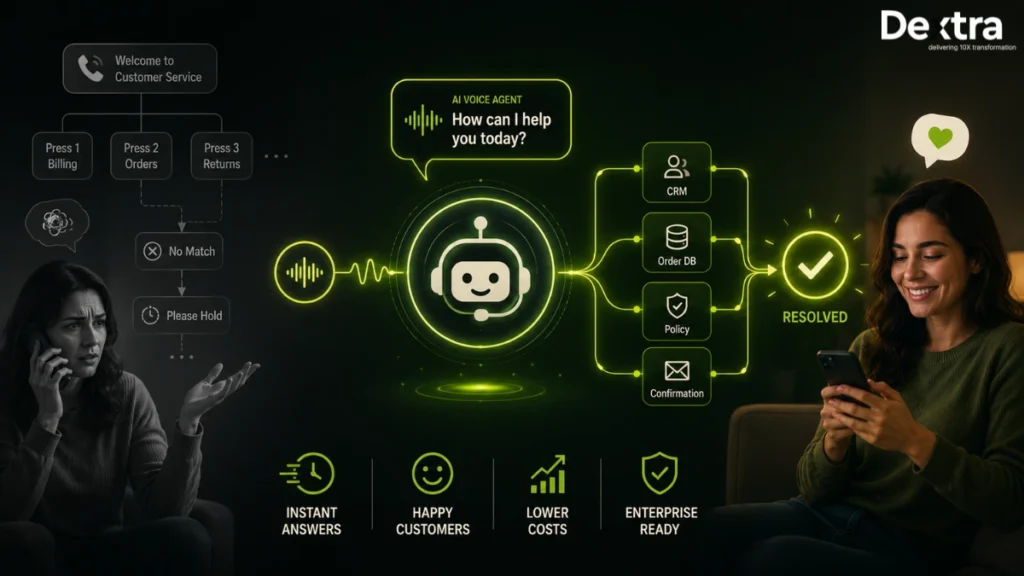
An AI voice agent for customer service is an AI system that lets customers speak to a business naturally over the phone instead of having to navigate endless IVR menus, repeat their issue, or wait on hold for a human agent.
These Voice agents listens, understands the customer request, retrieves relevant information from your business stack, and can execute required action across business systems, all within the same conversation, much like a human agent would.
The technology behind these conversations has changed significantly. Unlike traditional voicebots, today’s systems can understand intent, maintain context, retrieve information, and take action during a live conversation. In fact, Gartner has reported that by 2028, at least 70% of customers will use conversational AI to begin their customer service journey.
In this guide, we’ll explain how AI voice agents for customer service work from speech recognition and reasoning to response generation and system actions. We’ll also cover their real-world benefits, latency, hallucination risks, guardrails, human handoffs, and what enterprises should evaluate before deploying an AI voice agent for customer support.
What Is an AI Voice Agent for Customer Service?
An AI voice agent for customer service is a software system that conducts real-time voice conversations with customers to resolve service requests autonomously. It listens to what your customer says, understands the intent behind their request, retrieves relevant information from your business systems, decides what action to take, and executes it with natural-sounding speech. Customers can interact with your agent over a phone call, a web voice interface, or voice-enabled channels such as WhatsApp.
Unlike traditional IVR systems, an AI voice agent does not make your customers navigate a fixed menu tree. Instead of requesting customers to “Press 1 for Support” or repeat a specific phrase, it interprets the customer request, remembers the conversation, and adapts the response as the conversation develops. To put it more simply, an IVR makes you follow its flow, while an AI voice agent follows your customers flow.
The word “agent” itself signals that the system can do more than just answer questions. Based on the conversation and the information available, an AI agent can figure out the next step and act on your behalf completely. It can update a CRM record, check an order, process an eligible return, schedule an appointment, or transfer the customer call to a real human support with the relevant context from the conversation.
In customer service, an AI voice agent handles the calls that are suitable for autonomous resolution while working alongside human agents for everything else. Common examples include order updates, account changes, appointment rescheduling, refund requests, payment questions, and basic troubleshooting. When a request is complex, sensitive, or requires human judgment, conversational AI voice agents can escalate the call instantly without forcing you to start the conversation all over again.
The rest of this guide covers how these systems actually work, what they cost to run, and how to evaluate one for your operation.
The Problem Voice AI Was Built to Solve
The case for voice AI starts with three practical problems that includes customers need help outside business hours, traditional IVRs often fail to get them to the right resolution, and every unresolved call adds another layer of cost to the contact center.
Let’s look at each of these problems in detail:
Customers Don’t Call Only When Your Team Is Working
Modern customers’ demand does not follow a 9-to-5 schedule. For businesses serving customers across different regions, calls keep coming even after business hours, on weekends, during holidays, and while another market is asleep.
Staffing every hour with trained agents can become very expensive, especially when overnight shifts bring higher staffing costs, turnover, and inconsistent service quality.
A “we’re closed” message may save a staffing expense tonight, but it can also leave an urgent customer with nowhere to go until morning. For global operations, 24/7 customer service is increasingly becoming an operational requirement and not some premium feature.
The IVR Was Designed Around the Business, Not the Customer
Traditional IVRs are built around fixed options rather than how customers naturally explain what they need. When the right option is hard to find or does not exist, deep menu trees, unclear routes to a human, and dead-end transfers can turn a very simple request into several minutes of navigation.
The result is not just an abandoned call. A customer may call back later, reach another channel, or escalate the issue because the first attempt never reached the right person. NICE notes that high abandonment is closely tied to excessive wait times and can lead to repeat contacts and lost revenue.
The Cost of Every Unresolved Call
Every customer conversation has a cost, but the actual expense starts when the issue is not resolved. A customer who has to call again creates another support interaction, adds pressure to the support team, and increases the total cost of resolving what should have been handled in one conversation.
Human support is naturally expensive as every resolved call requires agent time. The actual cost varies with location, complexity, staffing model, and coverage requirements. In 2026, for example, outsourced customer service rates range from $9 to $18 per hour offshore to $29 to $45 for US based agents.
AI voice can reduce the cost of handling suitable conversations, but the economics only work when the agent actually resolves the customer’s problem. If the customer has to call back and reach a human anyway, the apparent saving disappears. The better metric is fully resolved calls per dollar, not calls handled per dollar.
Voice AI is not just about handling calls cheaper. It is about resolving them faster and better than a badly designed IVR ever could.
How AI Voice Agents Actually Work ?
A modern AI voice agent is a stack of connected technologies that work together in real time. They listen, understand customer queries, retrieve information, take required action, and respond in natural speech. Let’s take you through how each layer of AI voice agents actually works:
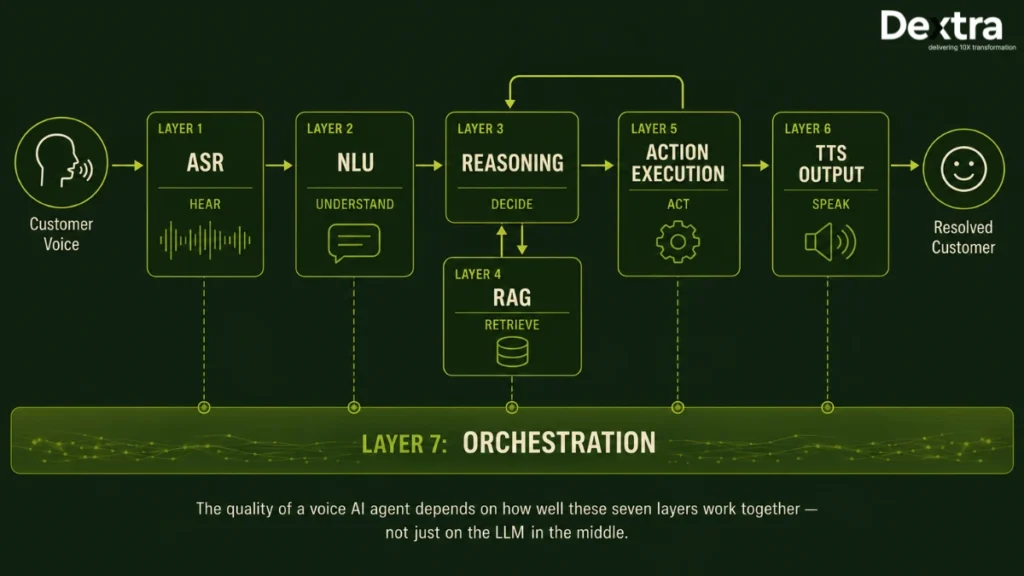
Layer 1: Speech Input (Automatic Speech Recognition)
Speech recognition turns the customer’s voice into text the AI can work with. Simply put, as your customer speaks, the audio is streamed to an automatic speech recognition (ASR) system that transcribes it in real time. Tools such as Deepgram Nova-3, AssemblyAI, and OpenAI Whisper are commonly used for this job. Accuracy is usually measured through Word Error Rate (WER), and even small transcription errors can matter when they affect names, order numbers, addresses, or other details the agent needs to act on.
Layer 2: Language Understanding
Language understanding finds out what the customer actually means. Instead of just looking for keywords such as “refund” or “appointment,” the system identifies intent, extracts important details, recognizes urgency, and connects the current request with what was said earlier. Modern LLMs increasingly handle this work directly because they can interpret ambiguity, context, and natural phrasing without forcing customers to use specific words.
Layer 3: Reasoning and Response Generation
Reasoning determines what the agent should do and say next. The model considers the conversation, retrieved information, available tools, and business rules before generating a response. For example, a simple request like checking an order status may need a fast model, while a refund involving multiple policies, account details, and approval rules may require a stronger reasoning model. The goal is to match the model to the complexity of each request while keeping response times and costs under control.
Layer 4: Knowledge Retrieval (RAG)
The knowledge retrieval layer gives the agent access to information it cannot safely rely on the underlying LLM to remember. It can pull relevant details from knowledge bases, CRM records, product catalogs, order databases, and internal policies before generating an answer. Modern implementations use Pinecone, Weaviate, or pgvector to support this retrieval layer. The better the system retrieves the right information, the less it has to depend on guesswork when answering customers.
Layer 5: Action Execution
The action execution layer connects the AI agent to business APIs and tools so it can interact with external systems and perform real actions. Approaches such as Model Context Protocol (MCP) can provide a standardized way for AI systems to access these tools and data. In practice, this means the agent can check an order, verify return eligibility, initiate the return, update the CRM, and send a confirmation to the customer rather than simply explaining what they could do.
Layer 6: Speech Output (Text-to-Speech)
Text-to-speech turns the agent’s response back into spoken audio. The system generates the response and streams it through a TTS engine designed for real-time conversation. ElevenLabs, Cartesia, and other modern speech models focus on low latency, natural pacing, pronunciation, and expressive delivery and lead the market in 2026. The important metric is not just how quickly the audio is generated, but how quickly the customer hears the first part of the response.
Layer 7: Orchestration
Last but not least, the orchestration layer keeps all of these components working together as one conversation. It manages conversation state, controls tool calls, handles failures, decides when additional reasoning is needed, and determines when a human should take over. It uses frameworks like LangGraph (state graphs for controlled flow), AutoGen (multi-agent coordination), and CrewAI (role-based agent orchestration). Without strong orchestration, even good speech and reasoning models can produce an unreliable customer experience. Therefore, choosing a voice AI platform is really choosing an orchestration strategy.
In practice, the quality of an AI voice agent depends on how well these seven layers work together. Accurate speech recognition means the Voice AI agent hears you correctly, reasoning determines the right response, retrieval keeps that response grounded, action execution gets the job done, and orchestration makes sure everything happens in the right order. When these work together with low enough latency, the technology largely disappears and the interaction feels more like a conversation.
For businesses exploring enterprise centric & diverse customer-support automation, our guide to AI Agent for Customer Service explains how AI agents can handle customer queries in each industry’s operations, resolve routine issues, retrieve information and escalate complex conversations to human agents.
Benefits of AI Voice Agents for Customer Service
Here are the benefits that matter most when AI voice agents are deployed around the right customer service workflows:
1. 24/7 Availability Without Around-the-Clock Staffing
Customers can get help even when your contact center is closed. An AI voice agent handles routine requests overnight, on weekends, and during holidays without requiring a full human team on every shift. Plus, your human agents can focus their time on complex cases during staffed hours while the AI handles suitable calls whenever they come in.
2. Immediate Answers Without Waiting on Hold
Voice AI can answer calls as they arrive instead of putting customers into a queue. That becomes especially valuable during product launches, seasonal peaks, or unexpected spikes in call volume when human teams cannot scale instantly. A customer calling to check an order or reschedule an appointment can get an answer immediately instead of waiting several minutes for an available agent.
3. More Consistent Service on Every Call
An AI voice agent follows the same approved process every single time. It can use the correct policy, ask the required verification questions, provide approved information, and follow the same escalation rules across thousands of conversations. This consistency can be particularly valuable in regulated industries where missing a required disclosure or applying a policy incorrectly can create more than just a poor customer experience.
4. Multilingual Support Without Building Separate Teams
One voice agent can support customers across multiple languages without requiring a separate team for every region. Modern speech and language models can detect the language being spoken and respond accordingly, while some systems can also handle code-switching within the same conversation. For global businesses, this can make multilingual support more accessible without creating a separate voice operation for every other region.
5. Shorter Calls for Routine Requests
Voice AI can remove many of the small steps that make simple calls take longer than they should. If a customer needs an order status, the voice agent can retrieve the information directly instead of making them wait while a human searches several systems. It can also collect basic details before an escalation, giving the human agent a clearer starting point and reducing unnecessary back-and-forth.
6. Conversation Data at Scale
Every conversation can become a source of useful customer insight. Voice agents can transcribe calls, identify recurring issues, detect common questions, and surface patterns across large volumes of conversations. Instead of reviewing a small sample of calls manually, customer service teams can analyze conversations at much greater scale and spot problems such as repeated product complaints or confusing policies earlier.
These benefits are real, but they depend heavily on how the voice agent is designed and deployed. Reliable guardrails, real-time system integrations, low-latency processing, and context-aware human handoffs are what turn those capabilities into consistent customer service outcomes. Without them, a system that gives wrong answers, responds too slowly, or loses context during escalation can turn these advantages into new customer service problems.
Top 7 Real Use Cases in Customer Service
Here are seven practical ways an AI voice agent for customer service is being used in real support operations:
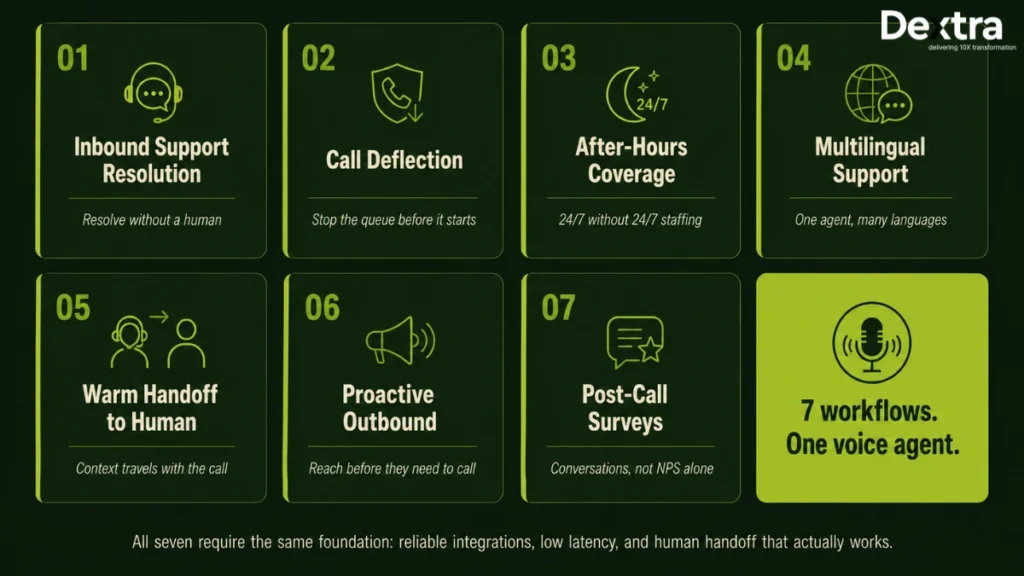
1. Inbound Support Call Resolution
An AI voice agent for inbound customer support calls can check an order status, process an eligible refund, change a subscription, reset access, or reschedule an appointment without involving a human. The value is straightforward: customers get the answer or action they need in one conversation while human agents stay available for issues that require actual judgment.
2. Contact Center Call Deflection
Call deflection keeps suitable conversations out of the human queue altogether. Voice AI answers the call, identifies why the customer is calling, and attempts to resolve the request before transferring anyone. If the issue does need a human, the system can pass along the customer’s identity, reason for calling, and relevant account information so the human agent does not have to start the conversation from scratch.
3. After-Hours and Overflow Coverage
An AI voice agent for customer support provides 24/7 coverage for routine customer requests when human support teams are unavailable or overloaded. It can handle calls overnight, on weekends and holidays, and during sudden spikes in demand. This makes voice AI useful for maintaining consistent support during product launches, seasonal peaks, billing periods, and unexpected service disruptions.
4. Multilingual Customer Support
Voice AI can extend support across languages without creating a separate operation for each market. A global business may receive calls in Spanish, French, German, Arabic, Hindi, Mandarin, or Japanese within the same support operation. A multilingual AI voice agent detects the caller’s language, responds accordingly, and retains the conversation context if the customer switches languages or needs to be transferred to a human agent.
5. Warm Handoff to a Human Agent
A human handoff works better when the customer does not have to repeat everything. Before transferring the call, the voice agent can verify the customer’s identity, understand the issue, check account or order information, and summarize what has already happened. The human agent then receives that context with the call, allowing them to focus on solving the problem instead of spending the first few minutes gathering basic information. Salesforce reports that 85% of service professionals say transitions from voice AI to human representatives are seamless for customers, representing why a well-designed handoff matters as much as the automation itself.
6. Proactive Outbound Service Calls
Voice AI can also reach customers before they need to call support themselves. It can confirm an upcoming appointment, notify a customer about a shipment delay, remind them about a payment, verify certain transactions, or follow up after a service interaction. This turns the phone from a channel customers use only when something goes wrong into a way for businesses to prevent avoidable support calls in the first place.
7. Post-Call Surveys and Customer Feedback
Voice AI can collect feedback through a conversation instead of reducing the experience to a single rating. After a support interaction, it can ask what went well, what could have been better, and whether the issue was actually resolved. The resulting transcript can capture details behind a low score, such as frustration with a policy or confusion about a product, giving CX teams more useful feedback than an NPS number alone.
All these use cases show where voice AI can make the biggest difference in customer service and the broader shift is already visible. Salesforce’s 7th State of Service research found that service professionals estimate AI resolved 30% of service cases in 2025, with that figure expected to reach 50% by 2027.
The Challenges of AI Voice Agents That Nobody Talks About
The following challenges can make or break a real-world voice AI deployment. These are the problems that show up when the system moves beyond a demo and starts handling real customers.
1. Hallucinations Are Harder to Fix on a Live Call
A wrong answer on a voice call cannot be taken back. If the agent gives an incorrect refund policy or account details, the customer has already heard it. Deloitte’s research found that one in three GenAI users had encountered incorrect or misleading information which shows why accuracy and trust controls matter when AI interacts directly with customers. For voice AI, this means deployments need strong guardrails, grounded knowledge, and controlled access to business data to reduce the risk of the agent saying something it cannot verify or should not disclose.
2. Latency Gets Worse as Systems Connect
Every extra system adds time to the conversation. A CRM lookup, knowledge search, authentication check, or backend action can turn a quick response into an awkward silence. Streaming, parallel processing, caching, and fast models for simple requests help keep responses quick enough to feel natural.
3. Interruptions Are Harder Than They Look
Customers interrupt when they are confused, in a hurry, or just ready to respond. The voice AI agent needs to stop speaking, recognize the interruption, understand the new input, and continue from the right point. Poor interruption handling quickly makes a conversation feel robotic, even when the underlying AI is otherwise capable.
4. A Bad Handoff Can Make Things Worse
A human transfer only helps when the customer does not have to start over. The handoff should carry the conversation history, authentication status, issue summary, and actions already taken so the human agent can pick up where the AI stopped. As AI takes care of more routine requests, the quality of this handoff becomes more important. Gartner found that 85% of service and support leaders are expanding human-agent responsibilities as AI shifts work toward higher-value tasks. This makes a smooth handoff an important part of good customer service rather than just a backup when AI cannot help.
5. Compliance Cannot Be Added at the End
Voice conversations can contain sensitive customer and payment information so security and privacy need to be considered from the start of a voice AI deployment. That concern extends beyond voice AI itself, as enterprises are already treating security and privacy as major barriers to wider AI adoption. Deloitte found that 92% of Indian executives identify security vulnerabilities as a primary AI adoption concern, while 91% cite privacy risks involving sensitive data. For voice AI deployments, that means the way calls are recorded, stored, processed, and accessed needs to be designed around the relevant requirements. Depending on the industry and region, these can include GDPR, HIPAA, PCI DSS, SOC 2, and India’s DPDP Act. Standard platforms may cover common requirements but multi-region data residency, custom retention policies, or isolated audit environments can require a more tailored architecture and, in some cases, custom development.
These challenges are manageable, but they cannot be treated as minor details. When your workflows, integrations, security requirements, and customer journeys are complex, custom development gives you greater control over safeguards, latency, handoffs, and how the entire system works around your business.
What Enterprises Should Look For in an AI Voice Agent for Customer Service?
When you evaluate an AI voice agent for customer service, you must look beyond the demo and focus on how it will perform in your actual operation. These seven checks can help you separate a convincing presentation from a system that can genuinely handle customer conversations at scale:
1. End-to-End Resolution Rate
You can start with a very simple thing – how many calls does this AI agent actually resolve? Ask for the autonomous resolution rate on a use case similar to yours rather than a broad marketing figure. If the AI voice agent mainly collects information and transfers customers to humans, you may be improving call answering without really reducing the workload.
2. Latency Under Real Load
You need to know how quickly the voice agent responds when your operation gets busy. Ask what happens when hundreds of calls run at the same time while CRM lookups, knowledge retrieval, and other integrations are active. Request the 95th-percentile response time under production-like conditions rather than relying on a controlled demo.
3. Integration With Your Existing Systems
Look at how deeply the voice AI agent can work with the systems you already use. Check your CRM, telephony, ticketing, knowledge base, authentication, and core business systems. Do not stop at “we have an API.” Ask what the AI voice agent can actually read, update, and execute because that determines whether it can resolve a request or simply tell you what to do next.
4. Escalation and Context Handoff
A good escalation should feel like a continuation of the same conversation. When you are transferred to a human, the voice agent should pass along the transcript, authentication status, issue summary, relevant account details, and actions already attempted. Ask to see the human agent’s screen during a real handoff so you can verify exactly how much context is preserved.
5. Complete Call Auditability
You should be able to see what happened throughout every conversation. Look for searchable transcripts, action logs, retrieved information, and guardrail events. You should also know how long those records are stored, who can access them, and whether you can export or delete them when required.
6. Compliance and Data Controls
Your compliance requirements should shape the architecture from the start. Check requirements such as SOC 2, HIPAA, PCI DSS, GDPR, and India’s DPDP Act where relevant. Ask about data residency, retention, consent, deletion, and audit controls. If you operate across regions or handle highly sensitive data, custom architecture may give you the control that a standard setup cannot.
7. Total Cost at Scale
The advertised per-minute price barely tells you the full story. Calculate telephony, ASR, TTS, LLM usage, integrations, monitoring, engineering, and ongoing optimization together. If you are comparing the best voice AI agent software for customer support, look at the total cost at your expected volume rather than the headline rate.
If your requirements involve complex workflows, multiple systems, strict compliance, or highly specific customer journeys, Dextra Labs is a custom AI agent development company operating across the USA, Singapore, India, UK, and UAE. As an experienced AI agent builder, we build custom AI voice agents particularly around your systems and workflows, giving you greater control over how the agent works as your operation grows.
The Modern 2026 Tech Stack for AI Voice Agents
Every production-grade AI voice agent for customer service in 2026 is built from a combination of technologies. Below is an overview of those technologies and how a modern AI voice agent stack looks like:
- LLM reasoning: Claude Sonnet 4.5, GPT-5, and Gemini 2.5 Pro are leading options for reasoning and response generation. They differ in speed, cost, and reasoning depth, so production systems often route simple requests to faster models and complex requests to more capable ones.
- Speech-to-Text: Deepgram Nova-3, AssemblyAI Universal-2, and OpenAI Whisper Large-v3 convert customer speech into text. Accuracy matters here because even a small increase in Word Error Rate can affect everything that happens after transcription.
- Text-to-Speech: ElevenLabs, Cartesia Sonic, and PlayHT turn generated responses back into spoken audio. The key factors are how natural the voice sounds and how quickly the first audio reaches the customer.
- Orchestration: LangGraph, AutoGen, and CrewAI help coordinate the agent’s reasoning, tools, workflows, memory, and handoffs. This is where much of the practical engineering happens because the agent needs to manage what happens across an entire conversation.
- Vector database and RAG: Pinecone, Weaviate, and pgvector help the agent retrieve relevant information from your business data. The right choice depends on your data volume, search requirements, and existing infrastructure.
- Guardrails and safety: Guardrails AI, NeMo Guardrails, and Lakera Guard help control what the agent can say and do. These safeguards become especially important when the agent handles sensitive customer information or operates in regulated environments.
- Evaluation and observability: Langfuse, LangSmith, and Ragas help teams monitor conversations, evaluate responses, identify failures, and understand why an agent behaved a certain way.
- Retrieval augmentation: Cohere Rerank improves the relevance of information retrieved from large knowledge bases. Better retrieval means the agent is more likely to use the right policy, document, or customer information instead of responding with something that is merely plausible.
- Integration protocol: Model Context Protocol (MCP) provides a standardized way for AI systems to connect with external tools and business systems. This can simplify how an agent accesses CRM records, databases, ticketing systems, and other backend capabilities.
- Model portability: Bring-your-own-key (BYOK) setups give enterprises more control over which models they use and how their data moves through the system. This can be useful when you need flexibility across providers or want tighter control over security and data governance.
At Dextra Labs, our AI Agent Builders architect production-grade voice agents on this exact stack, tailored to each client’s compliance, integration, and performance requirements.
How Dextra Labs Builds Custom AI Voice Agents for Customer Service?
Dextra Labs build production-grade AI voice agents for enterprise customer service, contact center automation, and complex compliance environments. As an AI Agent development service provider, we focus on building around your systems and workflows rather than asking you to fit your operation into a fixed platform.
How Does Engagement Work?
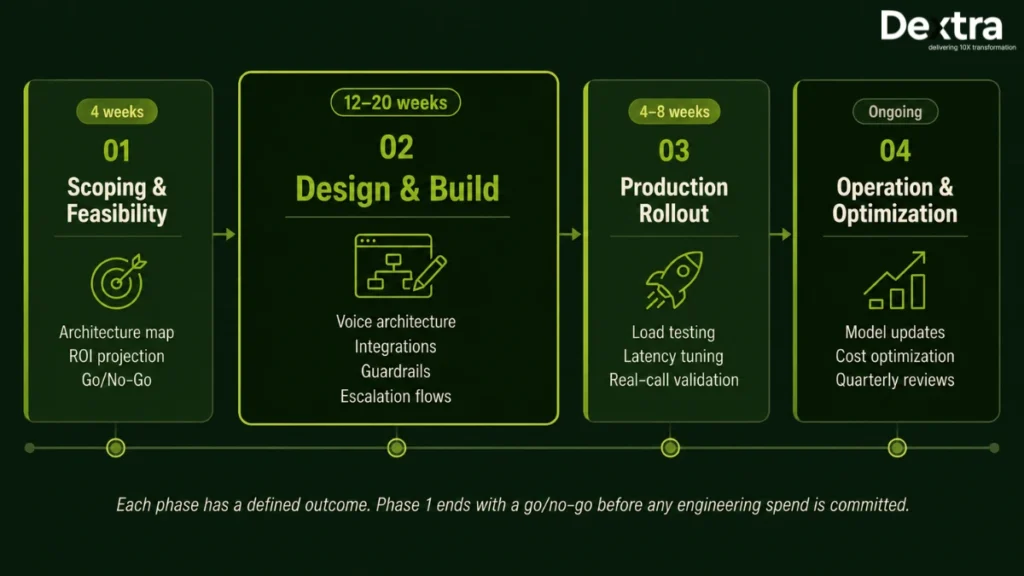
We take a phased approach so you can validate the business case before committing to a full production deployment. Here’s how:
Phase 1: Scoping and Feasibility (4 weeks)
We run discovery workshops in association with your customer service, engineering, compliance, and finance teams. There, we define the voice AI architecture, map your telephony, CRM, and knowledge systems, set the latency and cost targets, and project ROI at 3, 12, and 24 months. In this phase, we decide on a clear go and no-go decision.
Phase 2: Design and Build (12–20 weeks)
Next, we focus on building the voice architecture, engineer prompts, implement guardrails, integrate telephony and CRM systems, design escalation flows, and configure multilingual support where required.
Phase 3: Production Deployment and Tuning (4–8 weeks)
We ensure testing the system at your target call volume and concurrency, optimize latency, tune conversations using real call data, monitor quality, and validate escalation workflows before scaling.
Phase 4: Ongoing Operation
We continuously evaluate performance, update models, expand workflows, optimize costs, and conduct regular reviews as your operation evolves.
Typical all-in initial investment ranges from $500K to $1.5M, with annual operating costs typically around $250K to $500K, depending on deployment scope, call volume, integrations, and compliance requirements.
Where Dextra Labs Specializes
We build where standard voice AI setups often start to become restrictive. That includes regulated financial services, healthcare, insurance, high-volume ecommerce, and multilingual global support.
If you have complex integrations, strict data controls, or customer journeys that do not fit neatly into a standard platform, a custom voice AI architecture can give you far more control over how the system operates and scales.
When to Talk to Us
If you are evaluating AI voice agents and want to understand what would actually work for your operation, we can help you assess the architecture before you commit. Our AI Agent experts can review your workflows, integrations, compliance needs, and expected volume and help you determine the right approach.
The Future of AI Voice Agents in Customer Service
The following three shifts will shape where voice AI goes next. Together, they point to a move from reactive call handling toward more connected and capable customer service.
1. Agentic Voice AI Will Move From Conversation to Action
The next generation of voice agents will do more than just answer questions. They will reschedule appointments, process eligible refunds, update accounts, create tickets, and complete other tasks during the same conversation. This is where agentic voice AI becomes valuable: the system does not just understand what you want, it helps get it done.
2. Voice, Chat, and Messaging Will Share One Context
Customers will increasingly be able to move between channels without having to start over. The same voice agent could handle a phone call, continue the conversation through WhatsApp, and follow up by chat while retaining the relevant context. For enterprises, this means fewer disconnected systems, simpler governance, and a more consistent customer experience.
3. Outbound Voice Will Become More Proactive
Voice AI will increasingly reach customers before a support problem becomes a support call. It can confirm appointments, remind customers about renewals, follow up after an interaction, or identify customers who may need help. This moves voice AI from just responding to demand toward helping businesses prevent avoidable issues and strengthen customer relationships.
Conclusion
An AI voice agent for customer service understands customers, retrieves information, takes action across business systems, and brings in a human when the situation actually requires it. That capability is becoming increasingly relevant as conversational AI expands, with MarketDigits projecting the market to reach $34.7 billion by 2030, growing at a 20.9% CAGR from 2023 to 2030.
But market growth alone does not make every voice AI deployment a good investment. You still need to look at resolution rates, integrations, latency, security, compliance, and escalation before choosing an approach. If an off-the-shelf setup cannot meet those requirements, custom development gives you the flexibility to build around your operation.
Dextra Labs can help you design and build a custom AI voice agent from the ground up. We work with enterprise customer service teams to scope, design, and deploy custom AI voice agents when standard platforms do not fit their operational reality. Book a free consultation call with our experienced AI engineers to discuss your use case and find the right approach for your business.
Frequently Asked Questions:
Q1. What is an AI voice agent?
An AI voice agent is a software system that holds real-time voice conversations with customers. It listens, understands what the caller needs, retrieves information, takes action across business systems, and responds naturally. An AI customer service agent voice setup handles routine requests without needing a human to step in.
Q2. How does an AI voice agent work?
An AI voice agent works in six coordinated stages which include speech-to-text conversion, natural language understanding, LLM reasoning, retrieval of grounded knowledge, action execution across business systems, and text-to-speech response generation. An orchestration layer coordinates these stages and decides when to escalate to a human agent.
Q3. What is the difference between IVR and AI voice agents?
A traditional IVR follows fixed menu options, while on the other hand, AI voice agents understand what callers actually mean. Instead of asking you to press random numbers and follow preset paths, an AI voice agent can hold a natural conversation, access real-time information, complete tasks, and adapt its response to the situation.
Q4. How do voice AI agents handle frustrated or angry customers?
AI voice agents can detect signs of frustration through language, sentiment, and voice cues. When a conversation becomes sensitive or too complex, well-designed AI voice agents for customer support quickly transfer the caller to a human with the conversation history and relevant context intact.
Q5. How do AI voice agents handle multilingual support?
AI voice agents can support multiple languages using language-aware speech-to-text models and multilingual LLMs such as Claude Sonnet 4.5, GPT-5, and Gemini 2.5 Pro. Leading text-to-speech models can also handle different languages and accents which helps the AI voice agent to detect the customer’s language, continue the conversation naturally, and switch languages when needed without requiring a dedicated agent for each language. For enterprises with complex language, regional, or compliance needs, custom development also allows multilingual support to be designed around their specific requirements.
Q6. Are AI voice agents SOC 2 compliant?
AI voice agents can be deployed in SOC 2 Type II-compliant environments, but compliance depends on how the system is built as well as managed. Custom deployments can be architected around SOC 2 requirements for infrastructure, logging, access controls, and data handling which also gives enterprises greater control over how sensitive information is managed. When evaluating the best AI voice agent for customer service, ask for the current attestation letter rather than relying on a general compliance claim.