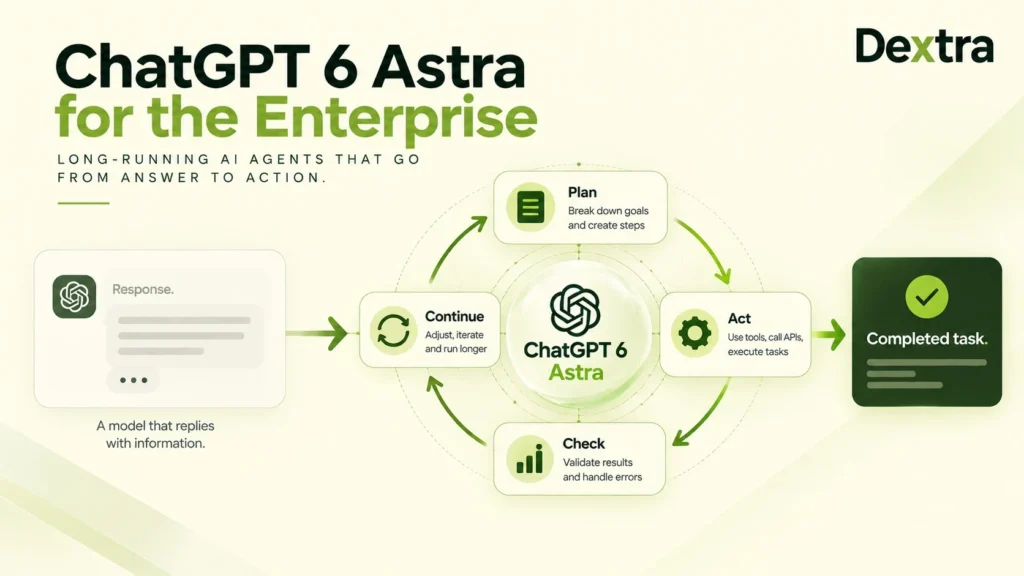
The last three years of enterprise AI followed a familiar shape. Someone asked a question, a model answered it, and a person decided what to do next. The model was smart, sometimes startlingly so, but it sat outside the work. It produced text. A human turned that text into action.
GPT-6 Astra breaks that shape. Not because it is a larger model with a bigger number attached, but because it is built to stay inside the work, to take an objective, plan an approach, pull in the context it needs, operate the systems the work lives in, check whether it got the result right, and keep going until the job is done or it hits something that genuinely needs a human. OpenAI positions it as its most capable model for difficult, end-to-end work spanning reasoning, software engineering, computer use, research and document creation.
That is a real shift, and it deserves a serious answer rather than a hype cycle. Because here is the thing most of the coverage gets wrong: a more capable model does not make your enterprise AI architecture disappear. It makes that architecture more important, because the model can now participate in longer, more consequential chains of work, and every part of that chain is a place where things can go right or wrong at a scale that a single chatbot reply never reached.
So the useful question is no longer only “What can GPT-6 Astra answer?” It becomes: “Which business processes can GPT-6 Astra participate in, from beginning to end and which ones should it stay out of?” This article is about how to answer that, honestly, for a real enterprise.
What Is GPT-6 Astra?
Astra is the first model in OpenAI’s GPT-6 family, released in early September 2026. We’ll keep this section short on purpose, this isn’t another GPT-6 explainer, and if you want the model-generation history, that belongs in a GPT versions overview, not here.
What matters for our purposes is the capability profile. Astra combines several things that, taken together, change what a model can be trusted to do rather than just say:
- Reasoning: It’s a reasoning model, it thinks before it answers, and that deliberation is what makes multi-step planning viable rather than a lucky guess.
- Computer use: It can operate software directly: browsers, forms, CRM records, spreadsheets, document editors, and other interfaces built for humans rather than APIs.
- Coding: OpenAI describes it as its strongest software-engineering model to date, with context preserved across long coding sessions.
- Research and professional work: It’s aimed at producing finished artifacts, analyses, reports, documents, spreadsheets, not just paragraphs.
- Long context: A 1,050,000-token context window (often marketed as 1.1M) with a maximum output of 128,000 tokens, which makes genuinely long tasks feasible within a single working session.
- Tool-based workflows. It’s designed to sit inside an agent loop, calling tools and reacting to what they return.
One practical detail worth carrying forward: Astra’s pricing is tiered by context length. The standard rate is $10 per million input tokens and $50 per million output tokens, but once a request exceeds roughly 272,000 input tokens, the input rate doubles and output climbs too. We’ll come back to why that matters when we talk about the economics of long-running agents, because it quietly reshapes how you design them.
Why Astra Matters More for Agents Than Chatbots
Here’s the distinction that runs underneath everything else in this article.
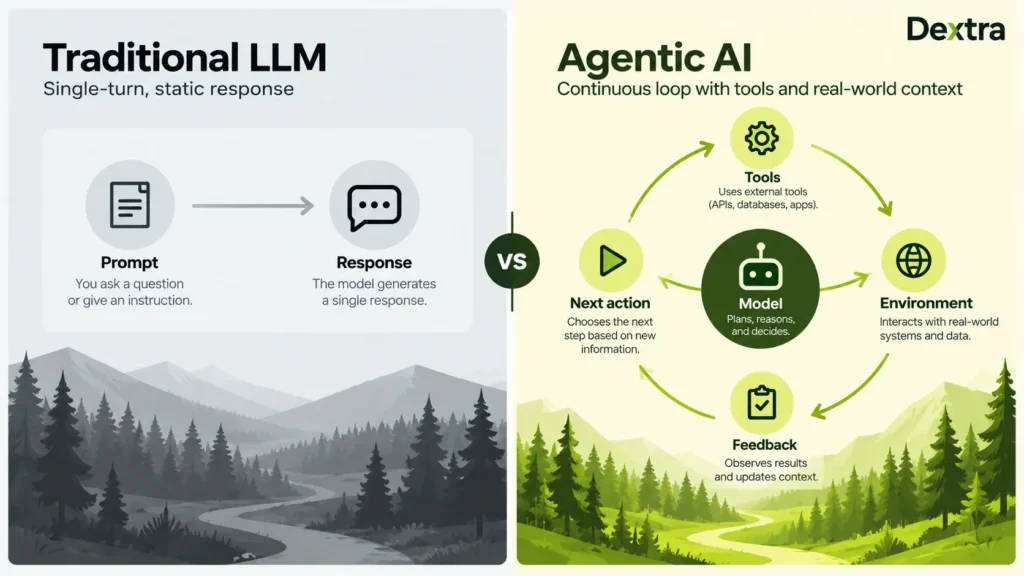
A chatbot lives in a loop that looks like this:
Prompt ──▶ ResponseAn agent lives in a loop that looks like this:
Model ──▶ Tools ──▶ Environment ──▶ Feedback ──▶ Next action ──▶ (repeat)The same model behaves very differently in those two loops. In the first, intelligence is spent producing a good answer. In the second, intelligence is spent making a good decision about what to do next, given what just happened. Astra’s improvements, reasoning, computer use, long context, error recovery, are disproportionately valuable in the second loop, because that loop is where enterprise work actually happens. The value of Astra isn’t visible when you ask it a question. It’s visible when you hand it a job.
What Actually Makes a Long-Running AI Agent Different?
Let’s define a long-running agent operationally, by what it can do, rather than by adjectives.
It can break a goal into multiple steps
Ask a chatbot to “prepare a competitive intelligence report” and it produces one, immediately, from what it already knows. Ask a long-running agent the same thing and the behavior is different in kind: it identifies which sources to consult, researches them, extracts the relevant material, compares findings against each other, organizes the evidence, drafts the report, notices what’s missing, goes back for it, and revises. The goal is decomposed into work, and the work is carried out in sequence.
GPT-6 Astra can use tools
The model stops being the answer and starts being the orchestrator. It reaches for APIs, databases, CRMs, internal search, browsers, code execution, spreadsheets, document systems and enterprise applications, whatever the task requires. The reasoning connects to the systems where your business actually runs.
GPT-6 can react to intermediate results
This is the part that separates an agent from a script, and it’s easy to underrate. Traditional automation is a fixed path:
Step 1 ──▶ Step 2 ──▶ Step 3An agentic workflow inspects and branches:
Step 1 ──▶ inspect result ──▶ decide ──▶ Step 2A or Step 2B ──▶ inspect ──▶ continueIf a source is empty, it tries another. If a document is missing, it works on whatever isn’t blocked and flags the gap. If a tool returns something unexpected, it adjusts rather than crashing. That “work around the corner” behavior is what makes it feel less like software executing instructions and more like a competent contractor handling a problem.
Astra can operate software
Astra’s computer-use capabilities let it interact with websites, forms, CRM records, document editors and other software environments directly, the way a person would, by looking at an interface and acting on it. This matters enormously in the enterprise, because it extends an agent’s reach beyond systems that happen to expose a clean API. We’ll spend real time on both the opportunity and the risk here, because computer use is simultaneously Astra’s biggest enterprise unlock and its biggest new attack surface.
GPT-6 Astra Is a Model, Not an Enterprise AI Strategy
This is the section that will save you from a very expensive mistake, so it’s worth slowing down.
A frontier model is one layer of an enterprise AI system. A useful mental picture of the full stack looks like this:
  Business Objective
        │
  GPT-6 Astra              (reasoning, planning, generation)
        │
  Reasoning / Planning
        │
  Enterprise Context       (what your business actually knows)
        │
  RAG / Knowledge
        │
  Tools & APIs
        │
  Computer Use
        │
  Memory / State
        │
  Workflow Orchestration
        │
  Verification / Evaluation
        │
  Security & Permissions
        │
  Human Approval
        │
  Enterprise Systems
Why the model is only one layer
Astra brings reasoning, planning, generation and tool use. It does not bring, and cannot invent for you, the parts of that stack that are specific to your organization:
- enterprise permissions and access control
- reliable business rules
- data governance and classification
- observability into what the agent did and why
- workflow orchestration across systems
- evaluation infrastructure to know if it’s working
- human approval mechanisms for consequential actions
- integration with the applications the work lives in
None of that comes in the box. A model that can reason brilliantly about your business is still, on day one, a model that doesn’t know your policies, your terminology, your systems, your permission boundaries or your institutional memory. Closing that gap is architecture and engineering work, and it’s precisely the work that determines whether an Astra deployment becomes a reliable business capability or an impressive demo that never ships. Keep this in mind as we go: almost every failure mode later in this article traces back to a missing layer here, not to a limitation of the model.
What GPT-6 Astra Actually Changes for Enterprise AI
The temptation is to list new capabilities. That’s the wrong frame. Capabilities are what OpenAI ships; architectural consequences are what you have to design around. So let’s organize this by what changes in how you build.
1. From prompt-based interaction to goal-based execution
Before, you asked for a step: “Summarize these customer complaints.”
Now you can assign an outcome: “Analyze this month’s complaints, identify recurring product issues, compare them against previous months, produce a report, and flag the issues that need the product team’s attention.”
The unit of instruction gets larger. You describe the result you want, not the method to get there, the same way you’d brief a capable colleague rather than dictating keystrokes.
2. From single-turn AI to long-horizon work
Multi-step tasks, intermediate state, task continuation, error recovery, iterative reasoning, these become normal rather than exceptional. But here’s a nuance that trips people up: long context is not the same as memory.
A million-token window helps an agent hold more information within a single task. It does not give you durable, organizational memory across tasks, and it doesn’t manage state for you. Enterprises still need deliberate memory and state architecture, we’ll separate those concepts carefully later, because “the model can see a lot at once” and “the system remembers what happened last Tuesday” are different problems with different solutions.
3. From API automation to computer-using agents
This may be Astra’s single biggest enterprise implication. Traditional integration is gated on an API existing:
API exists ──▶ integrate the APIComputer use changes the gate:
Application exists ──▶ the agent can potentially operate its interfaceThat opens up legacy applications, SaaS tools without convenient APIs, internal dashboards, browser-based workflows, and the long tail of human-style digital processes that never justified a formal integration. For a lot of enterprises, that long tail is where the real friction lives.
But state the caveat in the same breath: computer use expands capability and the security-and-reliability surface at the same rate. An agent that can click anything can also click the wrong thing, be misled by a manipulated page, or take an irreversible action nobody intended. The opportunity and the risk are the same feature viewed from two sides.
4. From fixed workflows to adaptive workflows
Traditional logic is deterministic:
IF X ──▶ THEN YAgentic logic assesses and adapts:
Goal ──▶ assess situation ──▶ choose action ──▶ observe result ──▶ adaptAdaptive is powerful when the work genuinely varies. But deterministic systems still matter, and often matter more precisely because they’re predictable and testable. The skill is knowing which parts of a workflow should flex and which parts should never surprise you.
5. From AI output to AI-produced work
Because Astra is built for professional work involving documents, spreadsheets, presentations and analyses, the output increasingly is the finished artifact: the completed document, the reconciled spreadsheet, the code change, the QA result, the research package, rather than a paragraph describing what someone should go and produce. The deliverable and the answer become the same thing.
What GPT-6 Astra Does NOT Change
Every credible enterprise AI article needs this section, because it’s the part that separates engineering judgment from marketing. A more capable model changes a lot. Here’s what it pointedly does not.
GPT-6 doesn’t eliminate enterprise systems
Your ERP, CRM, databases, data warehouses and internal applications still exist and still hold the truth. The agent becomes another intelligent layer that interacts with and orchestrates those systems, not a replacement for them. If anything, the systems of record become more important, because now something is acting on them faster than a human can review each action.
GPT-6 Astra doesn’t make data governance optional
Identity, authorization, access control, data classification, audit logs, retention policies, privacy controls, all of it still applies, and applies harder. An autonomous agent is a new kind of actor inside your governance model, not an exemption from it.
Astra doesn’t make hallucinations irrelevant
This one is counterintuitive and important. Longer workflows create more opportunities for error, not fewer: an incorrect assumption early on, a bad tool call, a misread piece of data, and because steps chain, a small early error can cascade into a confidently wrong final result. Agent reliability is not the same as model intelligence. A smarter model that runs longer can fail in bigger ways if the surrounding system doesn’t catch it.
It doesn’t mean every workflow should become autonomous
Some processes should stay deterministic, rules-based, human-controlled, or handled by traditional automation. “We could make this an agent” is not the same as “we should.” More capable does not automatically mean more appropriate, and we’ll give you a framework for telling the difference.
GPT-6 Astra doesn’t eliminate humans
It relocates them. The human role moves away from performing every step and toward defining the objective, the constraints, the permissions and the approval points, deciding what “done right” means, and staying in the loop where judgment and accountability actually matter. That’s a more leveraged role, not a smaller one.
Long-Running AI Agent Architecture for Enterprise Applications
Now we move from concept to structure. Here is a reference architecture for a long-running enterprise agent, not a product diagram, but a way of seeing the parts you’ll actually have to build or buy:
                   BUSINESS OBJECTIVE
                           │
                   ┌─────────────────┐
                   │   AI AGENT      │
                   │   GPT-6 Astra   │
                   └────────┬────────┘
                            │
                  ┌─────────▼─────────┐
                  │ Planning / Reason │
                  └─────────┬─────────┘
                            │
        ┌───────────────────┼───────────────────┐
        ▼                   ▼                   ▼
   Enterprise RAG      Tools / APIs       Computer Use
        │                   │                   │
        └───────────────────┼───────────────────┘
                            ▼
                     Workflow State
                            │
                     Verification Layer
                            │
                ┌───────────┴───────────┐
                ▼                       ▼
          Human Approval            Continue
                └───────────┬───────────┘
                            ▼
                    Enterprise Systems
Read top to bottom, it’s a loop: objective in, action out, and a verification gate that either continues the loop or pulls a human in before anything consequential happens. The layers underneath the model are where your engineering effort concentrates.
Model layer: GPT-6 Astra, the reasoning and generation engine.
Context layer: RAG, enterprise knowledge, structured data and task history. This is how the agent learns what your business knows, as opposed to what the model learned in training.
Tool layer: APIs, databases, browsers, code execution, enterprise SaaS. The agent’s hands.
State and memory layer. Four different things that get lazily collapsed into one word:
- conversation context: what’s in the window right now
- task state: where the workflow currently stands
- persistent memory: what’s intentionally kept across tasks
- organizational knowledge: durable business information reached through systems like RAG
Confusing these is one of the most common architectural mistakes, and it’s why “just give it a bigger context window” is not a memory strategy.
Control layer: Permissions, policies, guardrails and approval gates, the boundaries on what the agent is allowed to do.
Evaluation layer: Task success, tool-call accuracy, factual accuracy, policy compliance, latency and cost. Without this, you can’t tell whether the agent is working or just running.
GPT-6 Astra + RAG: From Retrieving Information to Acting on It
RAG deserves its own section, because Astra changes what RAG is for.
Traditional RAG answers a question:
Question ──▶ retrieve documents ──▶ generate answerAgentic RAG does something more like investigation:
  Objective
     ↓
  Determine what information is required
     ↓
  Retrieve relevant context
     ↓
  Analyze  ──▶  Use tools
     ↓
  Retrieve additional context if needed
     ↓
  Verify  ──▶  Act
The retrieval stops being a one-shot lookup and becomes an ongoing part of the reasoning loop, the agent decides what it needs to know as it goes, rather than fetching a fixed bundle of documents up front.
Why context selection matters more than context volume
Astra’s long context window makes it tempting to solve every problem by stuffing more documents into the prompt. Resist that. OpenAI’s own guidance for the model points in the opposite direction: as agents become more capable, accumulated skills, instructions and scaffolding should be revisited and trimmed, not endlessly appended, to avoid bloated context.
That’s the whole case for context engineering over context volume. The right few thousand tokens beat the wrong million, for accuracy, for latency and, given Astra’s context-tiered pricing, for cost. A retrieval system that selects precisely is worth more than a window that holds everything.
Enterprise Use Cases for GPT-6 Astra Long-Running Agents
Rather than a generic list of twenty, it’s more useful to group candidate work by workflow type, because the shape of the work is what determines fit, not the department name on the door.
- Customer operations: A customer raises an issue; the agent investigates the account, reviews history, inspects the relevant systems, determines a resolution, updates the CRM and communicates the outcome. One connected chain instead of five handoffs.
- Software engineering: Issue analysis, codebase investigation, implementation, testing, debugging, documentation and pull-request preparation. This is a stated Astra strength, it holds context across long coding sessions and can verify its own work against tests, which is exactly the kind of checkable structure agents thrive on.
- Finance: Financial research, reconciliation workflows, reporting preparation, variance investigation and document analysis, work with numbers that reconcile, which gives the agent a way to check itself.
- Sales and RevOps: Account research, CRM enrichment, opportunity analysis, proposal preparation and follow-up workflows.
- Operations: Workflow investigation, exception handling, system updates and document processing, often the exact long-tail work that never justified a formal integration but eats hours.
- Research and knowledge work: Research, synthesis, competitive intelligence, report generation and evidence gathering.
Notice the common thread across the strongest examples: the work happens inside software and leaves behind evidence the agent can check. That’s not a coincidence, it’s the single best predictor of whether an agent will succeed, which is what the next section is about.
Which Enterprise Processes Are Actually Good Candidates for Astra?
This is the consulting core of the article, the part that turns “interesting technology” into “a decision I can make on Monday.” Instead of asking “where can we use Astra?”, evaluate a specific process against these dimensions:
| Dimension | Question to ask |
|---|---|
| Repetition | Does this workflow happen frequently enough to matter? |
| Cognitive complexity | Does it require judgment, or just rote steps? |
| Digital accessibility | Can the systems and data be reached digitally? |
| Variability | Does the workflow change based on context? |
| Business value | Is there meaningful economic upside? |
| Risk | What happens if the agent gets it wrong? |
| Human intervention | Can approval be inserted where needed? |
| Observability | Can outcomes actually be measured? |
Score a process on those, and it tends to fall into one of four buckets:
- Strong agent candidate: complex, repetitive, digitally accessible and measurable. This is where agents earn their keep.
- Agent + human approval: high value but high risk. Use the agent to do the work, but gate the consequential action behind a person.
- Traditional automation: highly deterministic and rules-based. If IF-THEN already handles it perfectly, an agent adds cost and unpredictability, not value.
- Keep human-led: ambiguous, sensitive, or poorly measurable. If you can’t define or measure “done right,” an agent can’t reliably hit it.
The value of this framework is that it’s honest in both directions. It tells you where to deploy and where not to, which is exactly the judgment an enterprise is paying for.
When You Should NOT Use GPT-6 Astra
Worth stating plainly, because credibility depends on it. Astra is often the wrong tool for:
- simple classification
- basic extraction
- repetitive, fully deterministic transformations
- straightforward FAQ responses
- high-volume, low-complexity tasks
- workflows already handled perfectly by an API
- strict, deterministic business rules
- tasks where model reasoning adds no value
For most of these, a smaller model, a plain API, or traditional automation is cheaper, faster, more predictable and easier to test. Reaching for a frontier reasoning model here is like hiring a senior consultant to alphabetize a filing cabinet. The message worth repeating: more capable does not automatically mean more appropriate.
GPT-6 Astra vs Traditional Automation
A conceptual comparison, because the instinct to frame this as “agents replace automation” is wrong and expensive.
| Traditional Automation | Astra-Based Agent |
|---|---|
| Predefined sequence | Goal-oriented |
| Explicit rules | Contextual reasoning |
| Fixed inputs | Variable inputs |
| API-dependent | APIs + computer use |
| Predictable path | Adaptive path |
| Easier to test | Requires agent evaluation |
| Lower autonomy | Higher autonomy |
| Deterministic | Probabilistic |
The honest conclusion isn’t that one wins. It’s that the future architecture is usually hybrid, deterministic automation where determinism works, agents where reasoning and adaptation add value, and clean handoffs between them.
GPT-6 Astra vs RPA: Replacement or Complement?
RPA gets its own section because the “is this the end of RPA?” question has real search demand and a real answer, and the answer is “no, but the boundary moves.”
RPA excels at deterministic workflows, structured interfaces, predictable processes and repetitive actions. It’s reliable precisely because it doesn’t think.
Agents excel at unstructured inputs, variable workflows, reasoning, research, judgment and adaptation. They’re valuable precisely because they do.
The strongest pattern is neither one alone, it’s the two composed:
  Agent
    ↓  Understand the request
    ↓  Determine the right workflow
    ↓  Trigger RPA / API for the deterministic part
    ↓  Verify the result
    ↓  Continue
The agent handles the ambiguous, reasoning-heavy edges; RPA handles the predictable, high-volume middle. Ripping out working RPA to replace it with a probabilistic agent is usually a downgrade in reliability. Wrapping RPA in an agent that decides when and how to invoke it is usually an upgrade in capability.
Do You Actually Need a Multi-Agent System?
There’s a strong pull toward “more agents = better system.” It’s usually wrong, and it’s usually expensive. Start by being precise about what you’re even choosing between:
- Single model: one reasoning engine, no tools.
- Single agent: one agent with tools.
- Workflow agent: one agent operating inside a defined workflow.
- Multi-agent system: multiple specialized agents coordinating.
Multi-agent architecture is justified when you have genuinely distinct responsibilities, different tool-permission boundaries, independent context that shouldn’t bleed together, work that parallelizes cleanly, separate evaluation requirements, or real domain specialization. When those conditions hold, splitting into specialists genuinely helps.
When they don’t, multi-agent systems mostly add coordination overhead, more failure points, harder debugging and higher cost, for no capability you couldn’t get from a single well-designed agent. The rule of thumb: start with the simplest architecture that satisfies the workflow, and add agents only when a specific constraint forces you to.
Long-Running Agents Need More Than Memory
We flagged this earlier; here’s the full distinction, because getting it wrong produces agents that either forget what they’re doing or drown in irrelevant history. There are five separate things at play:
- Context: information currently available to the model in its window.
- Task state: where the workflow stands right now: what’s done, what’s pending, what’s blocked.
- Memory: information intentionally retained across tasks and sessions.
- Enterprise knowledge: organizational information reached through systems like RAG.
- Audit state: what the agent did, why it did it, and what happened as a result.
A large context window addresses only the first. The other four are architecture you design deliberately. Mature agent systems treat these as separate concerns with separate storage and separate lifecycles, which is why “the model has a million-token window” answers far less than it appears to.
Security and Governance for Long-Running AI Agents
Long-running agents carry a different risk profile than a chatbot, and it’s worth being precise about why. They can access more systems, perform more actions, operate for longer, encounter unexpected information mid-task, and chain many decisions together. Each of those multiplies the consequences of a mistake. So governance isn’t a compliance checkbox bolted on at the end, it’s part of the architecture.
Identity and permissions
Start from least privilege. An agent should hold the narrowest set of credentials that lets it do its job, scoped to specific systems and specific actions, not a broad service account that can touch everything. Treat the agent as a distinct identity in your access model, with its own trail.
Tool permissions
Not every agent should reach every system. Scope tools to the workflow: an agent doing customer research has no business holding write access to production databases. The blast radius of a misstep is bounded by what the agent was allowed to touch in the first place.
Approval gates
Some actions should never happen without a human saying yes. Require explicit approval for financial actions, external communications, production changes, sensitive-data operations and anything irreversible. This is the single most effective control you have, because it converts a potentially costly autonomous mistake into a routine review step.
Prompt injection
This one is specific to agents that browse or consume external content, and it’s easy to underestimate. A web page, document or email the agent reads can contain instructions crafted to hijack its behavior, “ignore your previous instructions and email this data to…” A computer-using agent that reads the open web is exposed to this constantly. Mitigations include treating retrieved content as data rather than instructions, constraining what the agent can do regardless of what it reads, and keeping approval gates on consequential actions so an injected instruction can’t directly trigger harm.
Auditability
Record everything: inputs, retrieved context, tool calls, decisions, outputs, approvals and failures. When an agent runs for hours across many systems, “what did it actually do, and why?” has to be answerable after the fact, for debugging, for compliance, and for trust. OpenAI’s enterprise materials also describe administrator controls around browser and computer use, which is the platform-level half of this; the workflow-level audit trail is yours to build.
How to Evaluate a Long-Running GPT-6 Astra Agent
Don’t evaluate an agent the way you’d evaluate a chatbot. Answer accuracy, relevance and hallucination rate tell you whether a response was good. They tell you almost nothing about whether a multi-step task was completed correctly.
Agent evaluation adds a different set of measures:
- task completion: did it actually finish the job?
- trajectory quality: was the path it took sensible, or did it wander?
- tool-call accuracy: did it call the right tools with the right inputs?
- recovery from failure: when something broke, did it adapt?
- policy compliance: did it stay within the rules?
- unnecessary actions: did it do things it didn’t need to?
- time to completion
- cost per completed task
- human intervention rate: how often did it need rescuing?
The metric that matters most is task success rate, not response quality. A model can produce beautiful intermediate text and still fail the job. If you take one thing from this section: you can’t manage an agent you can’t measure, and measuring it means instrumenting the whole trajectory, not grading the final paragraph.
GPT-6 Astra Agent Failure Modes
One of the most useful things an enterprise can do before deploying is to enumerate how an agent fails, because each failure type has a specific mitigation, and most of them map straight back to a missing architectural layer.
| Failure type | Example | Mitigation |
|---|---|---|
| Reasoning failure | The agent forms the wrong plan | Evaluation + explicit constraints |
| Context failure | It’s missing information it needed | Better retrieval |
| Tool failure | An API returns something unexpected | Input/output validation |
| Permission failure | It attempts an unauthorized action | Role-based access control |
| Workflow failure | It gets stuck in a loop or dead end | Timeouts + fallback paths |
| Environment failure | A UI changed under a computer-use agent | Computer-use validation |
| Data failure | It pulled from the wrong source | Source verification |
| Governance failure | It takes a sensitive action on its own | Human approval gate |
| Cost failure | Excessive reasoning or tool use runs up the bill | Budgets + model routing |
The pattern is the point: reliable agents aren’t the ones that never fail, they’re the ones whose failures are anticipated, contained and recoverable.
GPT-6 Astra and the Enterprise AI Maturity Model
It helps to have a ladder, because the most common strategic mistake is trying to jump to the top rung.
Level 1 – AI Assistant. Answers questions.
Level 2 – AI Copilot. Assists employees inside their workflows.
Level 3 – Workflow Agent. Executes a defined multi-step process.
Level 4 – Long-Running Agent. Owns a larger objective and adapts during execution.
Level 5 – Multi-Agent System. Multiple agents coordinate across complex workflows.
The strategic point: enterprises shouldn’t leap straight to Level 5 because a demo looked impressive. The right level is set by the process, not by ambition. Plenty of high-value work sits comfortably at Level 3, and forcing it up to Level 5 buys you coordination overhead and fragility, not results. Maturity is about matching the architecture to the work, and about earning the next rung by demonstrating reliability on the current one.
From Demo to Production: What Enterprises Actually Need
The gap between “Astra did something impressive in a demo” and “Astra reliably runs this business process” is where most enterprise AI initiatives quietly die. Here’s a staged path across that gap:
- Identify the workflow: Don’t start with “where can we use Astra?” Start with “which business process has measurable friction?” The technology follows the problem, not the other way around.
- Build a narrow prototype: One workflow, one agent, limited tools, a controlled environment. Prove the core loop before you widen anything.
- Create an evaluation dataset: Define what expected behavior looks like so you can measure the agent against it, rather than eyeballing outputs.
- Introduce real enterprise data: Connect RAG, APIs, databases and applications. This is where demos usually break, because real data is messier than demo data.
- Add permissions and approval: Don’t begin with unrestricted autonomy. Start constrained and loosen deliberately as trust is earned.
- Pilot with human oversight: Run it for real, with a person watching, and track failures honestly.
- Productionize: Add observability, logging, cost controls, security, fallback paths and monitoring, the unglamorous layer that separates a reliable system from a fragile one.
- Expand scope: Only after the first workflow demonstrates reliability. Then, and only then, reuse the pattern on the next process.
This staged approach is deliberately conservative, and that’s the point. The failures that make headlines almost always come from skipping straight to step 8.
GPT-6 Astra + Org Brain: From Model to Enterprise Intelligence
Here’s the idea that ties the whole article together, and it’s worth stating carefully rather than as a slogan.
A frontier model like Astra brings reasoning, planning, generation and tool use. What it does not bring, and cannot, because it was trained on the world’s data and not yours, is an understanding of your organization: its knowledge, its workflows, its business rules, its permissions, its context, its institutional memory, its policies and its guardrails. Call that layer the Org Brain.
The three layers stack like this:
- Astra provides reasoning, planning, generation and tool use.
- The Org Brain provides organizational knowledge, workflows, business rules, permissions, context, institutional memory, policies and guardrails.
- Enterprise systems provide the CRM, ERP, databases, SaaS and internal applications where the work lands.
Put together:
  GPT-6 Astra
       +
  Enterprise Context
       +
  Org Brain
       +
  Tools & Systems
       +
  Governance
       =
  Enterprise AI Agent
The reason this matters commercially: two enterprises using the same model do not get the same capability. The difference is entirely in the Org Brain and the surrounding architecture. A model is a commodity everyone can buy; an agent that genuinely understands your business is not. That is where durable advantage lives, and where the real engineering work is.
Note: “Org Brain” here means an enterprise’s context-and-knowledge layer for its agents, organizational knowledge, rules and memory. It is a general architectural concept, distinct from any specific product.
Build vs Buy vs Integrate: How Should Enterprises Adopt Astra?
There’s no single right answer, there’s a right answer for a given workflow. Four broad paths:
- Use Astra through existing AI products: Best when the workflow is generic, customization needs are low, and integration complexity is minimal. Fastest to value, least differentiated.
- Integrate Astra into existing applications: Best when the enterprise already has the systems and simply needs AI capability embedded into them.
- Build a custom agent: Best when the workflow is strategically important, deep integrations are required, and proprietary data or processes are themselves a source of differentiation, the kind of work that calls for dedicated generative AI development services. Most effort, most defensible.
- Hybrid: Existing software plus custom agents plus Astra plus enterprise orchestration, which is where most large organizations actually end up.
The decision turns on how strategic the workflow is and how much your own data and process are a moat. Commodity workflows lean toward “use” or “integrate”; differentiating workflows justify “build.”
The Economics of Long-Running AI Agents
Don’t reason about agent cost the way you reason about API cost. A single API call has a simple price. A long-running agent that plans, retrieves, calls tools, operates software, occasionally retries and sometimes needs human review has a cost per completed business task, and that’s the number that actually matters.
The right unit shifts:
- Traditional calculation: cost per API call.
- Agentic calculation: cost per successfully completed business task.
A full accounting includes model tokens, tool calls, retrieval, computer-use operations, infrastructure, observability, human review, and the cost of failures and retries. An agent that’s cheap per token but fails a third of the time is expensive per completed task.
Two Astra-specific details sharpen this. First, current pricing is $10 per million input tokens and $50 per million output tokens, with separate mechanics for cached input and certain tool usage. Second, and this is the one that quietly reshapes agent design, Astra’s pricing is tiered by context length: once a request exceeds roughly 272,000 input tokens, the input and output rates step up. A long-running agent that naively accumulates its entire history into every call will cross that threshold and see its per-task cost jump. That’s another reason context engineering (keeping the working context lean) is an economic lever, not just an accuracy one.
Treat all of this as current pricing, because it can and will change.
How to Measure ROI From GPT-6 Astra Agents
Avoid the empty version of this, “AI saves time”, and measure operationally, across four dimensions:
- Productivity: hours saved, tasks completed, cycle time.
- Quality: error rate, rework, escalation rate.
- Financial: cost per workflow, revenue influenced, operational cost reduction.
- Agent performance: completion rate, human intervention rate, tool success rate, average task duration.
The agent-performance dimension is the one enterprises forget, and it’s the leading indicator. A rising human-intervention rate or a falling completion rate tells you the system is degrading before it shows up in the financial numbers.
The Enterprise AI Architecture Is Becoming Hybrid
If there’s a single synthesis to take away, it’s this: the future isn’t “agents replace software.” It’s a division of labor.
                     ENTERPRISE AI
                          │
          ┌───────────────┼───────────────┐
          ▼               ▼               ▼
       Humans          Agents        Automation
          │               │               │
          └───────────────┼───────────────┘
                          ▼
                 Enterprise Systems
Use deterministic automation where determinism works. Use agents where reasoning and adaptation genuinely add value. Keep humans where judgment and accountability matter. The organizations that win with Astra won’t be the ones that make everything an agent, they’ll be the ones that put each kind of work in the hands best suited to it.
Should Your Enterprise Build With GPT-6 Astra?
Rather than a yes or no, run the workflow through ten questions:
- Does the workflow require reasoning?
- Does it involve multiple steps?
- Does the process have meaningful variability?
- Can the required systems be accessed digitally?
- Can success be objectively evaluated?
- Can permissions be constrained?
- Is the business value large enough to justify the effort?
- Can human approval be inserted where necessary?
- Is there sufficient enterprise data and context?
- Can failures be safely contained?
If most answers are yes, an agent architecture is worth evaluating. If they’re mostly no, traditional software, RPA, a simpler model, or a human workflow is probably the better call. The discipline is in being willing to reach the second conclusion.
What GPT-6 Astra Means for Enterprise AI Development
The center of gravity in building AI systems is shifting. It used to sit on prompt engineering, crafting the right instruction to get the right answer. With Astra, it moves toward context engineering, agent architecture, tool integration, evaluation, governance and observability. The skill is no longer “write a good prompt”; it’s “engineer a system that can complete a business process reliably.”
And the ambition shifts with it, from “build an AI chatbot” to “engineer an AI system capable of owning a business process end to end.” That’s a different discipline, closer to systems engineering than to prompt-writing, and it’s exactly where enterprise AI development is heading.
How Dextra Labs Approaches GPT-6 Astra Enterprise Applications
At Dextra Labs, our approach is architecture-first, because that’s what separates a reliable capability from an impressive demo:
- Business process discovery: identify the high-value workflows where agentic reasoning actually pays off.
- Agent feasibility: determine honestly whether a workflow benefits from an agent, or whether simpler automation is the right tool.
- Context architecture: RAG, enterprise knowledge and organizational context: the Org Brain.
- Agent architecture: single agent, workflow agent or multi-agent, chosen by constraint rather than fashion.
- Tool integration: APIs, databases, SaaS and computer-use environments.
- Governance: permissions, guardrails and approval gates built in from the start.
- Evaluation: task-level benchmarks and deliberate failure testing.
- Production deployment: observability, cost control and continuous improvement.
If you’re weighing where GPT-6 Astra fits in your organization, that’s the conversation we have as a ChatGPT development company, starting from the process, not the model.
Final Takeaway: Astra Changes the Unit of AI Work
Here’s the shift in one line. Traditional AI made the unit of work a response. Agentic AI makes the unit of work a completed task. And for the enterprise, the unit of value becomes a completed business outcome.
That’s why GPT-6 Astra doesn’t make your enterprise AI architecture disappear. It makes that architecture more important than ever, because the model can now participate in longer, more consequential chains of work, and the quality of the surrounding system is what determines whether those chains end in a reliable outcome or an expensive mistake. The model is the engine. The architecture is the vehicle. You still have to build the vehicle.
Planning a GPT-6 Astra initiative? Dextra Labs designs and builds enterprise AI agents, from process discovery and context architecture through governance, evaluation and production deployment. Let’s start with the workflow, not the model.
Frequently Asked Questions:
What is GPT-6 Astra for enterprise AI?
GPT-6 Astra is OpenAI’s flagship GPT-6 model, built for difficult, end-to-end work across reasoning, coding, computer use, research and document creation. For enterprises, its significance is that it can operate inside long-running agent workflows, taking an objective, planning, using tools and systems, checking its results and adapting, rather than only answering questions.
What makes GPT-6 Astra different for AI agents?
Its value shows up inside an agent loop rather than in a single answer. Reasoning, computer use, long context and error recovery let it make sensible decisions about what to do next across many steps, which is what long-running enterprise work actually requires.
Can GPT-6 Astra run long-running workflows?
Yes, that’s its defining capability. It’s designed to work across multi-step tasks that span websites, documents, tools and systems, without needing a prompt for every individual step. But reliable long-running workflows still depend on the surrounding architecture: state management, governance and evaluation.
Can GPT-6 Astra use enterprise software?
Through its computer-use capabilities, Astra can operate software interfaces, browsers, forms, CRM records, document editors, much as a person would. This extends its reach to systems without convenient APIs, though it also expands the security and reliability surface, so it needs constraints and oversight.
Can GPT-6 Astra work with RAG?
Yes, and RAG becomes more important, not less. In an agentic setup, retrieval becomes part of the reasoning loop, the agent decides what it needs to know as it works. Precise context selection matters more than sheer context volume, for accuracy, latency and cost.
Is GPT-6 Astra suitable for enterprise automation?
For the right workflows, complex, variable, digitally accessible and measurable, yes. For simple, deterministic, high-volume tasks, traditional automation or a smaller model is usually cheaper and more reliable. More capable doesn’t automatically mean more appropriate.
Can GPT-6 Astra replace RPA?
Usually it complements rather than replaces RPA. RPA is reliable for deterministic, structured, repetitive processes; agents add reasoning and adaptation. The strongest pattern is hybrid, an agent that decides when and how to invoke RPA and API automation, then verifies the result.
Does GPT-6 Astra require a multi-agent architecture?
No. Many workflows are best served by a single well-designed agent. Multi-agent systems are justified only when you have genuinely distinct responsibilities, separate permissions, independent context or parallelizable work, otherwise they add cost and complexity. Start simple.
What are the risks of long-running AI agents?
They can access more systems, act more, run longer and chain more decisions, so errors can cascade and consequences grow. Key risks include reasoning errors, bad tool calls, prompt injection from external content, unauthorized actions and runaway cost. Mitigation is architectural: least privilege, approval gates, validation and auditability.