A successful business project depends on more than a good idea or a signed agreement. Everyone involved needs to understand exactly what work will be done, what will be delivered, who is responsible, how success will be measured, and when the project is expected to be completed.
This is where a Statement of Work (SOW) becomes important.
A Statement of Work is a detailed document that defines the scope, objectives, deliverables, responsibilities, timeline, and requirements of a project. It helps ensure that the client, vendor, contractor, or internal project team shares the same understanding of what is expected.
A well-written SOW can reduce scope creep, prevent misunderstandings, improve accountability, and provide a clear framework for managing project execution.
This is particularly important in outsourcing and technology projects, where unclear requirements can lead to delays, unexpected costs, and disputes over deliverables.
In this guide, we’ll explain what an SOW is, why businesses use it, what a Statement of Work should include, the main types of SOWs, and how to create an effective one.
What is a statement of work (SOW)?
A Statement of Work (SOW) is a formal document that defines the scope, deliverables, responsibilities, timeline, and terms of a specific project or engagement.
It is commonly used between:
- A client and service provider
- A buyer and vendor
- A company and contractor
- A business and outsourcing partner
- Internal project stakeholders
Unlike a general employment or business agreement, an SOW focuses specifically on what work will be performed, who is responsible for it, and how the expected outcomes will be delivered.
This distinction is important because an SOW can be used in many different commercial and internal project arrangements, it is not limited to an agreement between workers and employers.
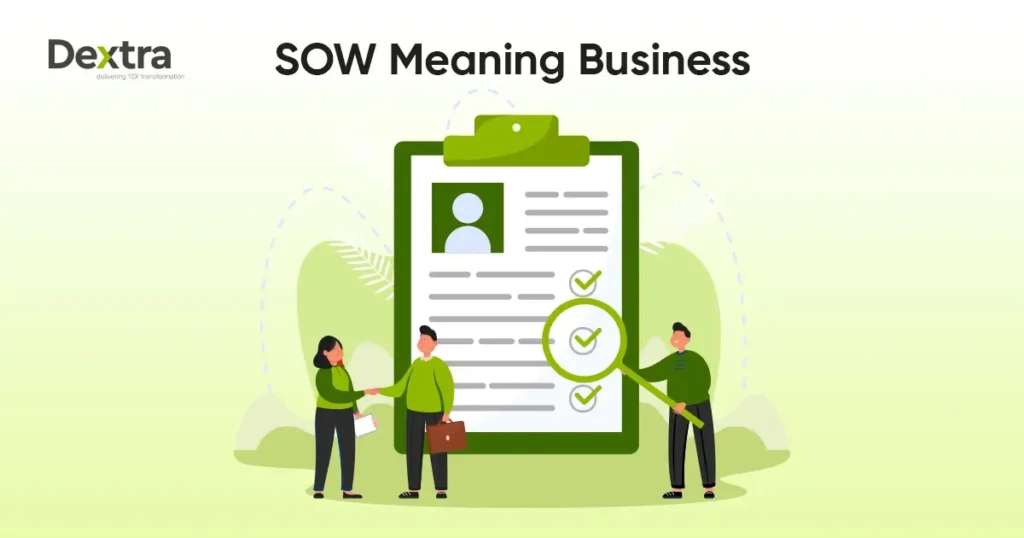
SOW meaning business
It is a legal document signed between two parties with goals and targets. It will highlight the importance of workers, timelines, quality assurance, and performance evaluation.
SOW provides a well-defined and organized road map to achieve specific tasks or projects. Everyone aligned with this agreement plays a vital role according to their skill and expertise. In business, it is an outstanding way to utilize a person or party’s full potential for a higher success rate.
SOW closely collaborates with the tidal quality management system regarding strategy, planning, execution, continuous improvement, and performance evaluation. Thus, there is a chance of achieving goals and targets on time without disruption or failure.
For example, a supplier and a customer wanted to start a project with similar objectives. To gain high-quality sourcing material on time for delivery, strategic work is continuously improving the vent system. The customers and suppliers need to sign a statement of agreement, on which both parties are on the same page. This will benefit both parties in terms of revenue, and everyone aligned with the agreement will feel responsible for delivering his best according to plan. Quality and quantity of production will be customer-focused. It is a beneficial approach for both stakeholders regarding goal sharing, minimizing rejection, and increasing efficiency in the project’s accomplishment.
Why a Statement of Work is Essential for a Business?
A statement of work builds confidence, trust, and faith between its aligned partners.
1- Project efficiency
Higher proficiency in any project depends on skilled professional workers, suitable sourcing materials, and quality-oriented production. To achieve better proficiency, the SOW will be well-defined, optimized, and implemented more effectively.
Another thing that elevates project efficiency is the division of work according to expertise and skills. Work performed by an experienced person stands out highly in the market.
2- Minimized risk
From a business point of view, health and safety risks and concerns are highly expected. So, to ensure the safety of every individual related to that project, SOW implementation is mandatory.
Those companies that ensure the safety of their employees and workers will gain more reputation with the government and legal approval. Sow provides a proper plan for dealing with tax, financial loss, and other ups and downs.
3- Business relation growth
For a business to run smoothly and effectively, it must have relationships with other companies, especially those in its field. SOW paves the way for better relationships between the parties and companies.
SOW: A goal-sharing strategy
It is a goal-sharing strategy in which both parties share their loss and profits equally according to an agreement. Aligned parties will feel secure in terms of finances and prospects.
- TQM Approach
Total Quality Management (TQM) works hand in hand with SOW. TQM helps to strategize well-crafted and planned statements of work targets and goals—with the attention of both parties toward more and more customer satisfaction scores.
TQM ensures that all project operations are executed and implemented according to plans. The SOW in Business also fulfils this requirement. Companies will get qualitative certificates from organizations like the International Standard Organization (ISO).
What are the types of SOWs?
Types of SOWs are categorized according to the purpose of the work or project. Here the some of the most commonly used Types of SOWs:
1- Design of SOWs
The design of SOWs focuses more on the design and development of products or services. It describes all the actions and activities needed to achieve the goal.
All kinds of interruptions, faults, and chances of damage are considered when detailing a document.
For example, a buyer and a supplier in the manufacturing industry. It outlines all the steps that answer what work to perform, how to accomplish it, and how to overcome shortages during the project.
2- Level of efforts
Level of effort SOWs highlight the severity and intensity required to achieve a specific task or project. It is a short-term agreement where there may be massive and less material needed to be provided in a minimum period.
Level of effort of work thoroughly with contractors, consultants, and advisors.
3- Performance-based SOWs
It is a highly competitive agreement where outcomes matter the most. The continuation of the business agreement is directly related to quality, on-time delivery, and a continuous improvement strategy.
For example, freelancers under this agreement are aligned with clients. They provide valuable, fresh, updated, and quality content that adds value to clients’ site users.
Another example is the customer and supplier, who work according to that agreement. Both parties are responsible for the continuation of the deal. So, at any point, either supplier provides damages and low-quality material, ending the contract.
Secondly, the customer also plays their role. If they provide reasonable profit and value to the supplier according to the product, the project agreement will be maintained.
What Does a Statement of Work Include?
A well-written Statement of Work (SOW) should clearly define what the project involves, what each party is responsible for, and how successful completion will be determined. While the exact format can vary, a comprehensive SOW typically includes the following components.
1. Project Background
This section explains why the project is being undertaken. It provides the context behind the engagement, including the business problem, opportunity, or need the project is intended to address.
2. Project Objectives
The objectives define what the project is expected to achieve. Clear objectives help ensure that everyone involved understands the intended outcomes from the beginning.
3. Scope of Work
This is one of the most important sections of an SOW. It explains what work is included in the project.
Where possible, it should also specify what is not included. Clearly defining exclusions can help prevent misunderstandings and scope creep later.
4. Deliverables
Deliverables are the specific outputs the client, stakeholder, or buyer expects to receive.
Depending on the project, these could include reports, software, designs, documentation, completed services, or other agreed-upon outputs.
5. Roles and Responsibilities
This section clarifies who is responsible for what.
It may outline the responsibilities of the client, service provider, contractor, internal team, or other stakeholders involved in the project.
6. Timeline and Milestones
The SOW should establish the expected project schedule, including key dates, milestones, deadlines, and the anticipated start and completion dates.
7. Technical or Business Requirements
This section defines any specific requirements, standards, processes, technologies, or business conditions that apply to the work.
For example, a software project may include technical requirements, while a consulting engagement may define reporting or business requirements.
8. Acceptance Criteria
Acceptance criteria explain how deliverables will be evaluated and approved.
This helps create a clear definition of completion and reduces disagreements about whether the agreed work meets expectations.
9. Pricing and Payment Terms
Where relevant, the SOW should explain how the work will be priced and compensated.
This may include project fees, hourly rates, milestone-based payments, invoicing schedules, or other agreed payment terms.
10. Assumptions and Dependencies
Projects often depend on certain conditions, resources, approvals, information, or third-party actions.
Documenting these assumptions and dependencies helps clarify what must happen for the project to proceed successfully.
11. Change Management
Projects can evolve after work begins. The SOW should therefore explain how changes to the agreed scope will be handled.
This may include a process for requesting, reviewing, approving, pricing, and documenting changes.
The Best Strategy to Implement SOW Processes
Sell defined and detailed planning and documentation, requiring a strong and skilled agent system. Meet the market’s variation and trends through conscious monitoring, control, and improvement in decision-making.
Management implements the SOW in Business is the process of using suitable and exemplary work. What operation should be performed first? An immediate and necessary strategy helps you improve your work performance.
1- Technologically, the Performance Measurement System
VMS and related software and tools collect data and continuously monitor work progress. They are like an alarm system on the site, which helps to identify and overcome challenges and difficulties in the process flow in a timely and effective way.
2- Cumulative Operating Systems
An organization’s human resource and supplier departments are combined with software to help. The integration helps improve visibility for both parties. It is an advanced system that monitors outcomes like a quality assurance system. A regular project output system lets parties make better decisions regarding prospects.
SOW in Business is an advanced organizational approach. Everyone will feel secure about their work and eager to complete their responsibility. Everyone is equally important and responsible. The skills and abilities of individual professions have been utilized to their full potential.
In the setting, a statement of work first identifies the types of SOWs, deliverables of items, and time of project, skill and proficiency required, the severity of the project, and outputs. It highlights the importance of collaborative work. Work performed collaboratively and by skilled professionals leads to higher accuracy and precision.
It increases the chances of project completion on time and with quality, which leads to more work sharing in the future. It also increases aligned parties’ confidence, trustworthiness, and market value.
Benefits of SOW in Business
1- Cost Saving Opportunities
The project team (manufacturers or developers) works under clear project guidelines to meet deadlines in a competitive environment. The business can spend less on unnecessary consultation and coaching to understand the clarity. An SOW in a Business contract and managing the affairs more flexibly offer several cost-saving opportunities.
2- Flexible and Scalable Opportunities
In the SOW in Business contact, flexible and business-scalable opportunities come under this echo system. The use of maximum business resources and allocation to multiple projects makes it flexible, and the potential outputs can manage the scalability to work on numerous projects under competitive and dedicated working.
3- Resource Allocation for Outsourcing Projects
SOW in Business is vital in improving outsourcing management while working on in-house or outsourcing projects. Experts can maintain a critical balance between project deadlines and available resources to meet deadlines and speed up project delivery to enhance their overall business efficiency of business potential. The clear statements in the project headlines and written contracts allow the companies to avail themselves of all the resources related to the project niche.
4- Clear Work Objectives
Do companies align their working potential to the project guidelines? Obviously, an SOW In Business is helpful in completing the project within the given deadlines only if the project is written and provided in understandable language at each level. The information has been passed from top management to the working channel below. A clear understanding makes the crucial project more straightforward to work on in a transparent flow.
5- Promote Collaboration
The collaboration among all departments and business channels measures the success of each project. A statement of work promotes a culture of cooperation between the project team and stakeholders to clarify the project details and provide easy access to relevant information. These collaborative environments in any organization can deliver quality projects that benefit outcomes and ensure core understanding.
6- Legal Protection
SOW in Business contact means clarifying the project objective in transparent language to meet the project deadlines under a binding contract. The parties in a project are bound to deliver quality work under each detail mentioned in the contract to protect it legally. If any conflict or issue arises, both parties can use legal action against each other if they do not abide by the contract details, which boosts confidence in doing business under legal terms.
7- Buyer’s Satisfaction
These bounded statements can enhance the confidence of working among buyers and manufacturers. Every buyer wants quality project completion, and they provide the core understanding and quality assurance materials to prevent the project from failure.
Statement of Work for AI and Software Development Projects
For AI and software development projects, a generic Statement of Work is often not enough. Technical projects involve existing systems, data dependencies, integrations, security requirements, and implementation decisions that need to be clearly defined before development begins.
At Dextra Labs, the project discovery and planning process focuses on translating business requirements into a clearer technical scope. This helps clients understand not only what will be built, but also the systems, data, dependencies, and responsibilities involved in delivering it.
A technology project SOW may need to cover:
- Existing system architecture
- APIs and third-party integrations
- Data availability and access requirements
- AI model and workflow requirements
- Security and privacy considerations
- Performance and scalability expectations
- Testing and acceptance criteria
- Deployment environment
- Human oversight and approval requirements
- Ongoing maintenance and support
Why This Matters for AI Projects
AI projects can be particularly challenging to scope because some requirements become clearer during experimentation and development. Model performance, data quality, retrieval accuracy, integrations, and workflow behavior may all influence the final implementation.
That is why Dextra Labs helps define the boundaries of the project early, including what is fixed, what requires validation during development, and how scope changes will be managed.
The goal is not to create an unnecessarily rigid document that prevents iteration. It is to establish enough clarity to manage expectations while allowing the technical team to validate the solution responsibly.
For Dextra Labs, a well-defined SOW is an important bridge between a business idea and a production-ready technology solution—aligning the project scope, technical requirements, deliverables, responsibilities, and success criteria before significant development work begins.
Summarized Words
In the final analysis, we can ensure that the statement of work can play an exciting role in the business scalability and resource allocation to meet the project deadlines under a detail-oriented contract, in which both parties perform their role respectively to avoid business risk. SOW in Business allows the development and manufacturing teams to ensure quality assurance throughout the project lines to enhance the project scalability to perform confidently in the competitive marketing approach. Additionally, all the project details and all necessary actions are written clearly in the contract for risk mitigation and prove themselves as cost-effective in the business channel. The project is aligned with the stakeholders’ ambition to present a clear roadmap for many business enterprises.
Frequently Asked Questions
Q. What is the meaning of SOW in business?
In business, SOW stands for statement of work, which indicates the core details and information about any project written under a binding contract between two parties to meet the quality of work and strengthen a professional relationship.
Q. How do you develop an SOW contract for any business?
There are some simple formats to write an SOW in a Business contract, compiling all relevant details for the smooth operation of a project, in which some details are necessarily mentioned, such as introduction, list of all project requirements, keyframe, deadline indication, deliverable methods, easy measures to access the project tracking, etc
Q. What is the best length for a Statement of Work?
The length of the statement of work can vary from project to project, but some headings are essential to mention, as we discussed above. The length of the SOW starts from ten to fifteen pages and can be maximized to twenty-five pages or more. Moreover, the SOW in Business length should not be considered; it should be written at any size, covering all the business project details and necessary actions.