Did you know why every CIO is Recalculating AI ROI in 2025? As per Goldman Sachs, In 2025, global enterprise spending on AI infrastructure is projected to exceed $200 billion, yet fewer than 35% of organizations can accurately measure their AI ROI. It’s one of the most significant disconnects in modern technology leadership: massive investment, shallow returns, and increasing pressure from boards and CFOs to prove that AI is more than a science experiment.
The conversation has changed. We’ve moved from proof of concept to proof of profitability.
The hype cycle has quieted; enterprise expectations have not. CIOs and CTOs are discovering that while AI’s capabilities grow exponentially, its cost curve is rising even faster, driven by compute-intensive models, multi-agent architectures, and relentless demand for inference. Meanwhile, CFOs want clearer answers: What is the AI return on investment? What is the payback period? What is the cost per decision?
And that’s where the shift begins. At Dextralabs, we describe the new mandate clearly:
“True AI ROI isn’t just about cutting costs, it’s about optimizing reasoning efficiency, scaling sustainably, and aligning every model decision with measurable business outcomes.” – CEO Dextra Labs
Welcome to the new era of AI ROI economics, where the leaders are the ones who can master infrastructure strategy, custom silicon, and reasoning efficiency, not merely deploy more models.
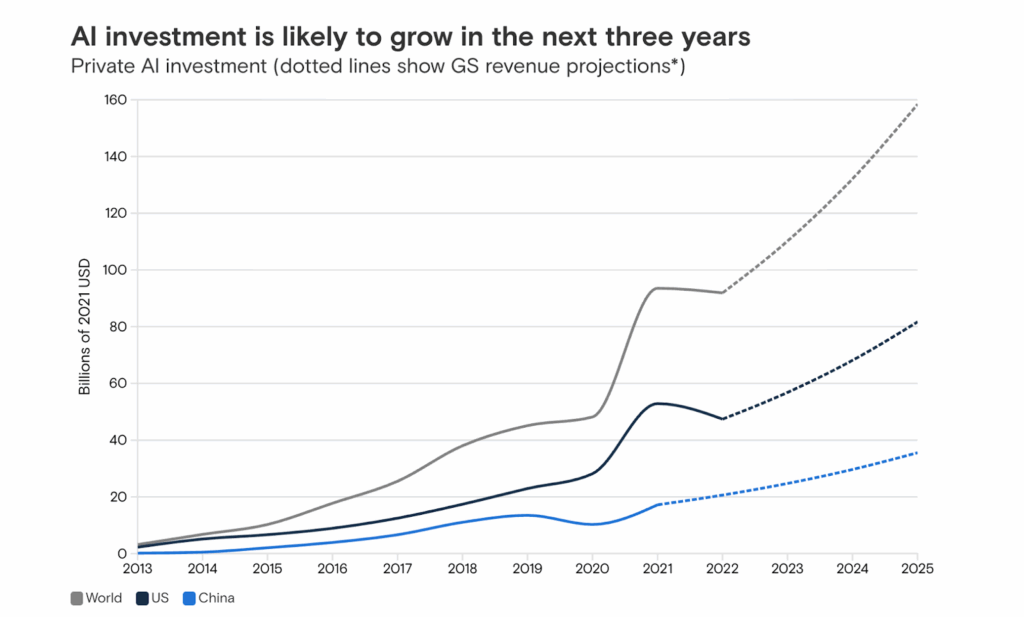
Why AI ROI Is Under Pressure in 2026?
For many enterprises, the conversation around AI ROI is changing.
The early question was often: What can AI do for us?
In 2026, a more important question is emerging: Can we create enough value to justify the cost of running AI at scale?
This is because the economics of AI are different from many traditional software investments. Once an AI system moves into production, costs do not stop after development or deployment. Every interaction can consume models, infrastructure, data systems, tools, and sometimes human attention.
Here are five reasons AI ROI is coming under greater scrutiny.
1. Inference Has Become a Permanent Operating Cost
Training or fine-tuning a model may be a one-time or occasional investment. Inference is different.
Every time an employee, customer, or automated system interacts with a production AI application, the organization may incur additional cost.
A single interaction can trigger:
- Model calls
- Information retrieval
- Reranking
- Tool and API calls
- Agent loops
- Output validation
- Human escalation
Individually, these actions may appear inexpensive. At enterprise scale, however, millions of interactions can turn them into a significant and recurring operating cost.
The challenge is no longer simply the cost of building an AI system. It is understanding the cost of running it every day.
2. More Capable AI Can Mean More Expensive AI
Not every task requires the same level of intelligence.
Some workflows can be handled efficiently by smaller or faster models. Others may require more capable models or reasoning-heavy systems that perform additional computational work before producing an answer or taking action.
This creates an important economic trade-off.
A more capable AI system may produce better results—but better results alone do not automatically justify a higher cost.
The critical question is:
Is the additional reasoning producing enough additional business value to justify its cost?
If a more expensive model improves accuracy by a meaningful amount in a high-value workflow, the investment may make perfect sense. But using maximum capability for every low-risk, repetitive task can quickly damage unit economics.
The goal is not to use the most powerful AI everywhere. It is to use the right level of intelligence for the value of the task.
3. AI Agents Multiply the Cost Surface
AI agents can create significantly more value than a simple chatbot because they can perform multi-step work.
But every additional step can introduce another cost.
A workflow might look like this:
Model → Search → Database → Tool → Model → Validation → Another Model
Each stage may involve a separate model call, infrastructure service, API, or external system.
This is not necessarily a problem. If the agent completes work that previously required significant human effort, the economics can still be highly attractive.
The problem arises when workflows become unnecessarily complex.
An agent that takes ten steps to complete a task that could have been handled in three may consume more resources without producing additional value.
Agentic AI makes workflow design an economic discipline, not just a technical one.
4. Context Is Becoming an Economic Variable
Giving an AI system more context can improve the quality of its output.
More documents, longer prompts, detailed instructions, conversation history, and enterprise knowledge can all help the system make better decisions.
But context is not free.
As enterprises build more sophisticated AI applications, they increasingly need to ask:
Does the system really need all of this context for every task?
In many cases, the answer may be no.
This is creating new opportunities to optimize the way AI systems access and use information through:
- Retrieval optimization
- Context selection
- Summarization
- Memory design
- Caching
The objective is to provide the AI with enough context to perform well without repeatedly processing information that adds little value to the outcome.
5. AI Infrastructure Decisions Are Becoming Strategic
The infrastructure conversation has also become more complex.
Enterprises are no longer simply deciding which cloud provider to use. They may need to evaluate a combination of:
- Proprietary model APIs
- Open-weight models
- Cloud accelerators
- Specialized hardware
- Hybrid deployment
- Private infrastructure
- Reserved capacity
Each option creates different trade-offs around cost, performance, control, security, and scalability.
A proprietary API may offer simplicity and access to advanced capabilities. An open-weight model may provide greater control and flexibility. Private infrastructure may make sense for certain high-volume or sensitive workloads.
There is no single best answer.
The right infrastructure strategy increasingly depends on the economics and operational requirements of the specific AI workload.
What Is AI ROI, and Why Is It Hard to Measure?
Every enterprise leader talks about AI Return On Investment, but very few can define it precisely.
AI ROI or AI Return On Investment is the balance of financial, operational, and strategic outcomes produced by AI relative to the total cost of building, training, deploying, and scaling those systems.
But unlike traditional IT projects, AI’s value is often diffuse, cross-functional, and compounding, which makes it notoriously difficult to measure.
The Four Dimensions of AI ROI:
1. Financial ROI
This is the most familiar dimension: the direct economic impact of AI.
Key measures include:
- Revenue generated
- Costs avoided
- Margin improvement
- Total cost of ownership (TCO) reduction
For example, AI may help a sales team qualify more opportunities, reduce the cost of handling customer requests, or automate work that previously required significant manual effort.
Financial ROI answers a straightforward question:
Is AI creating measurable economic value for the business?
2. Operational ROI
Financial results are often the outcome of operational improvements.
AI can change how quickly, accurately, and efficiently work gets done. That makes operational metrics particularly important for evaluating AI initiatives.
Key measures include:
- Cycle time
- Throughput
- Accuracy
- Error reduction
- Manual work eliminated
For instance, an AI system may reduce document-processing time from hours to minutes or help an engineering team investigate incidents faster.
Operational ROI shows whether AI is actually improving the way work gets done.
3. Strategic ROI
Not every important benefit can be measured immediately in dollars.
AI can also create strategic advantages that affect the organization’s long-term position, including:
- Faster innovation
- Competitive differentiation
- Risk reduction
- New business capabilities
An AI platform may enable a company to launch new products faster, respond more effectively to market changes, or build capabilities that competitors cannot easily replicate.
These benefits may take longer to translate into direct financial returns, but they can still be highly valuable.
Strategic ROI asks: What can the organization do now that it could not do before?
4. Economic Efficiency
This fourth dimension is becoming increasingly important as AI systems scale.
An AI program can clearly create value and still become economically inefficient.
For example, an AI agent may successfully automate a workflow, but its cost per successful completion could rise as the workflow becomes more complex. More model calls, larger context windows, repeated agent loops, tool usage, infrastructure, and human review can all affect the underlying economics.
That is why enterprises increasingly need to track measures such as:
- Cost per successful task
- Cost per decision
- Cost per workflow
- Compute per outcome
- Accuracy per dollar
This moves the conversation beyond “Is AI valuable?” to a more important question:
“Are we creating that value efficiently?”
Why Measuring AI ROI Is So Hard?
Let’s have a look:
A. Intangible benefits are hard to value: What is the dollar value of better decisions? Faster time-to-market? Improved employee productivity?
B. AI rarely works alone: AI’s impact is tied to other systems, processes, and organizational changes. Is that improvement from AI or from cloud migration? Or workflow redesign?
C. Benefits compound over time: AI systems improve with usage, data, and feedback loops, unlike linear IT systems.
Yet most organizations still lack this foundation; Wavestone’s 2025 Global AI Survey found that 46% of enterprises do not have any structured AI ROI measurement framework in place. This makes it even harder for CIOs and CFOs to accurately map AI performance to business impact.
Why AI Operating Costs Become More Visible at Scale?
AI can look relatively inexpensive during the pilot stage.
A team tests a model, connects a few data sources, builds a prototype, and runs a limited number of workflows. At that stage, the model or API bill may seem manageable.
The economics can change once the system moves into production.
As more employees, customers, workflows, and business units begin using AI, costs become more visible, and more complex. The organization is no longer paying simply to access a model. It is paying to operate an entire AI system.
Here are the major cost categories enterprises need to understand.
1. Compute
Some AI workloads require significant computing resources beyond the model itself.
This can include application servers, GPUs or accelerators, workflow processing, data processing, and other infrastructure required to keep AI systems running.
Compute costs can become particularly important for organizations running high-volume workloads, self-hosted models, or complex AI applications.
Enterprises want deeper reasoning, but deeper reasoning increases token usage, compute demands, and latency.
At Dextralabs, we summarize it as: “The next phase of AI ROI depends on optimizing every layer, from silicon to system to prompt.”
To move forward, organizations need a structured approach.
2. Inference
Inference is the cost of generating AI outputs in production.
Every prompt, request, classification, reasoning step, or generated response can consume computational resources. As usage grows, inference becomes a recurring operating expense rather than a one-time development cost.
A system used by 100 people has very different economics from one used by 100,000.
3. Data Movement
AI systems often need to move information between multiple environments.
Data may travel between enterprise applications, cloud services, retrieval systems, APIs, and AI models. At scale, transferring and processing this information can create additional infrastructure and network costs.
The more distributed the architecture, the more important data movement becomes.
4. Storage
Enterprise AI systems generate and consume large amounts of information.
This may include source documents, embeddings, vector data, conversation histories, logs, evaluation results, audit records, and cached responses.
Each individual storage requirement may appear small, but together they can become a meaningful part of the long-term operating cost.
5. Model APIs
For organizations using third-party models, API usage is often one of the most visible AI expenses.
Costs can vary based on the model selected, input and output volume, context size, and the number of requests being processed.
As workloads scale, even small differences in model selection or request design can have a significant effect on total spending.
6. Agent Tool Calls
AI agents can interact with multiple external systems to complete a task.
A single workflow might involve searches, database queries, API calls, CRM updates, ticket creation, or other actions.
Each of these tool calls can add cost and latency. A poorly designed agent may also repeat unnecessary steps, multiplying the cost of completing a single workflow.
This is why agent efficiency becomes increasingly important at scale.
7. Human Review
AI does not eliminate human work in every situation.
Higher-risk or uncertain outputs may need to be reviewed, corrected, approved, or escalated to an employee. This creates an important cost that organizations sometimes overlook when calculating AI ROI.
If an AI system handles 90% of a workflow automatically but the remaining 10% requires expensive manual intervention, the true unit economics need to include that human effort.
8. Observability
Production AI systems need to be monitored.
Organizations may need visibility into model performance, workflow completion, errors, latency, quality, usage, and cost. This requires logging, tracing, analytics, evaluation systems, and monitoring infrastructure.
Observability may not directly generate revenue, but without it, enterprises have limited ability to understand whether their AI systems are performing reliably or becoming inefficient.
9. Security and Governance
As AI becomes connected to enterprise data and systems, security and governance create their own operating requirements.
This can include:
- Identity and access controls
- Data protection
- Policy enforcement
- Audit trails
- Compliance monitoring
- Guardrails
- Security testing
These investments are essential for enterprise deployment, particularly when AI systems handle sensitive information or take actions across business systems.
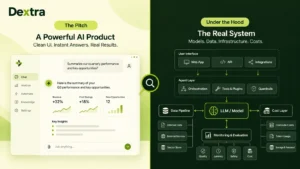
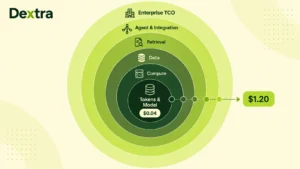
The Real Cost Is the AI Operating System
The important point is that the cost of AI is rarely just the cost of the model.
A production AI system has an entire operating environment around it—compute, inference, data, storage, tools, human oversight, monitoring, security, and governance.
That is why AI costs often become much more visible at scale.
A successful pilot proves that AI can work. Scaling forces the enterprise to answer whether it can continue working efficiently, reliably, and economically.
The organizations that manage AI costs most effectively will not simply look for the cheapest model. They will optimize the entire system around it.
How to Measure AI ROI: The Dextralabs Enterprise Framework
Based on client engagements, industry research, and real-world deployments, Dextra Labs developed the AI ROI Framework, a structured model to align AI investments with measurable results.
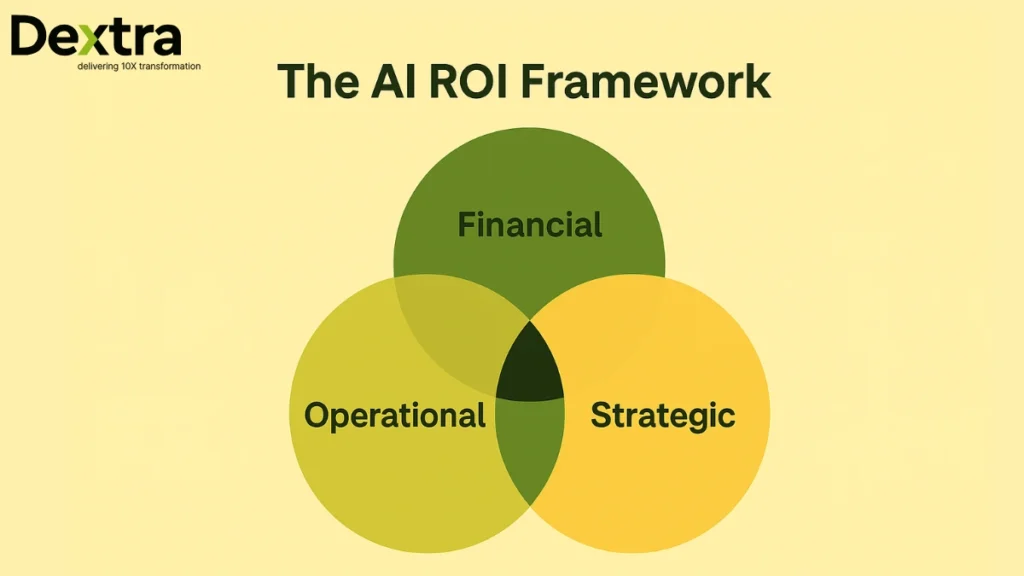
The Framework Has Three Dimensions
Let’s have a look at them:
1. Financial Dimension
Measure direct impact on revenue, cost savings, and TCO reduction.
Before/after comparisons and forecasting models help quantify value over time.
2. Operational Dimension
Measure how AI improves business processes: faster decisions, higher accuracy, fewer manual steps, lower error rates.
3. Strategic Dimension
Measure innovation enablement, improved compliance, enhanced risk posture, and competitive differentiation.
A key principle of the framework is continuity.
AI ROI must be measured continuously , not once.
Enterprises are now deploying AI ROI dashboards, tracking model cost, performance, usage, quality, and reasoning depth in real time. These dashboards integrate with FinOps workflows and provide CFOs a clear view of cost-per-output.
Cloud AI Cost Optimization: Doing More With Less
As enterprises scale LLM workloads, cloud AI cost optimization is becoming a critical priority for managing GPU demand and long-running inference costs.
Most enterprises dramatically overspend on cloud-based AI. The good news: reducing those costs doesn’t require sacrificing performance, it requires embracing smarter architecture.
Here are the four pillars of modern cloud AI cost optimization.
1. Resource Management
Strong resource allocation practices directly support cloud AI cost optimization by reducing idle GPU time and preventing overprovisioning. Cloud waste remains the biggest contributor to overspending.
CIOs are adopting:
- Autoscaling
- Workload-aware scheduling
- GPU right-sizing
- Distributed training schedules
- Dedicated GPU pools for predictable inference loads
Techniques like workload-aware scheduling significantly improve AI cloud efficiency by matching compute supply to workload patterns.
2. Cost Governance
FinOps is no longer optional; it’s essential.
Enterprises now track:
- Cost tagging across models, teams, workloads
- Daily usage patterns
- Token-per-output ratios
- Alerts for unexpected cost spikes
- Weekly audits of GPU utilization
This allows finance teams to anticipate spend instead of chasing it.
3. Model Optimization
This is where the largest savings often hide.
Techniques include:
- Model quantization to reduce precision and compute requirements
- Pruning to eliminate redundant model parameters
- Distillation to produce smaller, more efficient models
- Prompt optimization to reduce unnecessary tokens
- Context compression to shorten input sequences
A single optimization pass can reduce inference costs by 30–50%.
Strategic Procurement
CIOs now evaluate:
- Open-source models vs proprietary APIs
- Fine-tuning vs retrieval-augmented techniques
- Reserved GPU capacity vs on-demand cloud pricing
- Dedicated instances vs shared clusters
- AI-specific cloud providers vs general-purpose cloud
The result is clear:
Smart procurement can reshape the entire ROI curve.
The Rise of Custom Silicon: The New Frontier of AI Efficiency
The fastest-growing trend in AI infrastructure isn’t bigger clusters, it’s custom silicon.
To meet the rising compute demands, enterprises are increasingly adopting custom AI chips designed specifically for transformer and LLM workloads.
General-purpose GPUs are no longer the most efficient option for all workloads. They are powerful, but expensive, energy-intensive, and often inefficient for specific operations.
That has led to the rise of domain-specific AI chips, designed explicitly for AI training and inference.
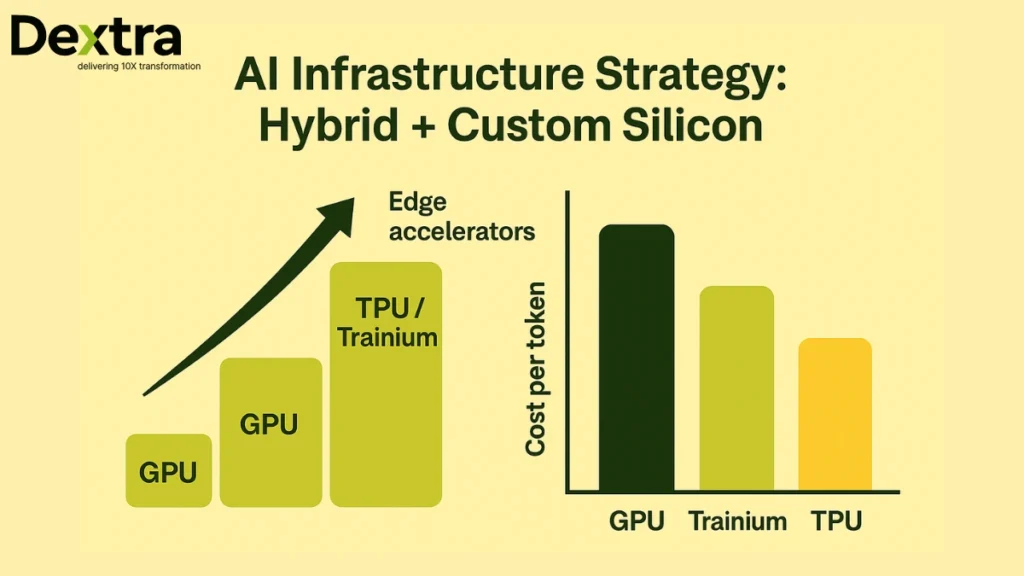
Why Enterprises Are Shifting to Custom Silicon?
- 2–3x faster training throughput
- 30–50% lower power consumption
- Lower cost per token generated
- Optimized for transformer models, attention mechanisms, and LLM workloads
The Major Players
The market for custom AI chips is expanding rapidly as hyperscalers build silicon optimized for training and inference efficiency.
- Google TPU
- AWS Trainium & Inferentia
- Microsoft Maia
- Meta MTIA
Enterprises are also conducting feasibility studies for on-premise accelerators from Habana, Cerebras, Groq, and SambaNova.
And the momentum is growing. Industry analysts estimate that custom silicon could represent over 50% of global AI semiconductor revenue by 2030.
This trend is not a matter of performance; it’s a matter of ROI. Hardware is becoming a competitive advantage.
As Dextralabs states:
“In the age of trillion-parameter models, hardware defines your AI ROI curve.”
Over time, custom AI chips will become a central factor in determining an organization’s AI cost structure and scalability.
Reasoning Efficiency: The Hidden Multiplier of AI ROI
Here’s the concept almost no enterprise is discussing, yet it determines the majority of AI cost outcomes:
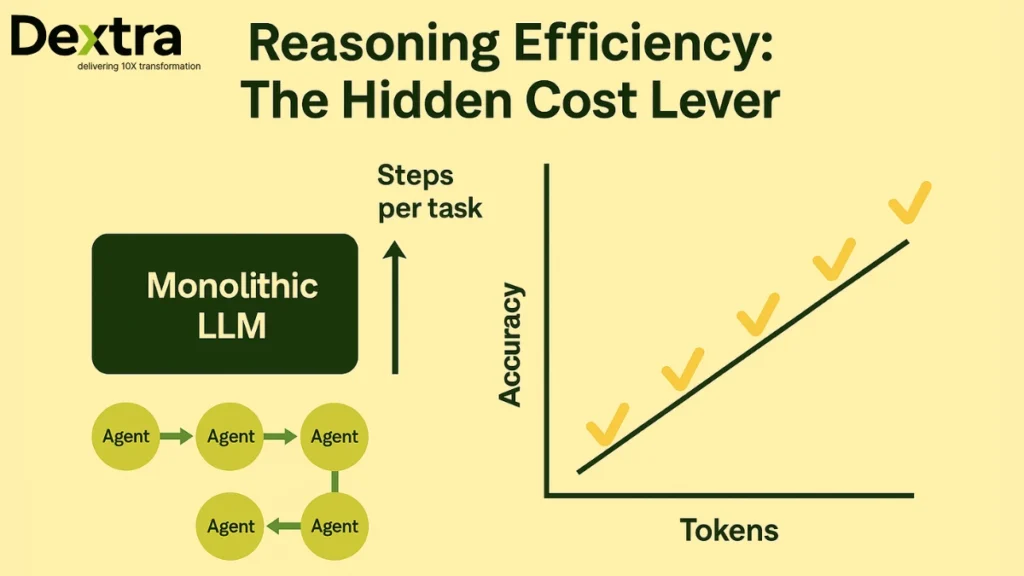
Reasoning Efficiency
It refers to the model’s ability to complete tasks using fewer steps, fewer tokens, and less computational intensity while maintaining or improving accuracy.
In modern LLM systems, especially agentic AI architectures, reasoning is the cost center.
Key Reasoning Metrics:
- Steps per task
- Token usage per decision
- Accuracy per dollar spent
- Latency per reasoning depth
- Quality stability across reasoning modes
The emergence of multi-agent systems is reshaping this dynamic.
Monolithic Models vs Agentic Systems
Have a look at Monolithic Models vs Agentic Systems
Monolithic LLMs
- High token usage
- Expensive inference
- Less modular
- Harder to optimize
Agentic Architectures
- Specialized agents handling specific subtasks
- Reusable context and memory
- Lower token consumption
- Better alignment with business workflows
This is why Dextralabs builds Reasoning-Oriented Agents, designed to:
- Reduce inference overhead
- Minimize unnecessary reasoning steps
- Increase accuracy per token
- Deliver predictable performance at scale
This is the future of enterprise AI economics: Smarter reasoning, not bigger models.
The Business Case for Sustainable AI Economics
CIOs today are not just technologists, they are stewards of enterprise investment. The shift toward sustainable AI economics aligns directly with the core goals of the business.
Here’s how optimized AI infrastructure creates tangible business value:
Faster Payback Periods
Companies shorten the time between investment and return by aligning models with efficient hardware and cloud strategies.
Reduced Carbon Footprint
Custom silicon, optimized models, and hybrid AI clouds consume less energy — enabling sustainability reporting and ESG alignment.
Better Financial Predictability
CFOs gain visibility into monthly inference costs, enabling better planning and budgeting.
Cross-Functional Resilience
CIOs collaborate with procurement, finance, operations, and data science to establish unified governance.
Dextralabs plays a crucial role here by bridging the gap:
“Dextralabs partners with enterprises to align AI investments with measurable financial outcomes, connecting technical efficiency to business profitability.”
Case Insight: How Dextralabs Improves Enterprise AI ROI
Enterprises work with Dextralabs for a simple reason:
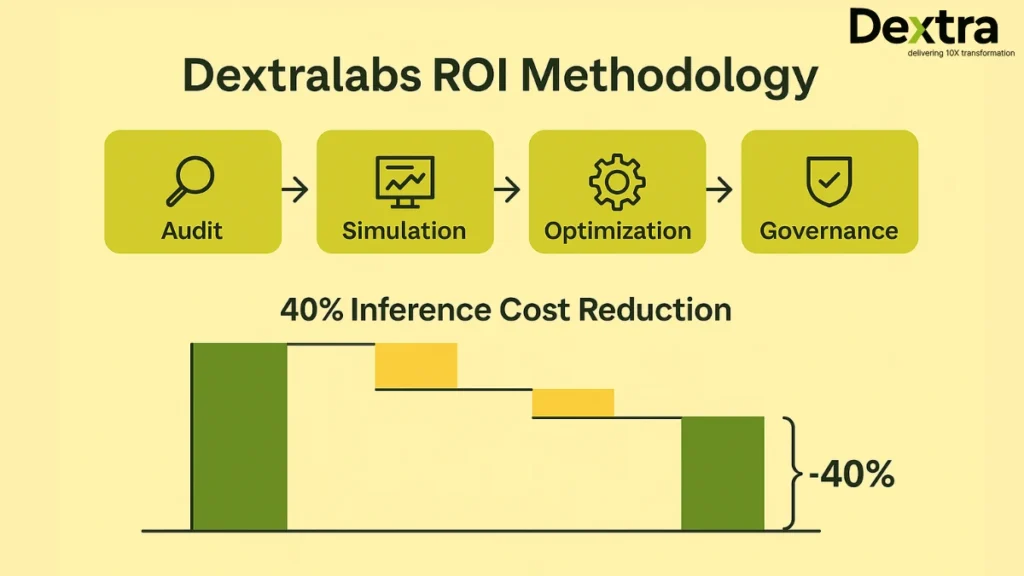
They need real ROI, not slideware. Here’s how the process typically works:
1. AI Cost Audit
Dextralabs analyzes compute, cloud, model architecture, data pipelines, and token usage to identify overspending zones.
2. ROI Simulation Models
Scenario-based simulations forecast return under various improvements, from switching silicon to optimizing prompts.
3. Infrastructure Optimization Roadmap
A step-by-step plan covering:
- Model distillation
- Retrieval optimization
- Silicon migration
- Cloud strategy
- Governance improvements
4. Governance & Observability
Establishing policies, guardrails, dashboards, and cost controls.
Outcome Example
A large enterprise reduced inference spending by 40% after Dextralabs redesigned their LLM architecture and applied quantization + agentic routing.
This is the kind of ROI transformation that is becoming standard, not exceptional.
Conclusion: AI ROI Is No Longer a Finance Metric; It’s a Strategy
Enterprises that master cloud AI cost optimization will achieve faster payback periods and more predictable operating costs. We’ve entered the era where the economics of AI matter as much as the innovation.
CIOs and CTOs are revisiting everything, from how models reason to what silicon they run on.
The winners will be the enterprises that master:
- Reasoning efficiency
- Cloud cost strategy
- Model optimization
- Custom silicon adoption
- Continuous ROI measurement
AI is no longer a “deploy and forget” technology. It’s a living system: economic, strategic, architectural. Every decision influences its ROI, impact, and sustainability.
If your organization is scaling AI but struggling to control costs, justify investment, or deliver measurable outcomes, now is the time to act.
Ready to Maximize Your AI ROI?
Dextralabs helps enterprises turn AI from a cost center into a value engine.
Through architecture intelligence, model optimization, and cloud cost strategy, we help organizations build the most efficient, scalable, and economically sustainable AI systems possible.
FAQs:
What is the best way to measure AI ROI?
Measure the value of successful business outcomes against the full cost of delivering them, including infrastructure, inference, data, integration, human oversight and ongoing operations.
Why is AI inference becoming an important cost?
Unlike one-time experimentation, production AI systems may process large volumes of requests continuously. As usage scales, inference becomes a recurring operational cost.
What is AI unit economics?
AI unit economics measures the cost and value of a specific AI-enabled outcome, such as the cost per resolved support case, correctly processed document or successfully completed workflow.
Does using a larger AI model always improve ROI?
No. A larger model may improve quality for some tasks while increasing cost and latency. The optimal choice depends on the value and complexity of the task.
Can AI agents reduce costs?
They can, but only when the workflow is designed efficiently. Poorly designed agents can increase cost by creating unnecessary model calls, repeated context and excessive reasoning loops.
When should enterprises consider specialized AI hardware?
Specialized infrastructure becomes more relevant when workloads are sufficiently large, predictable and stable for hardware-level optimization to improve the economics.
What is AI FinOps?
AI FinOps applies financial accountability and cost management practices to AI infrastructure and workloads, helping organizations understand, allocate and optimize AI spending.