Engineering teams are adopting AI faster than they are learning how to use it well.
A developer may have access to an AI coding assistant. A QA team may be experimenting with AI-generated tests. DevOps teams may be using AI for incident analysis. But access to AI tools does not automatically create AI capability.
The real challenge is helping engineers learn when to use AI, how to provide the right context, how to validate AI-generated output, and where human judgment must remain in control. A recent BCG report shows that 89% of leaders say their teams need better AI skills, yet only 6% have taken meaningful steps to close that gap.
Traditional training struggles with this problem. By the time a generic course is created, completed, and rolled out across the organization, the tools and workflows may already have changed.
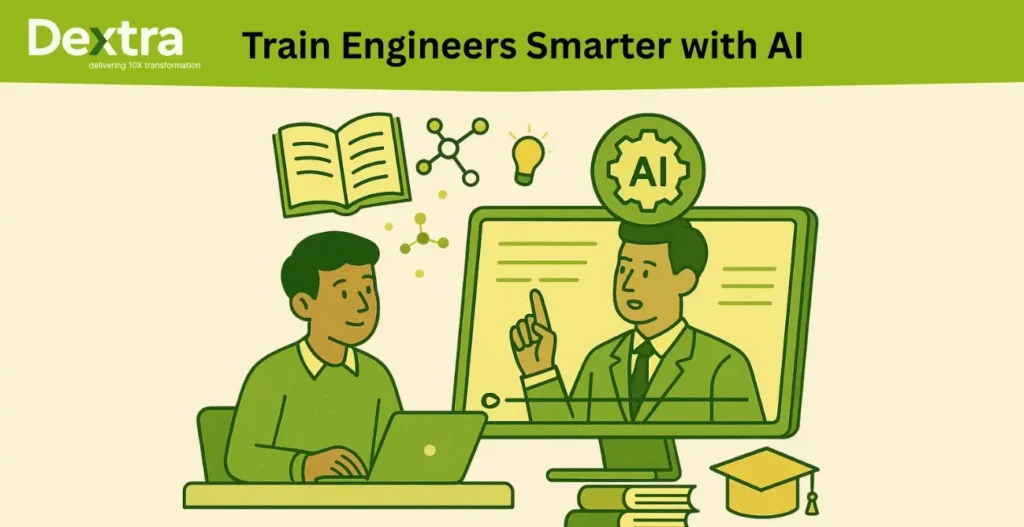
AI-powered learning offers a different model: personalized learning paths, hands-on practice, real-time coaching, role-specific simulations, and learning embedded directly into engineering workflows.
This guide explains how organizations can use AI-powered learning to help engineers develop relevant skills faster, and how to build an AI upskilling program that improves real engineering capability rather than simply increasing course-completion rates.
Why Traditional Engineer Training Falls Short?
Traditional training methods often struggle to keep up with the pace of innovation. These approaches are typically slow, rigid, and one-size-fits-all, which leads to disengagement and ineffective learning. Key shortcomings include:
- Lack of Personalization: Every engineer has different learning needs, but conventional systems fail to adapt.
- Slow Content Updates: In a field like AI, training content must evolve constantly, which legacy systems can’t handle efficiently.
- Disconnection from Real Tasks: Theoretical lessons don’t always translate into real-world skills.
This is where AI-powered learning tools can make a significant difference by tailoring content and providing dynamic feedback.
What is AI-Powered Learning?
AI-powered learning is an advanced approach to education that uses artificial intelligence technologies to personalize, automate, and optimize the learning experience. It encompasses tools and systems powered by machine learning, natural language processing (NLP), and generative AI to deliver smarter, adaptive training solutions.
AI-based learning systems can:
- Assess learner performance in real-time
- Recommend personalized learning paths
- Provide AI-generated content based on learner needs
Examples range from AI LMS solutions such as Docebo and LearnWorlds to AI chatbots for on-demand learning support and GenAI-powered simulation engines that enable hands-on, experiential learning. These AI-based learning solutions make ongoing education more immersive and effective.
The AI Skills Engineering Teams Need in 2026
AI skills are no longer just about knowing how to write a good prompt or use the latest coding assistant. As AI becomes part of everyday software development, engineers need to know where AI adds value, where it can fail, and how to work with it responsibly.
The most AI-ready engineering teams in 2026 will not simply be using more AI tools. They will have developed the following six capabilities.
1. AI Literacy
Engineers need a realistic understanding of what AI can and cannot do.
AI can generate code, explain unfamiliar systems, speed up repetitive tasks, and help solve problems. But it can also hallucinate, misunderstand requirements, and produce code that looks correct while containing serious errors.
The key skill is knowing when to trust AI, when to question it, and when human verification is essential.
2. Context Engineering
AI is only as useful as the context it receives.
Engineers need to learn how to provide AI systems with the right information, including:
- Codebase context
- Requirements and constraints
- Architecture details
- Documentation
- Coding standards
- Examples of similar implementations
Instead of simply asking AI to “build a feature,” engineers need to give it enough context to build the feature in a way that actually fits the existing system.
3. AI-Assisted Development
AI can support engineers throughout the development process—not just by generating new code.
Teams can use it for:
- Code generation
- Refactoring
- Debugging
- Documentation
- Test generation
The real skill is knowing which tasks to delegate to AI and which decisions still require human engineering judgment.
4. Agentic Workflow Skills
Coding agents are moving beyond simple conversations. They can now handle multi-step tasks, explore codebases, modify files, run tests, and iterate on solutions.
Engineers need to understand how to work with these agents safely by setting clear tasks, boundaries, permissions, and review processes.
The goal is not to give an agent unlimited freedom. It is to create a workflow where AI can move quickly while humans remain in control.
5. AI Validation
Generating code faster does not guarantee better software.
Engineers must still validate AI-generated work for:
- Correctness
- Security
- Performance
- Architecture
- Test coverage
AI can help produce the first version of a solution, but engineers remain responsible for ensuring that the final result is reliable and production-ready.
6. AI Governance and Security
AI tools can interact with sensitive code, data, systems, and infrastructure. Engineers therefore need to understand:
- What information can safely be shared with AI
- Which models and tools are approved
- What permissions AI agents have
- When human approval is required
- How enterprise AI policies apply to development
AI governance should become part of everyday engineering practice—not an afterthought.
The Real AI Skill Is Better Engineering Judgment
Ultimately, the AI skills gap is not just about learning new tools. It is about learning how to collaborate with AI effectively.
The engineers who succeed in 2026 will know how to give AI the right context, use it to accelerate their work, validate its output, and maintain control over critical decisions.
AI can make engineers faster. But strong engineering judgment is what makes AI-assisted development reliable.
How AI Transforms Developer and Engineer Upskilling?
AI transforms how engineers and developers learn by delivering content that is tailored to individual skills, goals, and job roles. Here’s how it makes upskilling smarter:
- Personalized Learning Journeys: AI evaluates each learner’s current abilities and goals to generate customized pathways.
- Adaptive Content Delivery: Lessons adjust dynamically based on real-time feedback and performance.
- AI-Generated Microlearning: Engineers can consume bite-sized, relevant content created by GenAI.
- Real-Time Feedback and Assessment: Learners receive instant performance insights and recommendations.
- Skill Gap Automation: AI identifies and addresses weaknesses automatically.
This AI upskilling framework ensures that learning is relevant, agile, and effective, enabling developer upskilling with AI at scale.
A Five-Step AI Upskilling Framework for Engineering Teams
Knowing which AI skills engineers need is only one part of the challenge. The bigger question for engineering leaders is: how do you actually build those capabilities across a team?
Sending everyone to the same AI training session is rarely enough. Different roles use AI differently, teams have different workflow challenges, and real capability develops when learning is connected to day-to-day work.
A more effective approach is to follow a structured five-step framework.
1. Assess Current Capability
Before designing an AI upskilling program, understand where the team is today.
Look at:
- Current AI usage across teams
- Role-specific skill gaps
- Workflow bottlenecks
- Barriers to adoption
- Security and governance awareness
This helps avoid generic training. For example, one team may already use coding assistants but struggle to validate AI-generated code, while another may not be using AI at all because engineers are unsure about security policies.
2. Define Role-Based Skills
Not every engineering role needs the same AI capabilities.
Software engineers may need to learn AI-assisted development, coding agents, and code validation.
QA engineers may focus more on AI-assisted testing, test generation, and test automation.
DevOps and SRE teams may benefit from AI for incident investigation, observability, troubleshooting, and operational workflows.
Engineering managers need a different perspective—AI workflow design, governance, adoption, and measuring business outcomes.
The goal should be to build skills around how people actually work, rather than forcing everyone through the same training path.
3. Learn Through Real Work
AI skills are difficult to develop through theory alone.
The most effective learning happens when engineers use AI on problems that resemble their actual work, such as:
- Internal codebases
- Real debugging scenarios
- Actual architecture decisions
- Production-like simulations
This gives engineers practical experience with both the strengths and limitations of AI. They learn not just how to use a tool, but when it works well, when it fails, and how to review its output.
4. Embed AI Coaching Into Everyday Workflows
Training should not end when a workshop ends.
Engineers often face their biggest questions when they are actively working: How should I give this agent context? Can I trust this output? Is this data safe to share? How do I validate this solution?
That is why AI coaching should be embedded into everyday workflows wherever possible.
Providing guidance during real development work helps teams turn AI knowledge into consistent habits instead of letting training become something people quickly forget.
5. Measure Capability and Outcomes
Finally, measure whether upskilling is actually improving engineering performance.
Look beyond course completion rates and attendance. Track whether learning is changing real outcomes, including:
- AI adoption
- Development cycle time
- Rework
- Defect rates
- Code review burden
- Engineering confidence
The objective is not simply to prove that engineers completed AI training. It is to understand whether they are becoming more capable, more confident, and more effective in using AI.
From AI Training to AI Capability
The strongest AI upskilling programs do not treat learning as a one-time event. They start with the team’s current reality, build skills around specific roles, use real work as the learning environment, provide continuous support, and measure whether the new capabilities are actually improving outcomes.
That is the difference between teaching engineers how to use an AI tool and building an engineering organization that can genuinely work with AI at scale.
Industries and Roles Benefiting Most from AI Training
AI upskilling is transforming several engineering and tech-focused roles across multiple industries. The most impacted areas include:
- Software Engineers: Use GenAI tools to write and debug code faster.
- Web Developers: Automate testing and design optimizations using AI.
- DevOps & Cloud Specialists: Streamline CI/CD pipelines with AI-driven insights.
- AI/ML Engineers: Stay updated on the latest models and research.
- Cybersecurity Teams: Build and deploy AI-based threat detection systems.
Industries such as fintech, healthcare, SaaS, and cybersecurity are seeing significant gains through AI-powered upskilling. Benefits include faster onboarding, empowering senior engineers with GenAI tools, and transforming QA via automated testing.
Examples of AI-Powered Learning in Action
AI-powered learning isn’t just a trend—it’s actively transforming how engineering teams grow, adapt, and deliver. Companies across different industries are already seeing measurable results by integrating AI-based learning systems into their training strategies. Here are some real-world examples that showcase the potential:
Company A: Reduced Onboarding Time by 40% Using AI Tutors
A mid-sized SaaS company in the USA integrated an AI-powered LMS with intelligent tutoring features. By using natural language chatbots and scenario-based microlearning, new engineers were able to complete onboarding in just three weeks instead of five. The system adapted to each learner’s pace, prioritized critical skills first, and used real-time feedback to boost retention.
Company B: Used AI to Build 3-Year Learning Paths for Engineers
A fast-growing tech startup in Singapore partnered with Dextralabs to design a long-term AI upskilling strategy. Leveraging skill-gap analysis and AI-curated content libraries, they created personalized 3-year learning journeys for every engineer based on their role and career goals. The result? A 28% increase in internal promotion rates within the engineering team, and more efficient project staffing.
Company C: Increased Product Deployment Speed Through GenAI Training
An enterprise in the UAE focused on cloud infrastructure and DevOps used AI-driven simulation tools and GenAI content to train their senior developers on faster deployment pipelines. With Dextralabs guiding the AI integration, the company reported a 35% improvement in time-to-deploy and better code quality, thanks to intelligent coding assistants and real-time training feedback.
Dextralabs Internal Case Study: Transforming QA Teams with AI Test Automation Learning
Dextralabs helped a cybersecurity firm train their QA team in AI-powered testing tools, including autonomous test script generation and AI bug prediction. The training, driven by simulation engines and AI mentors, resulted in a 50% reduction in manual testing hours—freeing the team to focus on higher-value tasks like test strategy and security reviews.
Choosing the Right AI-Powered Learning Solution
Selecting the best AI-based learning system for your team requires evaluating several factors:
- Integration Capabilities: Can the platform connect with your existing developer tools and workflows?
- Scalable Personalization: Does it adapt learning paths for each user at scale?
- Support for GenAI Use Cases: Can the tool train engineers in GenAI-based tools and methodologies?
Popular platforms include Docebo, LearnWorlds, and Spinach.ai. Look for an AI LMS that aligns with your team’s needs and technological ecosystem.
How Dextralabs Helps You Leverage AI for Business Growth?
At Dextralabs, we specialize in helping startups, SMEs, and mid-sized tech companies in the USA, UAE, and Singapore harness the full potential of AI in engineer training. Our services include:
- Custom AI Upskilling Solutions: Equip your team with modern AI tools and technologies.
- Boosted Productivity: Integrate automation to streamline development cycles.
- Accelerated Product Development: Embed smart systems into engineering workflows.
Whether you’re starting your AI journey or scaling an existing initiative, Dextralabs helps you build smarter, faster, and with confidence.
Make AI work for you with Dextralabs. Visit Dextralabs today.
Challenges and How to Overcome Them
While the benefits are clear, AI-powered learning also comes with challenges:
- Data Privacy Concerns: Ensure your AI LMS complies with GDPR, SOC-2, and internal data policies.
- Resistance to Automation: Provide awareness training to show how AI supports engineers, not replaces them.
- GenAI Misunderstandings: Run orientation programs to demystify GenAI capabilities and limitations.
- Change Management: Establish an internal champion team to lead AI adoption and training initiatives.
Future of AI in Engineer Training
The future of AI upskilling is highly promising and will likely include:
- Predictive Career Pathing: AI forecasts future roles and skill requirements.
- Autonomous Learning Agents: Self-driven AI bots that guide learners in real-time.
- Verified AI Certifications: Industry-standard AI-powered assessments and credentials.
- Hyper-Personalized Mentorship: AI-curated peer and mentor matching for deeper engagement.
These advancements will further streamline and personalize engineer learning journeys.
Ready to Build an AI-Ready Workforce?
Partner with Dextralabs to train your engineers using AI-powered learning that’s fast, personalized, and scalable.
Book Your Free AI ConsultationFAQs on AI training for engineers:
How can companies upskill engineers for AI?
Companies can start by assessing current skills, defining role-specific AI capabilities, providing hands-on training with real engineering tasks, and measuring whether AI adoption improves delivery quality and productivity.
What AI skills should software engineers learn?
Software engineers should understand AI limitations, context engineering, AI-assisted coding, coding agents, output validation, testing, security, and responsible AI usage.
Is AI-powered learning better than traditional training?
AI-powered learning can provide more personalization, adaptive practice, and real-time support. Its effectiveness depends on the quality of the learning design and how closely training connects to real work.
Can AI replace engineering mentors?
No. AI can provide scalable support and feedback, but experienced engineers and technical leaders remain important for architecture, judgment, domain knowledge, and professional development.
How should organizations measure AI training success?
Organizations should measure practical capability, workflow adoption, engineering outcomes, and business impact, not just course completion or tool usage.