“Which GPT model should I use?”
A couple of years ago, that was almost a trick question, because there wasn’t much to decide. You were choosing between GPT-3.5 and GPT-4, and the honest answer was usually “GPT-4 if you can afford it, GPT-3.5 if you can’t.”
That era is over. Open the model picker today and you’re looking at general-purpose models, reasoning models, lightweight variants, coding-focused systems, multimodal models, and a growing set of models designed to actually complete work using tools rather than just describe how to do it. And sitting at the top of the pile is GPT-6 Astra, which OpenAI introduced in September 2026 as its most capable model for difficult, end-to-end tasks.
So “which model is newest?” has quietly stopped being the useful question. The better one is: which model, and which architecture around it, fits the work you actually need done? A simple support chatbot and an autonomous coding agent don’t need the same model. A system fielding thousands of requests an hour has cost and latency constraints that a once-a-day research job simply doesn’t.
This guide walks through the major GPT generations and families – what each one was for, what changed between them, and how to think about choosing in 2026, when the choice is less about the model and more about what you build around it.
The Evolution of GPT Models
It helps to see the whole arc before zooming in. The family has moved through several major stages:
| GPT-3.5 → GPT-4 → GPT-4 Turbo / GPT-4o → GPT-4. → Reasoning models (o-series) → GPT-5 → GPT-5.5 → GPT-5.6 → GPT-6 → GPT-6 Astra |
The thing to notice is that this isn’t just “each model is bigger than the last.” Every stage pushed on a specific capability: reasoning, coding, multimodal understanding, longer context, tool use, better instruction-following, agentic workflows, computer interaction, and — most recently — the ability to finish a whole task rather than produce one good response. Early on, progress mostly meant better answers. Lately, it means the model can be handed an objective and left to work.
GPT-6 Models
GPT-6 is the current generation, and it’s the clearest sign yet that OpenAI has stopped treating “the latest model” as a single thing. Instead of one flagship, GPT-6 arrives as a tier built around different points on the capability-versus-cost curve: Astra for the most demanding reasoning and coding, Sol when you want strong intelligence without paying flagship rates, and Luna for high-volume, cost-sensitive work.
GPT-6 Astra
Astra is the flagship, OpenAI’s model for what it calls the “hardest end-to-end work.” That phrase is worth sitting with, because it signals a change in what the model is for. Earlier generations kept getting better at producing a single high-quality response. Astra is built around a broader idea: give it a difficult objective, the right context and the right tools, and let it work through the problem to a finished result.
Key capabilities:
- advanced reasoning
- software engineering
- computer use (operating browsers, forms, apps)
- web and browser workflows
- research and document creation
- tool use and long-context processing
- complex, multi-step and agentic workflows
The technical details that matter
- 1.05 million-token context window
- 128,000 maximum output tokens
- image input, function calling, structured outputs
- built-in web search, file search and computer use
- adjustable reasoning effort, from low through max, trade depth against speed and cost
- knowledge cutoff of April 30, 2026
That last capability, dialable reasoning effort, is more useful than it sounds. It means the same model can run cheap and fast on an easy request, then think hard on a difficult one, instead of you maintaining two separate models for the two cases.
What makes GPT-6 Astra different?
It is less about any single benchmark and more about where it sits. It’s designed to be the reasoning engine inside an agent or an enterprise AI system, where the model is only one part of a larger architecture. That makes it the right tool for complex AI agents, advanced software engineering, enterprise research, computer-use workflows, long-running tasks, heavy document analysis, and scientific or technical work, and the wrong tool, as we’ll get to, for a lot of simpler jobs.
Pricing:
As of September 2026, Astra’s standard API rate is $10 per million input tokens and $50 per million output tokens, with cached input far cheaper at around $1. One detail that quietly reshapes how you design with it: once a single request crosses roughly 272,000 input tokens, it moves into a long-context tier where the rates step up (input to around $20, output to around $75). An agent that naively piles its entire history into every call can cross that line without anyone noticing the bill climb, which is why lean context engineering is an economic decision, not just a technical one. And token price is only part of the story: the real cost of an agent also includes tool calls, retrieval, computer-use operations, retries, orchestration, monitoring and human review.
GPT-6 Sol
Sol is the model most production teams will actually reach for. It’s positioned as a lower-cost alternative to Astra for complex coding and agentic work – strong reasoning without the flagship price tag. At roughly $2 per million input tokens and $10 per million output tokens, it lands at about a fifth of Astra’s cost while keeping most of what you need for real workloads.
Best for: coding, agentic workflows, professional applications, business automation, reasoning-heavy tasks, and any production system where cost is a live constraint. If Astra is the specialist you bring in for the hardest problems, Sol is the capable generalist doing the day-to-day work.
GPT-6 Luna
Luna is built for volume. When latency and unit economics matter more than maximum intelligence, Luna is the answer, priced around $0.10 per million input tokens and $0.50 per million output tokens, roughly a hundredth of Astra’s rate.
Best for: high-volume applications, customer support, classification, summarization, content workflows, lightweight assistants and rapid iteration. It’s the model you run when you’re doing something simple a million times, not something hard once.
GPT-6 model selection at a glance
| Model | Primary strength | Best suited for |
|---|---|---|
| GPT-6 Astra | Maximum capability | Complex reasoning, agents, coding, research, computer use |
| GPT-6 Sol | Intelligence-to-cost balance | Coding, professional workflows, agentic applications |
| GPT-6 Luna | Speed and efficiency | High-volume, cost-sensitive applications |
The pattern here is the real takeaway: OpenAI isn’t asking you to always use the newest, most powerful model. It’s giving you a spectrum and expecting you to match the model to the job. A well-designed system often uses more than one, Luna to draft or triage, Sol to do the work, Astra to handle the genuinely hard cases.
GPT-5.6
Introduced in July 2026, GPT-5.6 was the generation that made the capability-versus-cost spectrum explicit, shipping as a family from the start rather than a single model. It focused on intelligence, efficiency, coding, knowledge work, cybersecurity and science, and came in three variants.
GPT-5.6 Sol
Sol is the flagship GPT-5.6 model, designed for complex reasoning and demanding professional workloads.
It is particularly relevant to:
- Advanced coding
- Research
- Science
- Cybersecurity
- Complex reasoning
- Computer use
- Professional work
GPT-5.6 Terra
Terra provides a balance between capability and cost.
It is suited to:
- Business applications
- Coding
- Writing
- Research
- General professional workloads
GPT-5.6 Luna
Luna focuses on speed and cost efficiency.
It is better suited to:
- High-volume applications
- Content generation
- Summarization
- Customer support
- Lightweight AI assistants
The GPT-5.6 family therefore introduced a more explicit capability-versus-cost spectrum rather than treating one model as the answer to every workload.
The interesting thing about GPT-5.6 in hindsight is that it’s still genuinely competitive. Newer isn’t automatically better, on some coding benchmarks, GPT-5.6 Sol actually holds its own against its GPT-6 successor. For plenty of workloads, a GPT-5.6 model remains the right, cost-effective call.
GPT-5.5
GPT-5.5 introduced another major step toward models optimized for professional and agentic work.
OpenAI describes GPT-5.5 as a flagship model for complex professional workflows, including coding, tool-heavy agents, long-context retrieval, and customer-facing applications. It supports a context window of up to 1.05 million tokens and up to 128K output tokens in the API.
GPT-5.5 is particularly notable for stronger:
- Reasoning efficiency
- Tool use
- Instruction following
- Long-running workflows
- Coding
- Computer use
- Agent orchestration
For developers, the important change was not simply that the model could generate better text. It became increasingly useful for workflows involving planning, tool selection, execution, verification, and multi-step completion.
GPT-5
GPT-5 was one of the bigger transitions in the family. Compared with the GPT-4 generation, it brought stronger reasoning, coding, multimodal understanding, instruction-following and long-context handling. It handled coding, research, writing, data analysis, document processing, image understanding, complex problem-solving and general assistant work.
Its lasting contribution was blurring a line. GPT-5 helped move things toward models that could handle both an everyday request and a demanding reasoning task without you having to switch tools, the beginning of the end for the hard split between “chat model” and “reasoning model.”
GPT-4.1
GPT-4.1 arrived as a highly capable non-reasoning model with a strong lean toward coding, instruction-following and long-context work. Its large context window made it a natural fit for large codebases, long documents, technical documentation, structured extraction, software development and enterprise knowledge applications.
Its large context window made it particularly useful for:
- Large codebases
- Long documents
- Technical documentation
- Structured extraction
- Software development
- Enterprise knowledge applications
For workloads that did not require extended reasoning, GPT-4.1 could provide a useful combination of capability, latency, and cost.
GPT-4o
The “o” is for omni, and it captures the point. GPT-4o was OpenAI’s shift to native multimodal interaction, one model working across text, images, audio and voice rather than bolting those on separately.
Its strengths were text and image understanding, voice interaction, real-time conversation, coding, document analysis and general assistance. It mattered most for applications that needed to feel natural across more than one modality, voice assistants, tools that see and discuss an image, anything conversational that isn’t purely text.
GPT-4 Turbo
GPT-4 Turbo took the original GPT-4 and made it more practical: more efficient, cheaper to run, and equipped with a 128K-token context window. That larger window opened up large documents, long conversations, big codebases and enterprise knowledge systems.
For developers, Turbo’s real contribution was economic. It helped make a genuinely capable model affordable enough to put into production at scale, a step that mattered as much for adoption as any capability jump.
GPT-4.5
GPT-4.5 was designed primarily around natural interaction, creativity, and pattern recognition rather than the deeper reasoning approach used by later reasoning models.
It was particularly useful for:
- Creative writing
- Brainstorming
- Storytelling
- Natural conversations
- Subtle instruction following
However, GPT-4.5 should now be treated primarily as a historical model in a 2026 comparison. OpenAI retired GPT-4.5 from ChatGPT on June 27, 2026, although API availability is a separate matter.
GPT-4
Released in March 2023, GPT-4 was a substantial jump over GPT-3.5 across reasoning, writing, coding, mathematics, analysis and instruction-following. It’s the model that established most of the capabilities every later generation went on to expand. If GPT-3.5 proved the idea, GPT-4 proved it could be serious.
GPT-3.5 Turbo
GPT-3.5 Turbo is the model that put generative AI in front of everyone. Fast, cheap and general-purpose, it powered the first wave of chatbots, content tools and basic coding help. Today it’s best understood as the legacy generation that built the on-ramp, the model that made the whole modern conversational-AI ecosystem mainstream, even if the frontier has long since moved past it.
are a bit too much.
What About the o-Series Reasoning Models?
Not every important OpenAI model carries a GPT number. The reasoning line, o1, o3, o3-pro, o4-mini, was built around deeper, more deliberate reasoning for hard mathematical, scientific, coding and analytical problems. These models made the case that thinking longer before answering produces materially better results on difficult tasks.
That idea didn’t stay in its own lane. By 2026, the hard boundary between “general GPT model” and “reasoning model” has largely dissolved. Newer frontier systems fold reasoning, tool use, coding, computer interaction, research, multimodal understanding and agentic execution into one model. GPT-6 Astra is the clearest example: it exposes configurable reasoning effort and supports tools like web search, file search and computer use in the same system. The o-series proved the point; the GPT line absorbed it.
GPT Models vs Specialized AI Systems
It’s also worth being clear about what isn’t a GPT language model, because the ecosystem includes several systems that are easy to lump in but shouldn’t be.
DALL·E and image models are for creating and editing visual content, marketing imagery, illustrations, concept art, product shots, creative assets. Useful, but not a “GPT version.” Don’t put them on the same ladder.
Codex is focused on software engineering. Modern coding systems go well beyond spitting out snippets, they work with repositories, inspect code, run tests, use tools and complete multi-step engineering tasks. That makes Codex and the GPT models complementary rather than interchangeable: one is a specialized engineering system, the others are general models you can point at engineering work.
Full GPT Model Comparison
| Model / Family | Primary strength | Typical use cases |
|---|---|---|
| GPT-6 Astra | Hardest end-to-end work | Agents, coding, research, computer use |
| GPT-6 Sol | Capability + cost balance | Coding, professional workflows |
| GPT-6 Luna | High-volume efficiency | Support, summarization, lightweight apps |
| GPT-5.6 Sol | Advanced professional work | Coding, research, science |
| GPT-5.6 Terra | Balanced performance | Business and development |
| GPT-5.6 Luna | Speed and efficiency | High-volume workloads |
| GPT-5.5 | Professional / agentic workflows | Coding, tools, long-context work |
| GPT-5 | General advanced intelligence | Reasoning, coding, assistants |
| GPT-4.1 | Non-reasoning + long context | Coding, documents, enterprise apps |
| GPT-4o | Multimodal interaction | Voice, images, chat, general AI |
| GPT-4 Turbo | Efficient GPT-4 | Long documents, APIs |
| GPT-4.5 | Creativity, natural interaction | Writing, brainstorming (retired from ChatGPT) |
| GPT-4 | General advanced intelligence | Analysis, coding, writing |
| GPT-3.5 Turbo | Low-cost legacy generation | Basic chat and text workloads |
| o-series | Deep reasoning | Mathematics, science, complex analysis |
| Codex | Software engineering | Coding agents and development workflows |
How to Choose the Right GPT Model
The newest model is not automatically the right one. Here’s a practical way to decide, in the order the questions actually matter.
1. Start with the objective: What are you actually trying to do, answer customer questions, analyze documents, generate content, write code, research a market, automate a workflow, operate software, build an autonomous agent? The outcome should pick the model, not the other way around.
2. Weigh the reasoning you genuinely need: Simple classification and summarization don’t need the same firepower as scientific research, financial analysis, complex software engineering, multi-step planning or autonomous workflows. Pay for stronger reasoning only where the extra intelligence produces measurable value, not as a default.
3. Think about context, not just context window: A million-token window is powerful, but a big window is not a reason to stuff everything into the prompt. For enterprise work, retrieval, context selection, context compression, memory, knowledge bases, RAG and tool-based lookups usually beat brute force. Good context engineering still matters, arguably more, now that the windows are huge.
4. Respect latency: For customer-facing or high-volume systems, speed can matter as much as raw intelligence. When requests are simple, volume is high, latency is critical or tasks are repetitive, a smaller, faster model is often the better product decision.
5. Calculate the real cost: Token price is one line item. The true figure is model tokens plus tool calls plus retrieval plus infrastructure plus retries plus monitoring plus human review. For an agent, a model that costs more per token can still win on economics if it finishes the task with fewer failures and less human cleanup.
6. Test before you commit: Don’t pick from a benchmark table. Build a representative evaluation set from your own work and compare the candidates on accuracy, task completion, reasoning quality, tool-use accuracy, latency, cost, failure rate, safety and how often a human has to step in. The model that wins on paper and the model that wins on your workload are not always the same one.
GPT-6 Astra Changes the Model-Selection Question
Astra doesn’t just add another row to the comparison table, it shifts what the question even is.
For years, choosing a model meant asking: which model generates the best answer? For agentic applications, the question becomes: which model can reliably complete the task, using the available context, tools and systems? That’s a much broader engineering problem, because the model is now one component inside a system that has to actually work end to end.
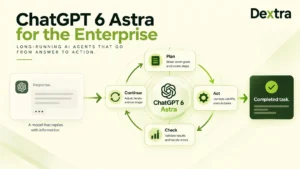
A real enterprise AI system tends to look like this:
| Business Objective ↓ GPT-6 Astra ↓ Planning / Reasoning ↓ Enterprise Context ↓ RAG / Knowledge Base ↓ Tools / APIs / Computer Use ↓ Verification ↓ Security & Guardrails ↓ Human Approval ↓ Enterprise Action |
The model sits near the top, but almost everything that determines whether the system is reliable lives in the layers below it, the context, the tools, the verification, the guardrails, the human checkpoints. This is the difference between a model that can answer a question and an agent that can be trusted to act on your business systems. The model is necessary. It’s nowhere near sufficient.
Final Thoughts
The GPT ecosystem has changed almost beyond recognition. GPT-3.5 made conversational AI mainstream. GPT-4 expanded reasoning and general capability. GPT-4o unified interaction across text, image, voice and audio. GPT-4.1 pushed coding and long-context work. The o-series proved the value of deliberate reasoning. GPT-5, 5.5 and 5.6 marched steadily toward professional and agentic workloads. And GPT-6 Astra pushes the trajectory further still.
But the important shift isn’t that one model produces better answers than the last. It’s that frontier models can now work through complex objectives using context, tools, computer interfaces and multi-step reasoning, they can finish work, not just describe it.
For businesses, that changes the equation. The question is no longer “which GPT model should we use?” It’s “what should we build around the model to reliably solve the business problem?” And the winning answer usually combines the model with RAG, enterprise data, APIs, tools, agent orchestration, security controls, evaluation, observability and human oversight.
The best AI implementation, in other words, is rarely the one running the newest model. It’s the one that matches the model, architecture, data, tools, cost and objective to the actual task. If your organization is exploring custom GPT applications, enterprise RAG or production AI agents, the next step isn’t choosing a model, it’s designing the whole architecture around it.
FAQs on GPT Models:
Q. How many versions of ChatGPT are there?
ChatGPT has moved through many generations – GPT-3.5, GPT-4, GPT-4 Turbo, GPT-4o, GPT-4.1, GPT-4.5, GPT-5, GPT-5.5, GPT-5.6 and GPT-6 – alongside separate reasoning models (the o-series) and specialized systems. The exact set available inside ChatGPT changes over time as OpenAI adds, updates and retires models.
Q. What is the latest GPT model?
As of September 2026, GPT-6 Astra is OpenAI’s most capable model, built for difficult end-to-end work across reasoning, coding, computer use, research and document creation.
Q. What is GPT-6 Astra?
GPT-6 Astra is OpenAI’s flagship model for complex end-to-end tasks. It supports advanced reasoning, coding, computer use, research, document creation and tool-based workflows, with a 1.05-million-token context window and up to 128,000 output tokens.
Q. Is GPT-6 Astra available through the API?
Yes. It’s offered under the model ID gpt-6-astra, available through the Responses API and Chat Completions API among other supported interfaces.
Q. How much does GPT-6 Astra cost?
The current standard API rate is $10 per million input tokens and $50 per million output tokens. Long-context requests (above roughly 272,000 input tokens) and other processing modes are priced differently, and cached input is much cheaper.
Q. What’s the difference between Astra, Sol and Luna?
They’re the same GPT-6 generation aimed at different needs. Astra is the flagship for the hardest work and maximum capability. Sol (around $2 / $10 per million tokens) balances strong reasoning against cost for production workloads. Luna (around $0.10 / $0.50 per million tokens) is built for high-volume, cost-sensitive, latency-sensitive applications.
Q. Is GPT-6 Astra good for coding?
Yes. Coding and software engineering are among its primary workloads. It’s built for difficult end-to-end work and supports the tool use and computer interaction that help across multi-step engineering tasks.
Q. Is GPT-6 Astra an AI agent?
No – it’s a model, not a full agent. A production agent combines a model with instructions, context, memory, tools, APIs, orchestration, permissions, guardrails, evaluation and monitoring. Astra can serve as the reasoning engine inside that system, but it isn’t the system by itself.
Q. Is GPT-5.6 still relevant after GPT-6 Astra?
Yes. GPT-5.6 remains a strong, cost-effective choice wherever its capability, latency and cost profile fit the workload. On some benchmarks it holds its own against newer models. Choose based on the requirements of your application, not on which model is newest.
Q. What are GPT models used for?
A wide range: conversational AI, customer support, content generation, coding assistants, software-engineering agents, research systems, document analysis, enterprise knowledge assistants, AI agents, workflow automation, data analysis and multimodal applications.