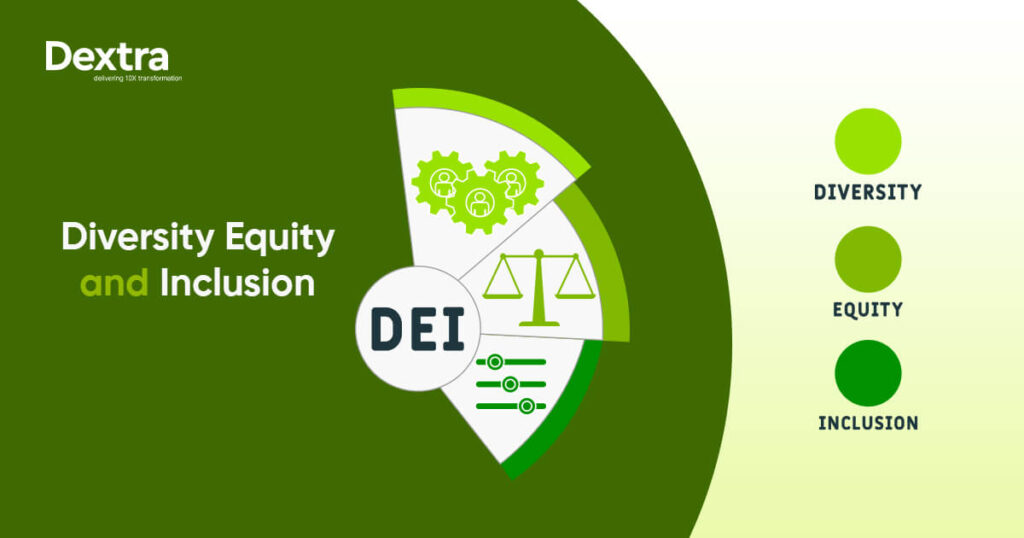
DEI stands for diversity equity and inclusion. It is a framework that organizations use to build workplaces where people of different backgrounds have fair access to opportunities and can participate fully in how work gets done. The three concepts are connected but distinct: diversity refers to who is represented, equity addresses whether access and opportunity are distributed fairly, and inclusion determines whether people can contribute meaningfully and feel that they belong.
This guide explains what each component means, how they differ from one another, and how organizations put them into practice. It also covers benefits, challenges, measurement, legal considerations, and the terminology variations that can make the topic harder to navigate than it needs to be.
What Does DEI Stand For?
DEI is an acronym for diversity, equity and inclusion. Each word describes a different dimension of how organizations relate to the people who work in them and the communities they serve. Understanding the differences between the three is essential because treating them as interchangeable leads to initiatives that address one dimension while neglecting the others.
What Is Diversity?
Diversity refers to the presence of differences within a group or organization. In a workplace context, this includes differences in race, ethnicity, gender, age, disability, sexual orientation, national origin, religion, socioeconomic background, education, language, neurodiversity, and professional experience.
A diverse workforce reflects varied backgrounds, perspectives, and life experiences. Diversity is often the most visible dimension of DEI because it can be measured through workforce demographics, but representation alone does not mean that an organization is equitable or inclusive.
What Is Equity?
Equity means designing systems and processes so that outcomes are not determined by irrelevant personal characteristics. It focuses on fair access to opportunities, resources, and advancement rather than assuming that identical treatment produces fair results for everyone.
In practice, equity shows up in how organizations handle pay, promotion criteria, performance evaluation, professional development, and reasonable accommodations. For example, equitable hiring processes evaluate candidates against consistent, job-relevant criteria rather than relying on subjective impressions that may reflect unconscious bias.
Equity is different from equality. Equality means giving everyone the same thing; equity means giving people what they need to have a fair chance. An organization that offers the same professional development budget to every employee is practicing equality. An organization that also provides mentoring, sponsorship, and flexible scheduling to employees who face systemic barriers to advancement is practicing equity.
What Is Inclusion?
Inclusion refers to the practices, norms, and cultural conditions that allow people to participate fully in workplace decisions, conversations, and opportunities. An inclusive workplace is one where employees can voice disagreement, contribute ideas, and access information without navigating unnecessary barriers.
Inclusion is often described through the concept of psychological safety: the belief that you will not be punished or marginalized for speaking up, asking questions, or making mistakes. Organizations can be diverse without being inclusive. A company may hire people from varied backgrounds but still concentrate decision-making authority, mentoring opportunities, and high-visibility projects among a narrow group.
What Is the Difference Between Equity and Equality?
Equality provides the same resources, treatment, or access to everyone regardless of circumstance. Equity recognizes that people start from different positions and adjusts support accordingly to produce fairer outcomes.
Consider a workplace that requires all employees to attend an in-person training session at a specific time. Equality says everyone gets the same invitation. Equity asks whether some employees face barriers to attendance, such as caregiving responsibilities, accessibility needs, or shift schedules, and provides alternatives such as remote access, recordings, or flexible timing.
Both concepts matter. Equality establishes a baseline of consistent treatment. Equity ensures that baseline does not systematically disadvantage people whose circumstances differ from the majority.
Why Is DEI Important in the Workplace?
Workplace DEI matters because the structures organizations build, from how they recruit and evaluate people to how they distribute resources and make decisions, directly affect whether employees can do their best work and develop their careers.
Representation and Equal Access to Opportunities
When an organization’s workforce does not reflect the available talent pool, the gap often points to barriers in recruitment, selection, or advancement rather than a shortage of qualified candidates. Addressing those barriers is both a fairness question and a practical one: organizations that draw from a wider talent pool are less likely to miss strong candidates.
Employee Belonging and Participation
Employees who feel excluded or marginalized are less likely to share ideas, flag problems, or invest discretionary effort. Research on psychological safety, including work by Harvard Business School professor Amy Edmondson, has consistently shown that teams where people feel safe to speak up perform better on measures of learning, error detection, and innovation. For growing companies looking to increase team productivity in startups, inclusion is not a separate initiative from performance; it is one of the conditions that makes sustained performance possible.
Hiring, Retention, and Career Development
High turnover is expensive. Employees who perceive unfairness in how promotions, pay, and development opportunities are distributed are more likely to leave. Structured and transparent processes for hiring, evaluation, and advancement reduce the influence of bias on individual decisions and make it easier to retain talent.
Decision-Making and Innovation: What the Evidence Shows
Diverse teams do not automatically produce better decisions. The evidence suggests that diversity combined with inclusive practices, where different perspectives are genuinely heard and integrated, can improve the quality of analysis and reduce groupthink. Without inclusion, diversity can increase friction without producing the benefits that organizations expect.
A 2018 Harvard Business Review analysis found that the link between diversity and financial performance varies significantly by context and that many studies overgeneralize from narrow samples. The most defensible claim is not that diversity guarantees better results, but that homogeneity carries risks: groups composed of people with similar backgrounds and viewpoints are more likely to overlook assumptions, miss emerging risks, and converge on suboptimal solutions.
What Are Examples of DEI in the Workplace?
DEI is not a single program or initiative. It shows up in specific workplace practices and the design decisions behind them.
Inclusive Recruitment and Hiring
Inclusive hiring means structuring the recruitment process to reduce the influence of irrelevant factors on candidate evaluation. Practical steps include writing job descriptions with skills-based language rather than cultural-fit proxies, using structured interviews with standardized questions, requiring diverse interview panels, and posting roles through channels that reach underrepresented candidate pools. Organizations that are actively hiring tech talent can embed these practices from the outset rather than retrofitting them into an established process.
Fair Performance Reviews and Promotions
Performance reviews are one of the most common sources of inequity in organizations. Research has shown that unstructured reviews tend to reward self-promotion and visibility over actual contribution, and that feedback given to women and employees from minority groups is more likely to focus on personality rather than performance.
Organizations can address this by using clear, role-specific evaluation criteria, calibrating ratings across teams, and tracking promotion rates by demographic group to identify patterns that may indicate bias.
Accessibility and Reasonable Accommodations
Accessibility means ensuring that physical spaces, technology, communication formats, and work processes do not create unnecessary barriers for people with disabilities. This includes providing assistive technology, offering flexible work arrangements, captioning video content, and designing office spaces that accommodate mobility differences.
In many jurisdictions, providing reasonable accommodations is a legal requirement. Beyond compliance, accessibility benefits all employees: captions help people in noisy environments, flexible scheduling supports caregivers, and clear documentation reduces miscommunication for everyone.
Employee Resource Groups and Mentoring
Employee Resource Groups (ERGs) are voluntary, employee-led groups organized around shared identity or experience. They can serve as sources of community, professional development, and organizational feedback. Effective ERGs are open to all employees, including allies, and have clear connections to organizational leadership so that the insights they generate can influence policy.
Mentoring and sponsorship programs help employees build relationships and visibility that support career advancement. Sponsorship, where a senior leader actively advocates for an employee’s advancement, is particularly important because it addresses the informal networks that often determine who gets promoted.
Inclusive Meetings and Team Communication
Small structural changes to how meetings are run can significantly affect who participates. These include rotating facilitation, sharing agendas in advance, explicitly inviting input from quieter participants, and following up in writing so that decisions are not determined solely by who speaks most confidently in the room.
What Are the Benefits of DEI?
The benefits of DEI are real, but they are often overstated in ways that undermine credibility. This section presents what the evidence supports.
A More Inclusive Employee Experience
Employees who feel included report higher job satisfaction, greater engagement, and stronger commitment to their organizations. This is consistently supported by engagement survey data across industries. Inclusion does not guarantee that every employee will be happy, but systematic exclusion reliably produces disengagement.
Fairer Access to Development Opportunities
DEI initiatives that focus on process design, such as structured interviews, transparent promotion criteria, and equitable access to training, reduce the role of personal connections and subjective impressions in determining who advances. This benefits employees who may be highly capable but lack the informal networks that traditionally drive career progression.
Potential Benefits for Collaboration and Retention
Organizations that invest in inclusion tend to see improvements in cross-functional collaboration and lower voluntary turnover. These outcomes are not automatic. They depend on whether the organization addresses the structural factors that drive exclusion, rather than relying on awareness training alone.
Why DEI Does Not Automatically Guarantee Better Business Results
The claim that DEI directly improves financial performance is common in corporate communications but difficult to substantiate with rigorous evidence. Correlation studies, such as McKinsey’s widely cited “Diversity Wins” reports, show associations between leadership diversity and financial outperformance, but they do not establish causation.
It is more accurate to say that well-implemented DEI practices, particularly those focused on equity in processes and inclusive decision-making, contribute to organizational health. Organizations that treat DEI primarily as a branding exercise or compliance checkbox are unlikely to see meaningful returns.
What Are Common DEI Challenges?
Unconscious Bias and Inconsistent Processes
Unconscious bias, the tendency to make judgments based on stereotypes or heuristics rather than evidence, is a well-documented phenomenon. It affects hiring, performance evaluation, feedback, and informal interactions. The challenge is not whether bias exists but how to design processes that limit its influence, since awareness training alone has shown limited long-term effectiveness.
Resistance to Organizational Change
DEI initiatives often encounter resistance, ranging from genuine concerns about fairness and merit to defensive reactions from employees who perceive the initiatives as implying personal blame. Effective implementation acknowledges these reactions, distinguishes between structural change and individual accusation, and ties initiatives to concrete organizational goals rather than abstract moral arguments.
Lack of Leadership Accountability
DEI programs that operate in isolation from organizational strategy tend to lose momentum. When senior leaders delegate DEI work entirely to a dedicated team without integrating it into business planning, performance management, and resource allocation, the work is treated as optional rather than core.
Poor Measurement and Tokenistic Initiatives
Organizations sometimes launch DEI initiatives that are visible but superficial: a heritage month celebration without changes to hiring practices, a diversity statement without workforce data to back it up, or a mandatory training session that is widely resented and quickly forgotten. These initiatives can create cynicism and make subsequent, more substantive efforts harder to implement.
How Can Organizations Implement DEI?
Assess Existing Policies and Workplace Practices
Before launching new initiatives, organizations should evaluate their current state. This includes reviewing workforce demographics, analysing hiring and promotion data by group, examining pay equity, surveying employee perceptions of inclusion, and identifying which policies may create unintended barriers.
Set Clear, Lawful, and Measurable Objectives
DEI goals should be specific, time-bound, and connected to organizational strategy. They should also comply with applicable laws, which means that goals framed as quotas or preferences for specific groups are likely to create legal risk, while goals focused on expanding candidate pools, removing process barriers, and improving transparency are generally on firmer ground.
Improve Recruitment, Development, and Promotion Processes
Process improvement is the highest-leverage area for most organizations. This includes structured hiring (standardized questions, skills-based assessments, diverse panels), transparent criteria for promotions and pay increases, equitable access to stretch assignments and leadership development, and regular audits of outcomes by demographic group. Companies that are working to build lean tech teams will find that equitable processes are especially important in smaller teams, where every hiring and promotion decision has an outsized effect on culture.
Provide Accessibility and Inclusion Support
Organizations should ensure that their physical and digital environments are accessible, that accommodations processes are clear and responsive, and that communication norms support participation by people with different working styles, language backgrounds, and accessibility needs.
Review Progress and Adjust Initiatives
DEI is not a one-time project. Organizations should track outcomes over time, solicit ongoing employee feedback, and be willing to discontinue initiatives that are not producing results. This requires both quantitative data (workforce demographics, promotion rates, pay gaps) and qualitative input (employee surveys, focus groups, exit interviews).
How Do You Measure DEI?
Workforce Representation
Representation metrics track the demographic composition of the workforce across dimensions such as race, gender, disability, and age. These metrics are most useful when compared across levels (entry-level, management, senior leadership) and tracked over time to identify trends. A workforce that is diverse at entry level but homogeneous at senior levels indicates a pipeline or advancement problem.
Hiring, Promotion, and Retention Metrics
Outcome metrics for DEI include application-to-hire ratios by group, promotion rates by group and level, time-to-promotion, voluntary turnover by group, and pay equity analyses. These metrics help organizations identify where disparities exist and whether interventions are having an effect.
Employee Engagement and Inclusion Surveys
Survey-based metrics capture employees’ subjective experience of inclusion, belonging, fairness, and psychological safety. These measures complement demographic data by revealing whether diversity translates into an inclusive experience. Well-designed inclusion surveys use validated scales and allow disaggregation by group to identify differences in experience.
DEI Reporting, Privacy, and Responsible Data Use
Organizations that collect and report demographic data must do so in compliance with privacy laws and with clear communication about how the data will be used. Employees should understand what data is collected, who has access, and how it informs decisions. The principles of ethical data management apply here as much as they do in customer-facing contexts: transparency, consent, and proportionality should govern what is collected and how it is used. In many jurisdictions, particularly in the European Union, collecting demographic data at work requires explicit consent and must comply with data protection regulations.
Responsible DEI reporting presents data at aggregate levels that protect individual privacy, acknowledges limitations and margins of error, and avoids presenting small group sizes in ways that could identify individuals.
What Is the Difference Between DEI, DE&I, and EDI?
Several acronym variations refer to closely related concepts:
- DEI (Diversity, Equity, and Inclusion) is the most widely used term in North America.
- DE&I (Diversity, Equity & Inclusion) is a formatting variation of DEI. Some organizations use the ampersand to visually connect equity and inclusion; the meaning is the same.
- EDI (Equity, Diversity, and Inclusion) is more commonly used in the United Kingdom, Canada, Australia, and parts of Europe. Placing equity first reflects a philosophical emphasis on structural fairness as the foundation for the other two concepts.
- DEIA (Diversity, Equity, Inclusion, and Accessibility) adds an explicit focus on accessibility for people with disabilities. This formulation was used by the U.S. federal government under the Biden administration and has been adopted by some international organizations.
- DEIB (Diversity, Equity, Inclusion, and Belonging) adds belonging as a distinct concept, emphasizing the emotional and social experience of feeling valued within an organization.
These are not competing frameworks. They represent different emphases within a shared commitment to fair and inclusive workplaces. Organizations should choose the terminology that best reflects their priorities and be consistent in how they use it.
DEI Policies and Legal Considerations
The legal landscape for workplace DEI varies significantly by jurisdiction and is evolving. Organizations operating across multiple countries or states face different requirements depending on where they operate and what specific practices are involved.
United States
In the United States, workplace anti-discrimination law is primarily governed by Title VII of the Civil Rights Act of 1964, which prohibits employment discrimination based on race, colour, religion, sex, and national origin. Additional federal laws protect against discrimination based on age (the Age Discrimination in Employment Act), disability (the Americans with Disabilities Act), and genetic information (the Genetic Information Nondiscrimination Act).
In January 2025, the federal government issued executive orders directing the termination of DEI programs within federal agencies and signalling an intent to scrutinize private-sector DEI practices. Executive Order 14151, signed on January 20, 2025, ordered the closure of federal DEIA offices and the rescission of prior executive orders related to equity and inclusion. A second executive order, signed the following day, revoked Executive Order 11246 (which had required affirmative action by federal contractors since 1965) and directed the Attorney General to develop enforcement recommendations targeting what the administration described as unlawful DEI programs in the private sector.
In March 2025, the U.S. Equal Employment Opportunity Commission (EEOC) and the Department of Justice (DOJ) issued joint technical assistance documents explaining their view of how DEI-related practices can constitute unlawful discrimination under Title VII. The guidance emphasized that employment decisions motivated by protected characteristics, including decisions made in the name of diversity, may be unlawful regardless of which group is favoured or disadvantaged.
These developments have prompted many U.S. employers to review their DEI programs. The core principle remains that federal anti-discrimination law prohibits using protected characteristics, such as race or sex, as a basis for employment decisions. Programs focused on expanding candidate pools, removing process barriers, improving accessibility, and creating inclusive working conditions are generally distinguishable from programs that use protected characteristics to determine outcomes.
Organizations should seek current legal advice based on their specific practices and the jurisdictions in which they operate. The legal environment in this area is changing rapidly, and general guidance cannot substitute for tailored analysis.
Outside the United States
In the European Union, the Employment Equality Directive (2000/78/EC) and the Racial Equality Directive (2000/43/EC) establish baseline protections against workplace discrimination. Individual member states may provide additional protections. The UK Equality Act 2010 protects employees from discrimination based on nine protected characteristics and imposes a public sector equality duty on government bodies.
Many countries have their own frameworks governing workplace diversity and non-discrimination. Organizations operating internationally should ensure that their DEI practices comply with local employment law, data protection requirements, and cultural norms around the collection and use of personal information.
Conclusion
DEI, at its core, is about three things: ensuring that workplaces reflect a range of backgrounds and perspectives, designing processes that distribute opportunities fairly, and creating conditions where everyone can contribute and develop their careers.
Effective DEI work is structural rather than symbolic. It focuses on how organizations hire, evaluate, promote, and support their people, and it measures outcomes rather than relying on intention alone. The organizations that get the most value from DEI are those that integrate it into their operational practices, hold leadership accountable for progress, and stay current with the legal frameworks that govern their specific context.
The conversation around DEI is evolving, and the terminology, legal requirements, and best practices will continue to change. What remains constant is the underlying question: are the structures an organization has built working fairly for the people inside them?
Frequently Asked Questions About DEI:
What does DEI stand for?
DEI stands for Diversity, Equity, and Inclusion. It is a framework for building workplaces where people of different backgrounds have fair access to opportunities and can participate meaningfully.
What does DEI mean in simple terms?
DEI means making workplaces fair and open to everyone. Diversity is about who is represented. Equity is about whether opportunities and resources are distributed fairly. Inclusion is about whether people can fully participate and feel they belong.
What is the difference between diversity, equity, and inclusion?
Diversity describes the presence of differences within a group. Equity focuses on fair access to opportunities and resources. Inclusion refers to the practices and conditions that enable full participation. An organization can be diverse without being equitable or inclusive.
What is the difference between equity and equality?
Equality means providing the same resources or treatment to everyone. Equity means adjusting support based on individual circumstances to produce fairer outcomes. Both are important, but equity addresses the reality that identical treatment does not always produce equal results.
What is an example of DEI in the workplace?
Examples include structured hiring processes that reduce bias, transparent criteria for promotions and pay, employee resource groups open to all staff, mentoring and sponsorship programs, accessible workspaces and technology, and meeting practices that ensure broad participation.
What are the main benefits of DEI?
Benefits include improved employee engagement and retention, fairer access to career development, better error detection and decision quality in inclusive teams, and reduced risk of discrimination claims. The strength of these benefits depends on implementation quality.
What are common DEI initiatives?
Common initiatives include bias-aware recruitment practices, pay equity audits, employee resource groups, inclusion training, mentoring and sponsorship programs, flexible working arrangements, accessibility improvements, and regular workforce data analysis.
How do organizations measure DEI?
Organizations measure DEI using workforce representation data, hiring and promotion metrics disaggregated by group, pay equity analyses, employee engagement and inclusion surveys, and retention data. Responsible measurement protects individual privacy and acknowledges data limitations.
What does DE&I mean?
DE&I is a formatting variation of DEI. The ampersand connects equity and inclusion visually, but the meaning is the same: Diversity, Equity, and Inclusion.
Is DEI the same as EDI?
EDI (Equity, Diversity, and Inclusion) covers the same concepts as DEI but places equity first. This ordering is more common in the United Kingdom, Canada, and Australia. The difference is one of emphasis rather than substance.