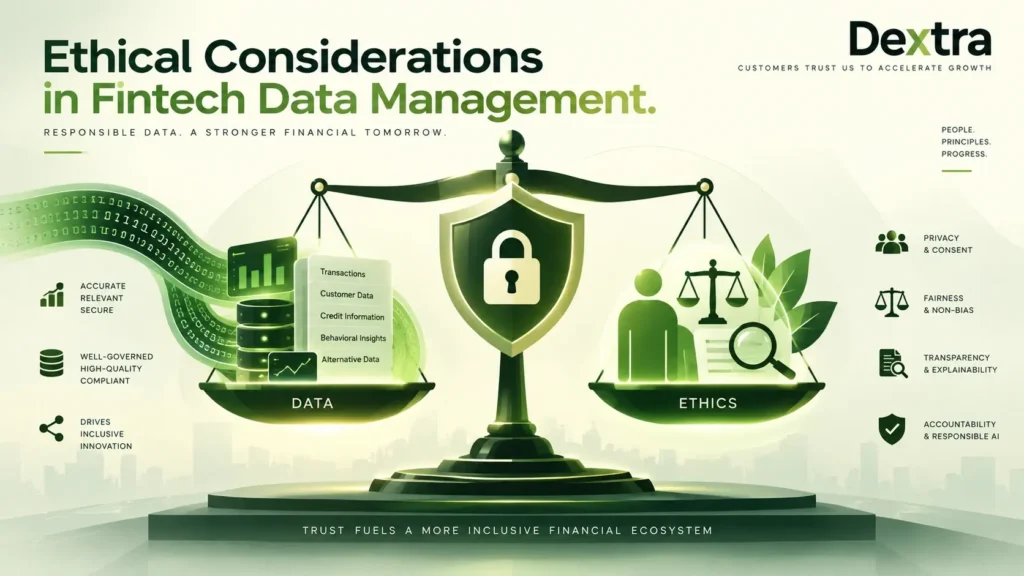
Data is at the core of modern fintech. Transaction histories, financial profiles, identity information, behavioral signals, and alternative data can help companies improve fraud detection, assess risk, personalize financial products, and automate decisions.
But the ability to collect and analyze more data also creates an important question: just because fintech companies can use certain data, does that mean they should?
Ethical considerations in fintech data management require organizations to consider how information is collected, what it is used for, who can access it, how long it is retained, and whether automated systems produce fair and explainable outcomes. These considerations become especially important when AI and machine learning influence decisions involving lending, credit, fraud detection, risk assessment, or access to financial services. Responsible data management in fintech therefore extends beyond privacy compliance. It combines privacy, data minimization, security, fairness, transparency, explainability, human oversight, and accountability throughout the data and AI lifecycle.
In this guide, we explore the key ethical considerations in fintech data management, the risks associated with irresponsible data and AI practices, and practical principles for building more transparent, fair, and responsible fintech systems.
What Are Ethical Considerations in Fintech Data Management?
Ethical considerations in fintech data management are the principles, standards, and practices that guide how financial technology companies collect, use, store, share, and dispose of data in ways that are fair, transparent, accountable, and respectful of individual rights.
While compliance with privacy and data-protection regulations is a baseline requirement, fintech data ethics goes further, it addresses questions about what is right and responsible, not only what is legally required.
Core ethical dimensions include:
• Privacy: Protecting personal and financial information from unauthorized access, misuse, or excessive collection.
• Consent: Ensuring individuals understand what data is collected and how it will be used, fintech data consent should be meaningful, not buried in terms and conditions.
• Fairness: Preventing data practices and algorithms from producing systematically unequal or discriminatory outcomes.
• Transparency: Communicating clearly about data collection, processing, and decision-making practices, fintech data transparency builds trust and supports accountability.
• Accountability: Establishing clear ownership and responsibility for data practices and automated decisions.
• Responsibility: Using data and AI in ways that serve customers and society, not just business objectives. Fintech data responsibility means considering the broader impact of data-driven products.
Ethical data use in fintech is not a separate function, it should be integrated into product design, data architecture, AI development, governance structures, and organizational culture.
Why Ethics Matters in Fintech Data Management
Fintech companies occupy a unique position at the intersection of financial services and technology. They handle some of the most sensitive categories of personal data, income, credit histories, spending patterns, identity documents, biometric information, and increasingly use that data to make or influence consequential financial decisions.
This creates ethical obligations that extend beyond what regulations alone can address:
• Financial impact on individuals: Decisions about credit, lending, insurance, and financial-product access can directly affect people’s lives and livelihoods. Unethical or poorly governed data practices can cause real harm.
• Power asymmetry: Fintech companies hold and analyze data that individuals cannot easily see, correct, or challenge. This information asymmetry creates a heightened responsibility for fintech data privacy ethics.
• Trust as a business foundation: Customers share sensitive financial information based on trust. Ethical failures erode that trust quickly and permanently.
• Regulatory trajectory: Regulators worldwide are increasingly focusing on AI transparency, algorithmic fairness, and data ethics. Companies that lead on ethics today are better prepared for tomorrow’s requirements.
• Investment and governance scrutiny: Investors, acquirers, and board members increasingly examine ethical data practices as part of technology risk assessment. Ethical gaps can affect valuations, deal structures, and post-transaction remediation costs.
Key point: Ethics in fintech data management is not about slowing down innovation, it is about ensuring that innovation creates value responsibly and sustainably.
Key Ethical Considerations in Fintech Data Management
The following sections outline the most important ethical dimensions that fintech companies should address across their data and AI practices.
1. Data Privacy and User Consent
Fintech privacy requires more than compliance with applicable regulations. It requires a genuine commitment to protecting customer data and providing individuals with meaningful control over how their information is used.
Fintech companies should establish an appropriate legal and governance basis for collecting and processing personal data, while providing clear information and obtaining consent where required. Consent mechanisms should be designed so that individuals genuinely understand what they are agreeing to, not buried in lengthy terms and conditions.
Fintech data privacy ethics also means avoiding dark patterns, deceptive defaults, and consent processes that manipulate users into sharing more data than they intend.
2. Data Minimization and Purpose Limitation
Data minimization fintech practices require collecting only the information needed for a defined business purpose. This reduces privacy risk, simplifies governance, and limits the potential harm from data breaches.
Purpose limitation means avoiding repurposing information for unrelated uses without an appropriate basis. When data collected for one purpose, such as identity verification, is later used for behavioral profiling or marketing, this can represent an ethical breach even if it does not violate a specific regulation.
Supporting practices include:
• Retention controls: Do not retain sensitive information indefinitely simply because storage is inexpensive.
• Data provenance: Maintain an understanding of where important datasets came from and how they are transformed.
• De-identification: Where appropriate, reduce direct identification risks through anonymization or pseudonymization techniques.
3. Transparency and Explainability
Fintech data transparency means providing clear, accessible information about what data is collected, how it is used, who it is shared with, and how decisions that affect customers are made. Organizations should communicate data practices in plain language rather than relying on dense privacy policies.
Explainable AI in fintech is particularly important when automated systems influence material financial decisions. Customers, regulators, and auditors should be able to understand the key factors that contributed to a credit decision, risk assessment, fraud alert, or product recommendation.
AI transparency in fintech is not about revealing proprietary algorithms. It is about ensuring that material decisions can be appropriately understood, reviewed, and challenged.
4. Algorithmic Bias and Fairness
Algorithmic fairness in fintech addresses the risk that data-driven systems produce systematically different outcomes for different groups of people. Algorithmic bias in fintech can occur when training data reflects historical patterns that embed existing disparities, when proxy variables inadvertently correlate with protected characteristics, or when model design choices produce unintended differential treatment.
Fintech algorithmic bias is not always intentional, it can arise from well-designed systems trained on data that does not adequately represent the populations they serve. This makes proactive testing, monitoring, and remediation essential.
Ethical credit scoring, lending, fraud detection, and risk-assessment models should be regularly evaluated for fairness, not just accuracy.
5. Responsible AI and Automated Decision-Making
Responsible AI in fintech means developing, deploying, and monitoring AI systems with appropriate governance, controls, and safeguards. As AI increasingly drives lending decisions, fraud detection, customer service, underwriting, and personalization, the ethical stakes increase.
Fintech AI ethics requires addressing:
• Whether training data was collected appropriately and is representative
• Whether the model could produce systematically different outcomes for certain groups
• Whether material automated decisions can be explained to customers, auditors, or regulators
• Whether people can review or challenge consequential decisions
• Whether model performance is monitored after deployment for drift, degradation, or emerging bias
• Who owns the model and its outcomes
Ethical AI in fintech is not about avoiding AI, it is about deploying AI responsibly with appropriate human oversight, testing, monitoring, and accountability. Fintech automated decision making systems require clear governance frameworks to ensure they remain fair, accurate, and explainable over time.
6. Data Security and Confidentiality
Data security is both a technical and ethical obligation. When fintech companies collect sensitive personal and financial information, they accept responsibility for protecting it from unauthorized access, breaches, and misuse. Security failures are also ethical failures because they expose individuals to financial harm, identity theft, and privacy violations. For a deeper look at the security landscape, see our analysis of cybersecurity risks in fintech.
Ethical data security means implementing appropriate encryption, access controls, monitoring, and incident response, and being transparent with customers when security incidents occur.
7. Accountability and Human Oversight
Accountability means establishing clear ownership for data practices and automated decisions. When an algorithm denies credit, flags a transaction as fraudulent, or excludes a customer from a product, someone in the organization should be responsible for that outcome.
Human oversight is particularly important for high-stakes fintech automated decision making. Automated systems should have appropriate review and escalation mechanisms so that people can intervene when systems produce incorrect, disputed, or harmful outcomes.
Fintech model governance frameworks should define who approves models for deployment, who monitors their performance, and who is accountable when things go wrong.
8. Third-Party and Data Vendor Responsibility
Fintech companies frequently rely on third-party data providers, credit bureaus, identity-verification vendors, and AI service providers. When sensitive customer data is processed by external parties, the ethical responsibility does not transfer, the fintech company remains accountable for how that data is handled.
Ethical third-party data management requires assessing vendor data practices, contractual protections, security controls, and alignment with the company’s own data-ethics standards. This is particularly important when vendors provide data or models that influence material customer decisions. Organizations operating on older technology stacks should also consider the compliance challenges in legacy fintech systems that can make ethical governance more difficult to implement and maintain.
9. Responsible Use of Alternative Data
Many fintech companies use alternative data, social media activity, mobile phone usage, browsing behavior, geolocation data, app usage patterns, to supplement traditional financial data for credit scoring, risk assessment, and customer segmentation.
While alternative data can expand access to financial services for underserved populations, it also creates ethical risks: privacy concerns, potential for discriminatory outcomes, lack of transparency about which signals influence decisions, and questions about whether customers understand and consent to this use.
Responsible financial AI requires careful governance of alternative-data usage, including fairness testing, transparency about data sources, and clear policies on what types of alternative data are appropriate to use.
Algorithmic Bias in Fintech: Where It Can Occur
Understanding where algorithmic bias in fintech can arise is essential for building effective testing and monitoring programs. The following areas represent common points where bias can emerge in fintech products and services.
| Use Case | Potential Ethical Concern | Why It Matters |
| Credit Scoring | Historical data may reproduce existing disparities in credit access | Affects individuals’ ability to access financial products |
| Lending Decisions | Automated criteria may create unintended unequal outcomes | AI fairness in lending is a growing regulatory focus |
| Fraud Detection | Certain customer segments may generate disproportionate false positives | Can block legitimate customers from accessing services |
| Insurance and Risk Assessment | Proxy variables can influence risk classifications | May result in unfair pricing or coverage decisions |
| Customer Segmentation | Behavioral profiling may produce exclusionary outcomes | Can limit access to products or services for certain groups |
| Marketing and Product Targeting | Targeting models can create unequal access to financial products | Raises questions about financial inclusion |
Important: These are potential risks that require testing and monitoring, not inevitable outcomes. The purpose of identifying bias risk areas is to build proactive controls rather than reactive responses.
Credit Scoring
Ethical credit scoring models should be evaluated regularly for unintended disparities. Historical credit data often reflects systemic patterns that, if left unexamined, can be perpetuated by machine learning models. Organizations should test models across demographic segments and monitor for outcomes that diverge significantly from expected distributions.
Lending Decisions
AI fairness in lending is increasingly important as more fintech companies automate approval, pricing, and limit-setting decisions. Models that use proxy variables, such as geographic location or educational background, may inadvertently produce outcomes that correlate with protected characteristics. Regular fairness audits help identify and address these risks.
Fraud Detection
Fraud-detection models trained on historical fraud patterns may generate disproportionate false positives for certain customer segments. This can result in legitimate customers being blocked, delayed, or subjected to additional scrutiny — creating both customer-experience problems and potential fairness concerns.
Insurance and Risk Assessment
Risk-assessment models in insurance and financial products should be evaluated for the influence of proxy variables that may correlate with sensitive characteristics. While these models aim to price risk accurately, the ethical question is whether the inputs and outputs produce fair outcomes across different populations.
Customer Segmentation
Behavioral segmentation and profiling can be used to improve product recommendations and customer experiences. However, when segmentation results in systematically different access to products, pricing, or services, it raises questions about fairness and inclusion that ethical fintech data management should address.
Responsible AI Principles for Fintech
Responsible AI in fintech requires a clear set of principles that guide how AI systems are developed, deployed, monitored, and governed. The following principles provide a framework for ethical AI in fintech applications.
Fairness
AI systems should be designed and tested to produce equitable outcomes. Fairness testing should be conducted before deployment and monitored continuously to detect emerging bias or disparate impact.
Transparency
Organizations should be transparent about where and how AI is used in their products and services. Customers should understand when AI influences decisions that affect them.
Explainability
Explainable AI in fintech means that material decisions, particularly those involving credit, lending, fraud, or risk, can be understood and reviewed. Explainability supports customer trust, regulatory compliance, and internal accountability.
Privacy
AI systems should be designed with privacy in mind, minimizing the collection and use of personal data, implementing appropriate access controls, and ensuring that training data is governed and protected.
Security
AI models and the data they use should be protected from adversarial attacks, unauthorized access, data poisoning, and model theft. Security is a prerequisite for trustworthy AI.
Human Oversight
Consequential decisions should have appropriate human review and escalation mechanisms. Fully automated systems should not make high-impact financial decisions without the ability for human intervention.
Accountability
Clear ownership should exist for every AI model: who approves it for deployment, who monitors its performance, and who is responsible for its outcomes. Fintech AI governance requires defined roles, processes, and documentation.
Continuous Monitoring
AI models should be monitored after deployment for performance degradation, data drift, emerging bias, and changes in the operating environment. Fintech model governance is not a one-time assessment, it requires ongoing attention and periodic revalidation.
Ethical Data Management Framework for Fintech
An ethical data management framework applies ethical principles across every stage of the data lifecycle. At each stage, fintech companies should consider the dimensions of privacy, fairness, security, transparency, and accountability.
The ethical data lifecycle for fintech can be summarized as:
| Ethical Data Lifecycle: Collect → Classify → Store → Process → Analyze → Decide → Share → Retain/Delete |
At each stage, the following questions should be addressed:
• Collect: Is the data collection necessary and proportionate? Is there an appropriate legal basis and informed consent?
• Classify: Is data classified by sensitivity? Are different protection levels applied appropriately?
• Store: Is data stored securely with appropriate access controls, encryption, and residency compliance?
• Process: Is processing limited to the stated purpose? Are data minimization principles applied?
• Analyze: Are analytics and AI models governed by fairness, explainability, and privacy standards?
• Decide: Are automated decisions fair, explainable, and subject to human review? Is there an appropriate appeal or challenge process?
• Share: Is data shared only with authorized parties? Are third-party data practices assessed and monitored?
• Retain/Delete: Is data retained only as long as necessary? Are deletion processes tested and effective?
This framework provides a practical structure for embedding fintech data governance and ethical data use in fintech into daily operations rather than treating ethics as an abstract governance exercise.
Ethical Risks Investors Should Assess in Fintech Technology Due Diligence
Ethical data practices can form an important part of fintech technology risk assessment when evaluating a fintech company. Investors and acquirers should understand not only whether the company’s technology works, but also how data and automated decision systems are governed.
A technology due diligence in fintech assessment can examine:
• Data provenance: Where critical datasets originate and whether their use is appropriately governed.
• Privacy controls: How sensitive personal and financial information is collected, processed, stored, shared, and retained.
• AI governance: Whether AI and machine learning systems have defined owners, controls, monitoring processes, and documentation, a core element of fintech AI due diligence.
• Algorithmic fairness: Whether models used for lending, credit, fraud detection, or risk assessment are tested for unintended bias.
• Explainability: Whether material automated decisions can be appropriately understood and reviewed.
• Human oversight: Whether people can intervene when automated systems produce high-impact or disputed outcomes.
• Third-party AI and data providers: Whether external vendors introduce additional privacy, security, model, or data-use risks.
• Monitoring: Whether models and data practices are continuously reviewed as products, datasets, and regulatory expectations change.
These areas can help investors identify technology risks that may affect regulatory exposure, product scalability, customer trust, remediation costs, and the long-term sustainability of the fintech’s technology platform.
The following matrix maps common ethical risks to where they occur, their potential consequences, and recommended controls:
| Ethical Risk | Where It Appears | Potential Consequence | Control |
| Excessive data collection | Product / data layer | Privacy exposure | Data minimization |
| Weak consent mechanisms | Customer journey | Trust and regulatory risk | Consent management |
| Algorithmic bias | AI/ML models | Unfair outcomes | Bias testing |
| Opaque decisions | Automated decisioning | Limited accountability | Explainability |
| Excessive retention | Data stores | Increased exposure | Retention policies |
| Uncontrolled third-party data | Vendor ecosystem | Data-use risk | Vendor due diligence |
| Poor AI oversight | AI operations | Model risk | Human oversight |
| Weak access controls | Infrastructure | Unauthorized access | IAM / least privilege |
Fintech AI risk assessment: A fintech AI risk assessment should evaluate not only model accuracy but also fairness, explainability, governance maturity, and the organization’s ability to detect and correct ethical issues before they cause harm.
Best Practices for Responsible Fintech Data Management
The following best practices can help fintech companies build and maintain ethical data management programs:
• Embed ethics in governance: Integrate ethical considerations into fintech data governance structures, policies, and decision-making processes, not as a separate initiative but as part of how data is managed.
• Implement fairness testing: Regularly test AI and ML models for bias, disparate impact, and fairness across relevant demographic segments. Algorithmic fairness in fintech requires ongoing evaluation, not one-time assessments.
• Build explainability into AI systems: Design AI systems with explainability as a requirement, not an afterthought. Customers and regulators should be able to understand material decisions.
• Practice data minimization: Collect only what is necessary, use it only for stated purposes, and delete it when it is no longer needed. Data minimization fintech practices reduce ethical and security risk.
• Strengthen consent mechanisms: Ensure fintech data consent is meaningful, informed, and easy to exercise, including the ability to withdraw consent. Avoid deceptive defaults.
• Establish human oversight for high-stakes decisions: Ensure that consequential automated decisions have appropriate review, escalation, and appeal mechanisms.
• Govern third-party data relationships: Assess and monitor vendors who handle sensitive data or provide AI models. Responsibility does not end at the organizational boundary.
• Continuously monitor AI performance: Establish fintech AI governance and model monitoring processes that detect drift, degradation, and emerging bias. Monitor continuously, not periodically.
• Document and audit: Maintain clear documentation of data practices, AI governance decisions, and audit trails. This supports internal accountability and external assessments including fintech data risk assessment reviews.
• Prepare for technology due diligence: Build ethical data practices that can withstand scrutiny during a fintech technology due diligence assessment. Well-governed data and AI systems reduce risk and support stronger outcomes for investors and leadership.
How Ethical Data Practices Affect Trust, Risk & Innovation
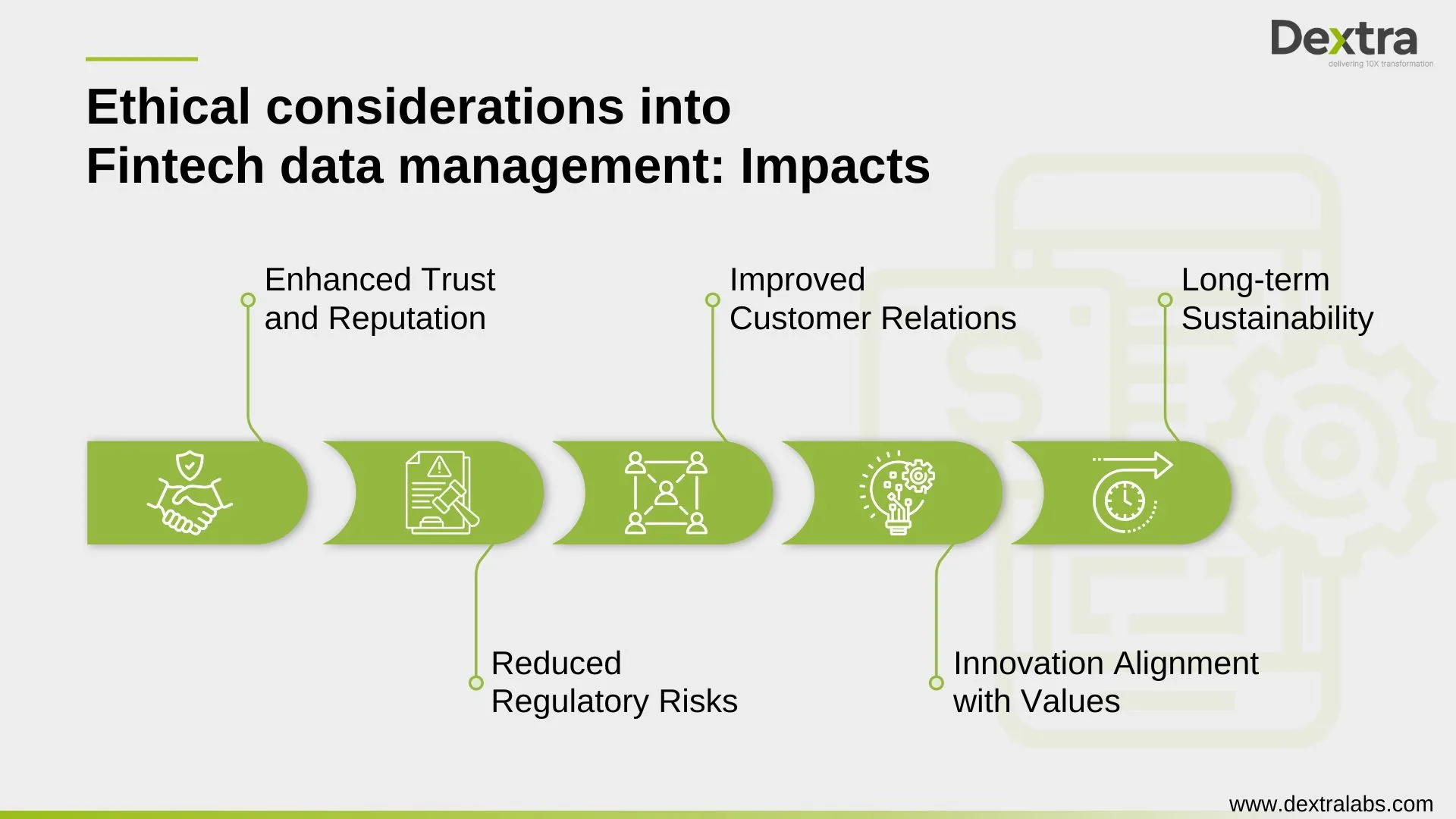
Ethical fintech data management is not just about avoiding harm, it creates tangible business value:
• Customer trust: Transparent and responsible data practices can strengthen confidence in financial products. Customers are more likely to share data and adopt new products when they trust how their information is handled.
• Regulatory and legal risk: Clear governance can help organizations identify and manage privacy, data-use, and automated-decision risks before they become enforcement actions or litigation.
• Technology risk: Ethical failures can expose weaknesses in data architecture, AI governance, access controls, and third-party systems. AI risk in fintech extends beyond model accuracy to fairness, governance, and organizational readiness. For more on evolving risks, explore data privacy in emerging fintech technologies.
• Product quality: Better data governance can improve the quality and reliability of analytical and AI-driven products. Responsible financial AI produces more reliable, trustworthy outputs.
• Investment readiness: Well-governed data and AI systems can make technology environments easier to assess, operate, and scale. This directly supports stronger outcomes during fintech technology risk assessment processes and potential transactions.
How Dextra Labs Supports Fintech Technology Due Diligence
Dextra Labs helps fintech investors, acquirers, and leadership teams assess the technology foundations behind financial products, including data governance, AI ethics, privacy controls, and responsible AI practices.
A Dextra Labs fintech technology due diligence engagement can assess:
• Data governance maturity, ethical data policies, and accountability structures
• AI and ML model governance, fairness testing, and bias-monitoring capabilities
• Privacy controls, consent management, and data-minimization practices
• Algorithmic explainability and human-oversight mechanisms
• Third-party data-vendor practices and ethical alignment
• Fintech data risk assessment and ethical risk identification
• Technology architecture, security, scalability, and compliance readiness
Learn more about our technical due diligence services and how we help investors and fintech leadership teams make informed technology and governance decisions. Evaluating AI governance and data ethics in a fintech investment? Contact Dextra Labs for a confidential technology due diligence conversation.
Conclusion
Ethical considerations in fintech data management are not optional extras, they are essential to building trustworthy, sustainable, and resilient financial technology businesses.
As AI becomes more deeply embedded in fintech products, driving credit decisions, fraud detection, risk assessment, personalization, and customer interactions, the need for robust ethical governance grows. Responsible data management in fintech requires organizations to go beyond compliance and address fundamental questions about privacy, fairness, transparency, explainability, accountability, and the responsible use of AI.
Companies that invest in ethical fintech data management build stronger customer relationships, reduce regulatory and technology risk, improve the quality of AI-driven products, and create technology environments that are better prepared for investment scrutiny and growth.
For investors and acquirers, ethical data and AI governance is increasingly a material consideration in fintech technology risk assessment. A fintech company’s approach to data ethics can reveal both its governance maturity and its exposure to risks that traditional technology assessments may overlook.
Fintech data ethics is not about choosing between innovation and responsibility. It is about building products and systems where both can thrive together.
Frequently Asked Questions:
What are ethical considerations in fintech data management?
Ethical considerations in fintech data management include privacy, consent, fairness, transparency, explainability, accountability, data minimization, and responsible AI. They guide how fintech companies collect, use, store, share, and dispose of data in ways that respect individual rights and produce fair outcomes.
What is algorithmic bias in fintech?
Fintech algorithmic bias occurs when data-driven systems produce systematically different outcomes for different groups of people. It can arise in credit scoring, lending, fraud detection, risk assessment, and customer segmentation, often from historical data patterns rather than intentional design. Algorithmic bias in fintech requires proactive testing, monitoring, and remediation.
What does responsible AI in fintech mean?
Responsible AI in fintech means developing, deploying, and monitoring AI systems with appropriate governance, fairness testing, explainability, human oversight, and accountability. It covers fintech AI ethics across the full AI lifecycle, from data collection and model training to deployment and monitoring.
How do ethical data practices affect fintech technology due diligence?
Ethical data practices can form an important part of fintech technology due diligence and fintech AI due diligence. Investors and acquirers assess data governance, AI controls, privacy practices, algorithmic fairness, and human oversight to identify technology risks that may affect regulatory exposure, customer trust, and valuations.
What is the difference between fintech data ethics and compliance?
Compliance addresses what is legally required. Fintech data ethics addresses what is right and responsible beyond regulatory minimums. Ethical fintech data management includes fairness, transparency, meaningful consent, responsible AI use, and accountability, areas where regulation may be evolving but organizational responsibility already exists.
How can fintech companies implement ethical AI governance?
Fintech companies can implement fintech AI governance by establishing model ownership, conducting fairness testing, requiring explainability for material decisions, implementing human oversight for high-stakes automated decisions, monitoring models continuously, and documenting governance decisions. Fintech model governance frameworks should be integrated into the broader data governance structure.