
Fintech companies depend on data to power payments, lending, fraud detection, identity verification, personalization, risk assessment, and increasingly AI-driven financial services. But the same data that creates business value also introduces significant privacy, security, regulatory, and operational risk.
Fintech platforms may process transaction records, identity information, financial histories, account details, behavioral data, and data used by AI and machine learning systems. Managing this information effectively requires more than secure storage. Companies need controls for how data is collected, classified, accessed, processed, shared, retained, monitored, and deleted.
The challenge becomes greater as fintech businesses connect legacy financial systems with cloud infrastructure, APIs, payment providers, data vendors, open banking platforms, and third-party services. Cross-border operations can add further complexity because data protection and financial-sector requirements vary across jurisdictions.
This makes fintech data management and privacy a technology, governance, and risk-management issue, not simply a compliance task.
Fintech companies need to evaluate not only how data is stored and protected but also how their broader technology environment manages privacy, security, governance, and regulatory risk. This is one reason technology due diligence fintech assessments have become an important part of evaluating technology risk.
In this guide, we examine the key fintech data management and privacy challenges, common risks, governance and security best practices, and the areas investors and acquirers should consider when assessing a fintech company’s technology environment.
What Is Fintech Data Management?
Fintech data management is the set of processes, policies, technologies, and controls that govern how financial technology companies collect, store, organize, process, protect, share, and dispose of data across the data lifecycle.
Unlike general enterprise data management, data management in fintech must address the specific requirements of handling sensitive financial and personal information — including transaction data, payment records, customer identities, credit histories, account balances, and behavioral signals, within a heavily regulated industry.
Effective fintech data management encompasses:
• Data collection and ingestion from multiple sources, including customer inputs, payment networks, open banking APIs, credit bureaus, and third-party data providers
• Data storage and organization across databases, data warehouses, data lakes, and cloud infrastructure
• Data quality management, including validation, deduplication, reconciliation, and lineage tracking
• Data access controls, including role-based access, least-privilege policies, and privilege management
• Data protection, including encryption, tokenization, masking, and secure key management
• Data sharing and processing with internal teams, external partners, regulators, and AI/ML systems
• Data retention and deletion, governed by regulatory requirements and business needs
The objective of fintech data management is to ensure that sensitive financial data is accurate, accessible to authorized users, protected from unauthorized access, governed by clear policies, and handled in compliance with applicable regulations, while supporting the business’s ability to operate, grow, and innovate.
Key point: Data management in fintech is not purely an IT function. It requires coordination across engineering, security, compliance, product, legal, and business operations to be effective.
Why Data Privacy Matters in Fintech
Financial data privacy is among the most consequential areas in technology because fintech companies handle some of the most sensitive categories of personal and financial information. A single failure in fintech data privacy can result in direct financial harm to customers, regulatory enforcement actions, loss of customer trust, and significant reputational damage.
Data breaches can create direct financial losses, regulatory exposure, operational disruption, and significant reputational damage. For fintech companies, where trust is essential to customer acquisition and retention, fintech data protection failures can threaten the viability of the business.
There are several reasons why fintech data privacy deserves specific attention:
• Sensitivity of the data: Financial records, identity documents, credit histories, and transaction patterns are high-value targets for attackers and high-risk datasets for mishandling.
• Regulatory complexity: Fintech companies operate under overlapping privacy, data protection, financial-services, and payment-security obligations that vary by jurisdiction, product, and customer type.
• Customer trust: Users entrust fintech platforms with their most sensitive financial information. A privacy failure can permanently damage that relationship.
• Business impact: Fintech privacy risks extend beyond fines. They include lost partnerships, reduced customer lifetime value, investor scrutiny, and potential acquisition deal failures.
• AI and data-driven decision-making: As fintech companies increasingly use AI for credit scoring, fraud detection, and personalization, the privacy implications of how financial data used for AI systems is collected, processed, and governed become more significant.
Financial data privacy is therefore not only a compliance requirement but a core component of fintech business resilience and competitive positioning.
What Types of Data Do Fintech Companies Manage?
A comprehensive approach to fintech data management and privacy requires understanding the different categories of data that fintech platforms collect, process, and store. Each category carries different risk profiles, regulatory requirements, and governance needs.
1. Customer and Identity Data
This includes personal identifiers collected during onboarding and throughout the customer relationship: names, addresses, dates of birth, government-issued identity documents, Social Security or national ID numbers, email addresses, phone numbers, biometric data, and Know Your Customer (KYC) verification records.
Identity data is among the most sensitive categories and is subject to stringent data protection and financial-services regulations.
2. Transaction and Payment Data
Transaction records include payment amounts, dates, recipients, merchant information, payment methods, and settlement details. For payment processors, neobanks, and lending platforms, this data flows at high volumes and requires real-time processing, strong access controls, and secure retention.
Payment data is often governed by payment-card security standards and anti-money laundering requirements in addition to general data protection regulations.
3. Financial and Credit Data
This covers account balances, income information, credit scores, credit histories, loan records, investment portfolios, insurance claims, and other financial-health indicators. Lending platforms, wealth management tools, and credit services rely heavily on this data for underwriting, risk assessment, and financial product delivery.
The accuracy and integrity of financial and credit data directly affect customer outcomes, making data quality a critical governance concern.
4. Behavioral and Product Data
Fintech platforms also collect usage data, session information, feature-interaction patterns, device data, location signals, and customer engagement metrics. This behavioral data supports product optimization, fraud detection, personalization, and customer analytics.
While behavioral data may seem less sensitive than financial records, it can reveal spending patterns, financial habits, and personal circumstances that carry significant privacy implications.
5. AI/ML Training and Model Data
As AI becomes more embedded in fintech products, companies increasingly manage datasets used for training, validating, and operating machine learning models. This includes labeled training datasets, model inputs and outputs, feature data, synthetic data, model performance logs, and datasets used for monitoring bias and drift.
AI data privacy in fintech is an emerging governance area. Financial data used for AI training and inference requires careful access controls, provenance tracking, and data-quality assurance to reduce the risk of privacy violations, biased outcomes, or regulatory non-compliance.
Key Data Management and Privacy Challenges in Fintech
Fintech companies face a unique combination of data management challenges that arise from the intersection of sensitive financial data, complex technology environments, evolving regulations, and increasing reliance on AI and third-party services. Understanding these fintech data management challenges is essential for building effective governance and risk-management frameworks.
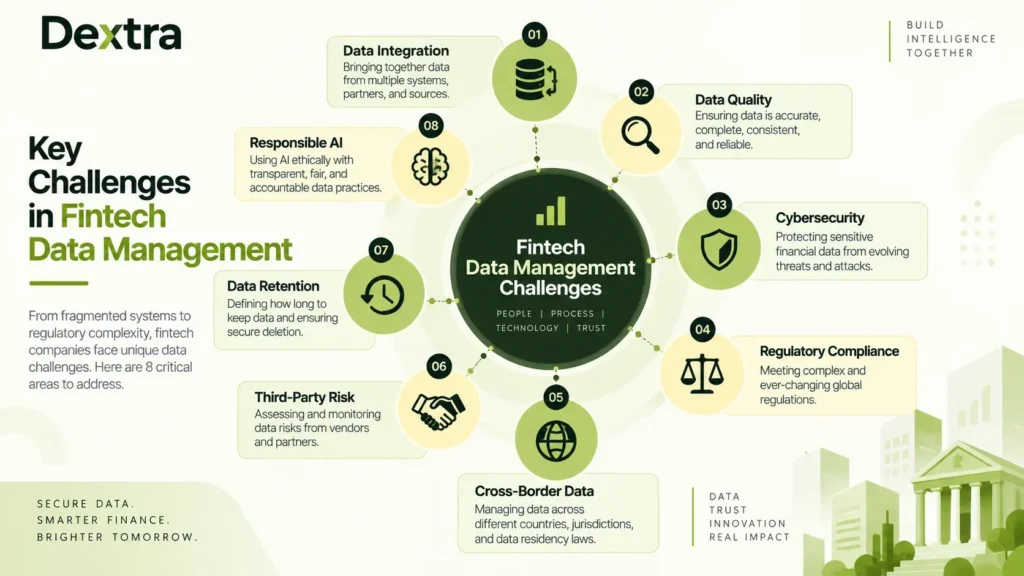
1. Data Integration Across Legacy and Modern Systems
Many fintech companies operate hybrid technology environments that combine legacy banking systems, core processing platforms, modern cloud infrastructure, microservices, APIs, and third-party integrations. Data often flows across these systems in different formats, with different schemas, and under different access controls.
This creates significant fintech legacy system risks: fragmented data, inconsistent governance, difficulty maintaining audit trails, and increased attack surface. Legacy architecture can make data governance and regulatory compliance particularly difficult when critical financial data is distributed across older systems.
2. Data Quality and Consistency
Maintaining data quality across interconnected fintech systems is a persistent challenge. Duplicate customer records, inconsistent transaction data, mismatched identifiers across systems, and incomplete data migrations can all compromise data integrity.
Poor data quality affects not only reporting and analytics but also customer experiences, regulatory reporting accuracy, and the reliability of AI/ML models that depend on high-quality input data.
3. Cybersecurity and Unauthorized Access
Fintech cybersecurity risks are elevated because financial platforms process high-value data and high-volume transactions. Threats include external attacks (ransomware, phishing, API exploits, DDoS), insider threats, and credential compromise.
Fintech data security requires layered defenses including identity and access management, encryption, network segmentation, continuous monitoring, vulnerability management, and incident response capabilities. Weaknesses in any of these areas can lead to fintech data breach risks that affect both the business and its customers.
Data privacy and cybersecurity: Data privacy also depends heavily on the security controls protecting the systems that collect and process sensitive information. A fintech data security failure is almost always a fintech data privacy failure as well.
4. Regulatory and Privacy Compliance
Fintech companies must navigate a complex landscape of overlapping regulatory requirements. The specific obligations applicable to a fintech depend on its products, data flows, business model, customers, payment activities, and jurisdictions.
Relevant regulatory categories may include:
• Privacy and data protection obligations (such as GDPR, CCPA, and other jurisdiction-specific frameworks)
• Payment-card security requirements (such as PCI DSS)
• Financial-sector regulations (such as SOX, GLBA, or jurisdiction-specific banking and securities rules)
• Anti-money laundering (AML) and Know Your Customer (KYC) requirements
• Contractual requirements from partners, processors, and platform providers
Fintech compliance data management requires maintaining controls, documentation, audit trails, and reporting capabilities that can satisfy multiple regulatory frameworks simultaneously. This is a core component of fintech data governance best practices.
5. Cross-Border Data Transfers and Data Sovereignty
Fintech companies that serve customers across jurisdictions face additional complexity around fintech data sovereignty, the principle that data may be subject to the laws and regulations of the jurisdiction where it is collected or stored.
Cross-border data transfers must comply with applicable transfer mechanisms, adequacy decisions, and contractual safeguards. Conflicting requirements across jurisdictions can create operational complexity and compliance risk, particularly for fintech platforms processing payment, identity, and financial data across multiple regions.
6. Third-Party and Vendor Data Risk
Fintech platforms typically depend on multiple external partners and vendors: payment processors, banking-as-a-service providers, identity verification vendors, cloud services, credit bureaus, fraud detection platforms, and open-banking API providers.
Each third-party relationship introduces fintech third-party data risk. When sensitive customer or transaction data is shared with external processors, the fintech company remains accountable for how that data is handled. Vendor concentration, where critical functions depend on a single provider, amplifies this risk.
Assessing and monitoring third-party data practices is a critical but often underestimated component of fintech data protection.
7. Data Retention and Deletion
Fintech companies must balance competing pressures: regulations that require retaining certain records for defined periods, privacy laws that require deleting personal data when it is no longer necessary, business needs that benefit from historical data, and storage costs that increase with data accumulation.
Without clear retention and deletion policies, and the technical capability to execute them across distributed systems, fintech companies face both compliance exposure and unnecessary data-breach risk from retaining data longer than required.
8. Responsible AI and Ethical Data Use
As AI becomes more embedded in fintech products for credit scoring, fraud detection, customer service, underwriting, and personalization, responsible AI in fintech has become a governance priority.
Key concerns include:
• Training-data provenance: Where did the data come from and was it collected appropriately?
• Personally identifiable information in training datasets and the risk of sensitive financial data exposure
• Model access controls and data leakage between environments
• Bias and discriminatory outcomes in credit, insurance, and lending decisions
• Model monitoring, data drift, and performance degradation
• Explainability requirements for decisions that affect customer financial outcomes
• Human oversight mechanisms for high-stakes automated decisions
• Third-party foundation models and AI vendor data-retention policies
AI governance fintech frameworks must address these concerns to reduce fintech AI data risks while enabling innovation. This also creates a natural bridge to AI due-diligence capabilities as part of a broader fintech technology assessment.
Common Risks of Poor Fintech Data Management
When fintech data management and privacy practices are inadequate, the consequences can be severe and wide-ranging. Understanding these fintech data risks helps organizations prioritize investments in governance, security, and infrastructure.
Data Breaches
Fintech data breach risks are among the most visible consequences of weak data management. A breach involving customer financial records, identity data, or payment information can result in direct financial losses to customers, regulatory investigations and penalties, class-action litigation, and long-term reputational damage.
The severity is amplified when breaches expose data that attackers can use for identity theft or financial fraud.
Regulatory Exposure
Inadequate fintech data governance can lead to regulatory enforcement actions, fines, consent orders, required remediation programs, and restrictions on business activities. In some jurisdictions, repeated compliance failures can threaten a fintech company’s operating license.
Regulatory exposure is particularly acute for fintech companies that handle payments, process customer identity data, or operate across multiple jurisdictions.
Financial Fraud
Weak data management controls, including poor access management, insufficient transaction monitoring, and inadequate identity verification, can create opportunities for financial fraud. This includes payment fraud, account takeover, synthetic identity fraud, and money laundering.
Fintech privacy risks extend to fraud scenarios where stolen personal and financial data enables downstream criminal activity.
Poor Data Quality
Poor data quality affects financial reporting accuracy, customer communications, credit and lending decisions, fraud detection effectiveness, and the performance of AI and machine learning models.
When financial data used for AI systems is inaccurate, incomplete, or inconsistent, the resulting models can produce unreliable outputs, creating both business risk and potential regulatory exposure.
Operational Disruption
Data management failures can directly disrupt fintech operations: corrupt data migrations, failed integrations, database performance issues, and data-pipeline outages can all affect transaction processing, customer access, and business continuity.
For fintech platforms that process real-time payments or manage customer accounts, even brief operational disruptions can have significant financial and customer-trust consequences.
Customer Trust and Reputation
Customer trust is foundational to fintech businesses. Privacy failures, data breaches, unauthorized data sharing, or visible data-quality problems can erode trust rapidly and permanently.
In a competitive market where customers can switch providers easily, fintech data protection failures can directly affect customer acquisition, retention, and lifetime value.
AI Model and Decisioning Risk
AI-powered fintech products create specific risks when data management and governance are inadequate. Models trained on poor-quality, biased, or improperly governed data can produce discriminatory credit decisions, inaccurate fraud detection, unreliable risk assessments, and compliance violations.
Fintech AI data risks are compounded when there is insufficient model monitoring, limited explainability, or no clear human oversight for high-stakes automated decisions.
Fintech Data Governance Best Practices
Strong fintech data governance best practices provide the foundation for effective fintech data management, privacy, and security. The following framework outlines the key governance areas that fintech companies should address.
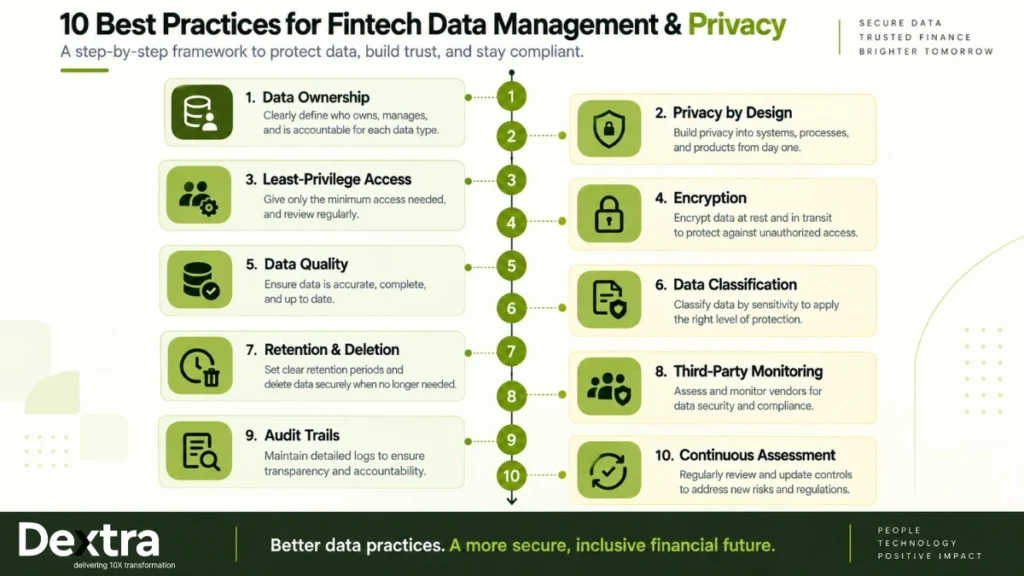
1. Establish Data Ownership and Governance
Define who owns each critical data domain, customer data, transaction data, financial data, identity data, AI/ML training data, and who is accountable for its quality, protection, and lifecycle management.
Establish a data governance structure with clear roles, responsibilities, policies, and escalation paths. Data governance should not be an afterthought attached to IT, it should be a cross-functional discipline involving engineering, compliance, security, product, and business stakeholders.
2. Apply Privacy by Design
Address fintech data privacy requirements during product and architecture design rather than after deployment. Privacy by design means building privacy controls, data minimization, consent management, and access restrictions into systems from the start.
This reduces the need for costly retrofits and helps ensure that new products and features are launched with appropriate privacy protections already in place.
3. Enforce Least-Privilege Access
Users and systems should receive only the access necessary for their functions. Implement role-based access controls (RBAC), regularly review access permissions, manage privileged access separately, and remove access promptly when roles change.
Excessive user privileges are one of the most common, and most preventable, fintech data security weaknesses.
4. Encrypt Sensitive Data
Protect data both in transit and at rest with appropriate encryption algorithms and key-management controls. This applies to customer data, payment information, identity records, financial data, API communications, and AI/ML training datasets.
Encryption is a baseline fintech data protection control, but it must be implemented correctly with proper key rotation, storage, and access management to be effective.
5. Improve Data Quality
Use validation rules, deduplication processes, reconciliation checks, and lineage tracking for critical financial and customer data. Establish data-quality metrics, monitor them continuously, and address quality issues before they affect downstream systems, customer experiences, or regulatory reporting.
For fintech companies using AI, data quality is directly linked to model reliability and fairness.
6. Implement Data Classification
Separate financial, identity, authentication, transactional, behavioral, and other sensitive datasets according to risk level. Classification should determine which security controls, access policies, retention rules, and monitoring requirements apply to each data category.
Without clear data classification, fintech companies cannot effectively prioritize their data protection investments or demonstrate governance maturity to regulators and investors.
7. Establish Retention and Deletion Policies
Define how long different categories of data should be retained, what legal and regulatory requirements govern retention periods, and how data is securely deleted when it is no longer needed.
A fintech compliance data management program must include tested deletion processes that work across all systems where data is stored, including backups, analytics platforms, and third-party systems.
8. Monitor Third-Party Data Access
Evaluate the security, privacy, and data-processing practices of all third-party providers that handle sensitive data. Assess concentration risk, contractual protections, data-residency implications, and incident-response coordination.
Third-party data risk management is an ongoing process, not a one-time vendor assessment. It requires continuous monitoring and periodic reassessment as vendor relationships evolve.
9. Maintain Audit Trails
Track access, changes, transfers, and other important data activities across all systems that handle sensitive information. Audit trails support regulatory compliance, incident investigation, forensic analysis, and internal governance reviews.
Comprehensive audit logging is a fundamental requirement for fintech companies and a key area of focus in any fintech data risk assessment.
10. Continuously Assess Security and Compliance
Combine security testing, access reviews, compliance assessments, and technology due diligence to maintain an ongoing understanding of the organization’s data-management posture.
Static, point-in-time assessments are insufficient. Fintech data governance requires continuous evaluation as the technology environment, regulatory landscape, threat landscape, and business operations evolve.
Important: Best practices alone are not enough. Organizations need to validate that their controls are working through testing, monitoring, auditing, and periodic independent assessment, including fintech technology risk assessment as part of broader due diligence processes.
Data Management in Fintech Technology Due Diligence
Data management is a critical component of fintech technology due diligence because weaknesses in data architecture, governance, security, or privacy can create both technical and business risk.
A fintech data due diligence assessment should examine how data moves through the platform, where sensitive information is stored, who can access it, how it is protected, and whether the organization can demonstrate appropriate governance and controls.
Key areas that a fintech technology assessment should evaluate include:
Data Architecture
Assess how customer, transaction, payment, identity, and operational data flows across applications, databases, APIs, and third-party systems. Evaluate whether the data architecture supports the company’s growth trajectory, operational requirements, and regulatory obligations.
Data Governance
Review data ownership, classification, quality controls, access policies, lineage, retention, and accountability. A fintech data governance assessment should determine whether governance is formalized, enforced, and integrated into the organization’s technology and operating processes.
Privacy and Regulatory Controls
Examine how personal and financial information is collected, processed, shared, retained, and deleted. Assess whether privacy controls are embedded in the technology architecture or applied as manual, ad-hoc processes. Review consent management, data-subject rights handling, and privacy-impact assessment practices.
Security
Evaluate encryption, identity and access management, privileged access, monitoring, logging, vulnerability management, and incident response. Fintech data security assessment should cover both the controls themselves and the organization’s ability to detect, respond to, and recover from security events.
Third-Party Dependencies
Identify external processors, payment providers, data vendors, cloud services, and other dependencies that handle sensitive information. Assess the contractual protections, security posture, concentration risk, and data-residency implications of each critical dependency.
Data Quality
Review data-quality practices, validation mechanisms, reconciliation processes, and the organization’s ability to detect and correct data-quality issues before they affect downstream operations, customer experiences, or regulatory reporting.
AI/ML Data Readiness
Where AI is used, assess data quality, provenance, access controls, model inputs, governance, monitoring, and potential privacy or bias risks. AI data privacy in fintech is an increasingly important dimension of technology due diligence as AI-driven products play a larger role in financial decision-making.
Objective: The objective of fintech data due diligence is not simply to determine whether a fintech company has a privacy policy. It is to determine whether the underlying technology and operating processes can support secure, governed, compliant, and scalable use of sensitive data.
Fintech Data Privacy Red Flags for Investors and Acquirers
During a fintech data risk assessment, certain findings consistently indicate elevated risk. The following red flags should raise concerns for investors, acquirers, and fintech leadership teams:
| Red Flag | Potential Implication |
| Sensitive data stored without clear classification | Poor governance and higher exposure |
| Excessive user privileges | Increased unauthorized-access risk |
| No documented data lineage | Difficult auditing and troubleshooting |
| Multiple inconsistent customer-data sources | Data quality problems |
| Weak API security | Exposure through connected systems |
| Heavy reliance on third-party data processors | Vendor concentration and dependency risk |
| No tested data-retention process | Compliance and storage risk |
| Legacy databases with weak controls | Modernization and security risk |
| Limited audit logging | Poor investigation and accountability |
| Uncontrolled AI data usage | Privacy, governance and model risk |
| No tested incident-response process | Greater impact from breaches |
| Cross-border data flows without clear controls | Jurisdictional and privacy risk |
Investor insight: These red flags are particularly valuable because they move the conversation from generic educational content to technology-risk analysis. Each red flag can be traced to specific areas of a fintech technology due diligence assessment, helping investors and acquirers identify where deeper investigation is required.
How to Build a More Resilient Fintech Data Environment
Building a resilient fintech data environment requires a coordinated approach across technology, governance, operations, and culture. The following priorities can help fintech companies strengthen their data management and privacy posture:
• Treat data management as a cross-functional discipline. Effective fintech data governance requires participation from engineering, security, compliance, product, legal, and business leadership, not just the IT team.
• Invest in data architecture. A well-designed data architecture reduces integration complexity, improves data quality, simplifies compliance, and enables secure scaling.
• Automate governance where possible. Manual data governance processes do not scale. Invest in automated classification, access management, retention enforcement, and monitoring.
• Plan for regulatory change. Build compliance frameworks that can adapt to new requirements rather than rebuilding controls for each regulatory change.
• Address AI data governance proactively. As AI becomes more central to fintech products, AI governance fintech frameworks should be established before AI-related data issues become enforcement priorities.
• Test and validate regularly. Policies and controls are only effective when they are implemented correctly and maintained. Regular testing, auditing, and independent assessment are essential.
• Prepare for due diligence. Fintech companies that may seek investment, partnership, or acquisition should build data management practices that can withstand a thorough fintech technology risk assessment. Good practices reduce risk during due diligence and support higher valuations.
New technologies can improve data handling while introducing new privacy and governance considerations. Organizations that proactively address data management, security, and governance will be better positioned to adopt emerging technologies safely and to demonstrate readiness during technology due diligence assessments.
How Dextra Labs Supports Fintech Technology Due Diligence
Dextra Labs helps fintech investors, acquirers, and leadership teams assess the technology foundations behind financial products. Our assessments combine architecture, engineering, cybersecurity, data, infrastructure, scalability, and AI evaluations to identify material risks and translate technical findings into actionable investment and technology priorities.
A Dextra Labs fintech technology due diligence engagement can assess:
• Data architecture, flows, and integration patterns
• Data governance maturity and policy effectiveness
• Privacy controls and regulatory compliance readiness
• Fintech data security posture and incident preparedness
• Third-party data dependencies and vendor risk
• Data quality practices and monitoring capabilities
• AI/ML data governance, model risk, and data-readiness evaluation
• Legacy system risks and modernization requirements
• Cross-border data flows and data-sovereignty implications
• Technology economics and cost-to-scale modeling
Learn more about our technical due diligence services in USA, Singapore and how we help investors and fintech leadership teams make informed technology decisions.
Conclusion
Fintech data management and privacy is not a single project or a compliance checkbox, it is a continuous discipline that must evolve alongside the business, its technology environment, regulatory requirements, and the threat landscape.
Companies that invest in strong fintech data governance, establishing clear ownership, implementing privacy by design, enforcing access controls, classifying and protecting sensitive data, managing third-party risk, and addressing AI governance proactively, build more resilient, compliant, and trustworthy businesses.
For investors and acquirers, the quality of a fintech company’s data management and privacy practices is a direct indicator of technology maturity and operational discipline. A thorough fintech data due diligence assessment can reveal both material risks and opportunities to strengthen the technology foundation through targeted investment.
Effective fintech data management reduces technology risk, supports regulatory readiness, protects customer trust, and enables the secure scaling of fintech products and platforms.
Organizations that treat data management as a strategic priority, not just a compliance obligation, will be better positioned for growth, investment, and long-term success in an increasingly data-driven financial-services environment.
FAQs:
What is fintech data management?
Fintech data management is the set of processes, policies, technologies, and controls that govern how financial technology companies collect, store, organize, process, protect, share, and dispose of sensitive financial and customer data across the complete data lifecycle.
Why is data privacy important for fintech companies?
Fintech data privacy is critical because financial technology companies handle sensitive personal and financial information. Privacy failures can result in data breaches, regulatory penalties, customer trust erosion, financial fraud, and significant business disruption. Financial data privacy is both a regulatory requirement and a business-resilience concern.
What are the biggest fintech data management challenges?
The most significant fintech data management challenges include integrating data across legacy and modern systems, maintaining data quality, managing cybersecurity threats, navigating complex regulatory requirements, handling cross-border data transfers, managing third-party data risk, and governing AI/ML data usage.
What should investors assess during fintech data due diligence?
A fintech data due diligence assessment should evaluate data architecture, data governance maturity, privacy and regulatory controls, security posture, third-party data dependencies, data quality practices, and AI/ML data readiness. The objective is to determine whether the technology can support secure, governed, compliant, and scalable data management.
What is the role of AI governance in fintech data management?
AI governance fintech frameworks address how financial data used for AI training and inference is collected, accessed, processed, governed, and monitored. Responsible AI in fintech includes managing training-data quality, preventing bias, ensuring explainability, maintaining human oversight, and controlling data access to reduce fintech AI data risks.
How does data management affect fintech technology due diligence?
Data management is a core dimension of technology due diligence in fintech. Weaknesses in data architecture, governance, security, or privacy can create regulatory, operational, and business risk. A thorough fintech technology assessment includes evaluating data flows, access controls, governance policies, retention practices, and AI/ML data readiness as part of the overall technology risk assessment.