
Startups move fast, and so do the deals around them. Funding rounds come together in days, not months. Bridge rounds appear and close before a traditional diligence process could even schedule its kickoff call. If you’re an investor, a PE firm, an advisor, or a founder preparing to raise, you rarely have the luxury of a twelve-week technical review.
Market experts put the average technical due diligence at around 12 weeks, yet a live deal often demands a turnaround measured in days. That gap is why a 7-day tech DD has moved from ambitious to essential. With the right prioritisation and a focused approach, you can build a clear, defensible picture of a startup’s technology, team, product, and risks in a single week.
This guide walks through exactly how to do it, one day at a time, with the typical risks flagged along the way, so a busy investor or advisor can evaluate a startup quickly without evaluating it carelessly.
What Is Rapid Technical Due Diligence?
Rapid technical due diligence is a compressed, risk-based version of the technical evaluation an investor runs before committing capital. It keeps the goal of a full technology due diligence confirming the technology is solid, secure, and ready to scale, but concentrates the week on the pillars that most affect a go/no-go decision, leaving slower specialist investigations for after the deal moves forward.
In a startup context, it’s never just a code review. It looks at the product, the tech stack, the engineering team, and the risks, from security gaps to a dangerous reliance on one founding engineer, or a vendor contract with no exit. It confirms three things: the technology is well built, the product works as promised, and the team can deliver. Investors run it to spot red flags before writing a cheque; founders run it internally to fix issues before investors ever see them.
Can It Really Be Done in 7 Days?
Honestly, it depends on what you mean by “done.”
A seven-day engagement won’t exhaustively catalogue every line of technical debt, load-test every endpoint, or resolve a complex IP dispute. What it will do and do reliably is surface the risks that should actually change an investment decision. It’s a focused, prioritised assessment, not a compressed version of everything. The deep specialist investigations still exist; they’re just sequenced to happen after the week gives you enough to decide whether to keep going.
And if that sounds like a compromise reserved for those who can’t afford a full review, it isn’t. It’s how the top of the industry already operates when a deal is time-boxed.
| 🏛️ EVEN BAIN RUNS RAPID TECH DD When a leading private equity firm had questions about a target’s technology and just a two-week exclusivity window, Bain & Company’s Tech Insights Group ran a rapid technical deep dive, covering data architecture, cloud migration, and cybersecurity, and delivered both a go/no-go call and holding-period recommendations. The firm bid with confidence and moved to invest.The takeaway: a time-boxed technical review, done well, is a recognised discipline at the very top of the deal world. Speed and rigour are not opposites. (Source: Bain & Company client results.) |
The 7-Day Rapid Tech DD Framework
Here’s how the week breaks down. Each day targets one pillar, building toward an investor-ready report on Day 7. The order matters, mid-week infrastructure and security findings feed the risk picture the final report consolidates.
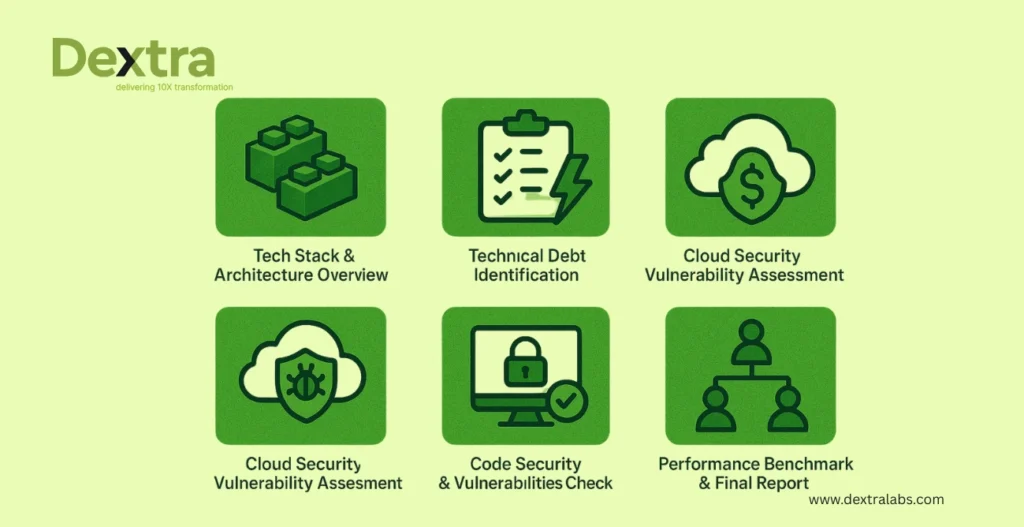
Day 1: Tech Stack & Architecture
– Identify the core components of the stack
– Evaluate whether the architecture aligns with business goals
– Check modularity, maintainability, and upgrade readiness
Day 2: Codebase & Technical Debt
– Review outdated frameworks, redundant libraries, and shortcuts
– Identify high-risk areas likely to cost time or money at scale
– Prioritise refactoring zones and immediate risks
Day 3: Cloud Infrastructure & Costs
– Analyse the cloud setup (AWS, Azure, GCP)
– Validate cost-efficiency and scaling configuration
– Detect misconfigured or unused resources
Day 4: Cybersecurity, Access & Compliance
– Scan for access-control misconfigurations
– Review exposed services, unpatched environments, insecure ports
– Validate compliance-readiness by market, SOC 2, GDPR, PDPA, DPDP, and more
Day 5: Code Security & Dependencies
– Run static analysis (SAST) to flag security issues
– Detect hard-coded secrets, dependency risks, weak encryption
– Review secure-coding practices and build hygiene
Day 6: Engineering Team & Key-Person Risk
– Assess technical roles and skill distribution
– Identify key-person dependency and talent gaps
– Evaluate readiness for scaling, re-architecture, or a pivot
Day 7: Scalability, Performance & Final Report
– Benchmark against industry metrics (latency, scalability, uptime)
– Consolidate findings into an investor-ready report
– Highlight strengths, red flags, and investment risks
This compressed sequence follows the same logic as a full technical due diligence process the difference is prioritisation and pace, not a lower standard of evidence.
What Should Investors Look For During a Rapid Tech DD?
Across those seven days, the review covers seven assessment areas, architecture, codebase, cloud, security, IP, team, and product. But the findings themselves aren’t the value. The value is translating each one into a deal consequence, which is exactly what the RCOI framework is built to do: every finding becomes a risk, with a cost to fix, an opportunity if resolved, and an impact on the deal. This is the table to keep in front of you:
| Area | What to assess | Typical red flag | Investment impact |
|---|---|---|---|
| Architecture | Scalability, dependencies, modularity | Fragile architecture | Rebuild / remediation cost |
| Codebase | Maintainability, testing, tech debt | Poor test coverage | Engineering drag |
| Cloud | Cost, reliability, scalability | Misconfigured resources | Opex / scaling risk |
| Security | Vulnerabilities, access, secrets | Critical vulnerabilities | Security / compliance risk |
| IP | Ownership, OSS, licences | Unclear ownership | Legal / deal risk |
| Team | Skills, ownership, dependencies | Key-person dependency | Execution risk |
| Product | Performance, roadmap, scalability | Growth bottlenecks | Investment-thesis risk |
That final column is the whole point. A vulnerability nobody can price is just anxiety; the same vulnerability with a cost and a timeline is a decision an investor can actually make.
What Does a Rapid Tech DD Report Include?
A rapid report is only useful if a decision-maker can absorb a week’s work in a few minutes. A strong one leads with the summary and flags, then layers in the detail for anyone who wants it:
- Executive summary: the headline read, ideally with a red / yellow / green flag system for high, moderate, and low-risk areas.
- Scope and methodology: what was assessed, how, and what was intentionally deferred.
- Technology architecture: design, scalability, and structural risk.
- Codebase and technical debt: maintainability, testing, and remediation zones.
- Infrastructure and cloud: cost, reliability, and scaling readiness.
- Security and compliance: vulnerabilities and market-specific compliance posture.
- IP and third-party dependencies: ownership clarity and open-source exposure.
- Engineering team: capability, gaps, and key-person risk.
- Scalability and performance: benchmarks against the growth the thesis assumes.
- Risk matrix: every finding, rated by severity and business impact.
- Remediation priorities and deal implications: what to fix now, what can wait, and how the findings should shape the bid, valuation, or holding-period plan.
Turning a Week of Findings Into a Decision
A rapid DD is only as good as the report it produces — and a good report never ends as a raw list of technical problems. The findings have to connect to the decision: what’s the risk, what will it cost to fix, and how should it affect the bid, the valuation, or the post-deal plan?
At Dextra Labs we structure that translation through our RCOI framework (Risks, Costs, Opportunities, Impact), so every finding lands in terms an investor can act on rather than as an engineering note. A vulnerability nobody can price is just anxiety; the same vulnerability with a cost and a timeline is a decision. Explore our technical due diligence services, or book a free consultation to scope your next deal.
However it’s framed, a strong rapid report leads with an executive summary, ideally a simple red / yellow / green flag system that shows high, moderate, and low-risk areas at a glance, then moves through the tech-stack review, the team review, and roadmap alignment: does the technical plan actually match the business strategy and investor expectations? That structure is what lets a decision-maker absorb a week’s work in a few minutes.
Rapid Tech DD Across Global Markets
One thing most rapid-DD guides ignore: the compliance layer changes with geography, and a seven-day review has to check the right regime for the target’s markets, not a generic one. This matters most on Day 4, where compliance-readiness is assessed.
- USA — SOC 2 is the expected security benchmark; CCPA governs data privacy.
- UK & EU — UK/EU GDPR set a high bar, and the EU AI Act adds obligations for AI-driven startups.
- Singapore — the PDPA governs data protection, with MAS expectations layered on for fintech.
- UAE — data-residency and localisation rules, plus sector-specific regulation in finance and health.
- India — the DPDP Act governs data protection, and the IBC framework applies in distressed or acquisition contexts.
A startup selling across borders has to satisfy the strictest regulator it touches, not just its home one, which is why Dextra Labs runs rapid tech DD across all five of these markets rather than through a single-country lens.
Rapid vs. Full Technical Due Diligence
| Rapid (7-Day) | Full-Scope DD | |
|---|---|---|
| Objective | Rapid risk identification | Comprehensive assessment |
| Time | ~7 days | Longer engagement |
| Scope | Priority risk areas | Broader, deeper review |
| Best for | Time-sensitive deals | Complex transactions |
| Output | Decision-ready risk report | Comprehensive DD report |
The two aren’t rivals, they’re stages. The rapid review answers “should we keep going?”; the full one answers “exactly what are we buying, and at what cost?” For how pricing differs between them, see our technical due diligence cost guide.
Final Word
A structured, rapid technical due diligence is what lets investors, PE firms, and deal aggregators make fast decisions without making blind ones. Compressed into 7 days, it surfaces the key risks and opportunities and keeps a deal on track when the timeline won’t bend. The twelve-week review still has its place. But when a deal won’t wait, a disciplined 7-day process isn’t a compromise, as the top of the industry has already shown, it’s simply how modern diligence gets done.

Need a 7-day DD for your next deal?
Book Dextra labs’ Rapid Tech DD Package Today.
Book Your Free CallFAQs on Rapid Startup Due Diligence:
Can a full technical due diligence really be done in 7 days?
A rapid 7-day engagement is a focused, risk-based assessment, it reliably surfaces the issues that should change an investment decision, but it isn’t an exhaustive audit. Deeper specialist investigations (load testing, forensic security, IP disputes) may need more time. Even Bain & Company runs rapid tech DD on comparable two-week windows for PE clients.
What’s the difference between rapid and full technical due diligence?
A full review runs around 12 weeks and examines everything in depth. A rapid review prioritises the pillars that most affect a go/no-go decision and defers the slower analysis. The rigour on each pillar assessed is the same; the scope is narrowed to the deal’s timeline.
What does a rapid tech DD report include?
An executive summary with a risk-flag system, scope and methodology, and sections on architecture, codebase and technical debt, cloud, security and compliance, IP and dependencies, the engineering team, and scalability, plus a risk matrix, remediation priorities, and the investment/deal implications.
When is a rapid tech DD not enough?
When the target is a large enterprise platform, operates in a heavily regulated environment, spans many repositories or products, involves a complex M&A integration, requires deep cybersecurity forensics or IP dispute analysis, or needs production-scale load testing. In those cases the rapid review works best as a first pass before a fuller engagement.
Should founders be involved during the DD week?
Yes, founder availability is essential. They provide context, answer technical questions, and clarify areas needing deeper investigation. A compressed timeline depends on fast, direct access to the people who built the system.
Does a rapid tech DD account for different countries’ regulations?
It should, compliance requirements differ by market; SOC 2 and CCPA in the USA, GDPR and the EU AI Act in the UK and Europe, PDPA in Singapore, data-residency rules in the UAE, and the DPDP Act in India. A cross-border startup must satisfy the strictest regulator it touches, so the review checks the right regime, not a generic one.