Just a few years back, AI in customer service meant answering FAQs and routing tickets. Today, it’s handling refunds, resolving billing issues, updating orders, booking appointments, and deciding when a human should step in, all with little to no manual intervention.
Gartner predicts that 80% of common customer service issues will be resolved autonomously by AI agents by 2029. So, if you’re evaluating an AI customer service agent, you’re investing in more than automation. You’re rethinking how your business delivers customer support at scale while keeping every interaction fast, consistent, and personalized.
However, the challenge is figuring out what’s real. Nearly every platform now markets itself as an AI customer service agent, but not every solution delivers true autonomy. Some are conversational AI tools with limited workflows, some are full-fledged agentic systems, and others are platforms for building custom solutions. As agentic AI for customer service continues to evolve, understanding these differences is important before you invest time, budget, and resources.
This guide covers what AI agents for customer service actually are, how they work, where they create the most value, how today’s leading solutions compare, and whether buying, building, or adopting a hybrid approach is the right choice for your business.
What Is an AI Agent for Customer Service?
An AI agent for customer service is an autonomous AI system that understands customer intent, decides the best course of action, and resolves customer issues by interacting with enterprise systems often without human intervention.
Beyond simply answering customer queries like traditional chatbots, AI customer service agents can maintain context across conversations, execute multi-step workflows, integrate with CRM, ticketing, and order management systems, and complete tasks such as processing refunds, updating accounts, and escalating complex cases when needed.
AI Agent vs Chatbot vs AI Assistant: The Distinction That Matters
Here’s how chatbots, AI assistants, and AI agents compare across the capabilities that matter most for enterprise customer service.
| Capability | Chatbot | AI Assistant | AI Agent |
| Understanding | Chatbot understands keywords, predefined intents, and rule-based commands to respond to specific user requests. | AI Assistants understands natural language and answers single-turn queries with relevant, context-aware responses. | AI Agents understands context, reasons across multi-turn conversations, and adapts responses based on goals and evolving situations. |
| Memory | It is session-based with no long-term memory | It maintains limited conversational context during an interaction. | It remembers conversation context, user preferences, and customer history across sessions to deliver personalized experiences. |
| Action | They provides scripted or predefined responses. | They generates answers, recommendations, summaries, and insights to assist users in decision-making. | These AI agents executes end-to-end workflows, automates business processes, and performs tasks across multiple systems with minimal human intervention. |
| Integration | It connects primarily to FAQs, static content, or basic knowledge bases to retrieve information. | It accesses enterprise knowledge bases, documents, and business information to provide informed responses. | It integrates with CRM, ticketing, payment, ERP, HR, and other enterprise systems to complete actions and manage workflows. |
| Autonomy | It follows predefined rules and workflows with little or no independent decision-making. | It assists users by answering questions and providing recommendations while relying on user direction. | It reasons, makes decisions, plans tasks, and takes appropriate actions independently when authorized. |
| Learning | The Chatbots require manual updates. | These AI Assistants learn and improves within a limited scope. | They continuously improves through user feedback, operational data, and evolving workflows to improve performance over time. |
While chatbots and AI assistants still play an important role in customer support, they’re primarily designed to answer questions and help users. An AI agent for customer service goes a step further by understanding context, making decisions, and completing end-to-end tasks across enterprise systems. As customer expectations continue to rise, this ability to act and not just respond is what sets AI agents apart.
Types of AI Agents for Customer Service
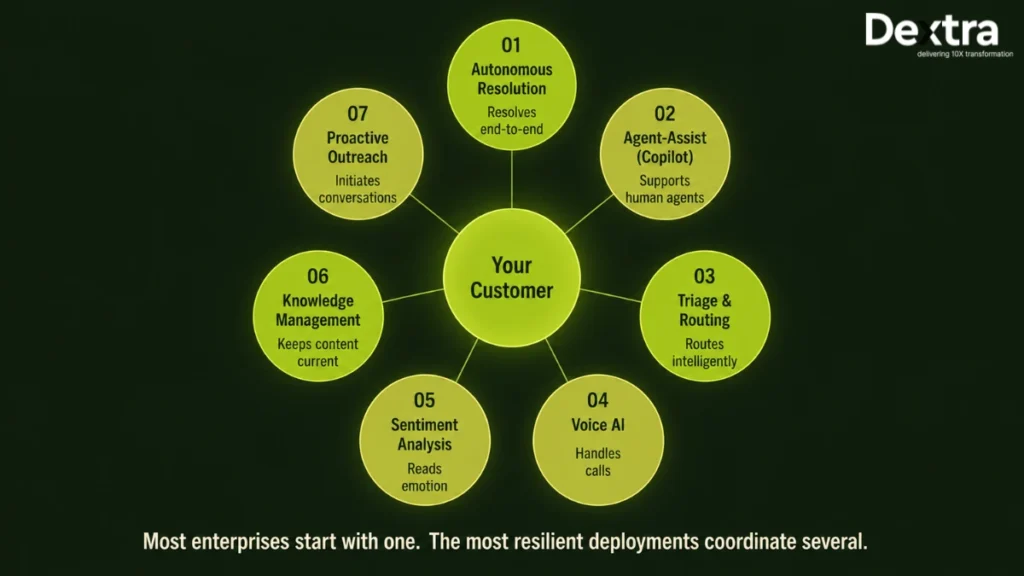
Not every AI agent is designed to do the same job. Below are the different types of AI agents for customer service and the role each one plays in modern customer support operations.
1. Autonomous Resolution Agents
Autonomous resolution ai agents are the most advanced AI customer service agents, capable of resolving customer issues from start to finish without human involvement. They can process refunds, update customer accounts, manage subscriptions, track orders, and complete other multi-step workflows by interacting with enterprise systems. For many organizations, they’re the foundation of AI agents for customer service automation. Leading platforms in this category include Sierra AI, Decagon, Ada CX, and Intercom Fin.
2. Agent-Assist (Copilot) Agents
Rather than replacing support teams, copilot agents work alongside them. They draft responses, surface relevant knowledge, summarize conversations, and recommend the next best action, allowing human agents to respond faster and more accurately. They’re often the first step for enterprises that want to improve efficiency while keeping humans involved in every customer interaction. Salesforce Agentforce and Zendesk AI Agents offer strong agent-assist modes alongside autonomous capabilities.
3. Triage and Routing Agents
Triage and routing ai agents automatically analyze incoming requests based on intent, urgency, customer sentiment, and priority before routing them to the right support team, specialist, or autonomous workflow. By replacing manual ticket sorting, they help contact centers manage high conversation volumes more efficiently and reduce response delays.
4. Voice AI Agents
Voice AI agents handle inbound and outbound customer calls using natural, real-time conversations. They understand spoken language, detect interruptions and customer emotions, and respond with low latency to create a human-like experience. They’re increasingly being integrated with chat and messaging channels to deliver a seamless omnichannel customer experience.
5. Sentiment Analysis Agents
Sentiment analysis AI agents continuously monitor customer conversations to identify emotions such as frustration, satisfaction, or urgency. They can prioritize unhappy customers, detect early churn signals, and provide valuable insights that help support teams improve service quality and customer retention. In most enterprise deployments, sentiment analysis is embedded within broader customer service AI agent workflows rather than used as a standalone solution.
6. Knowledge Management Agents
Knowledge management AI agents keep support content accurate and up to date. They identify gaps in help center articles, generate FAQs from recurring customer issues, highlight outdated documentation, and continuously improve the knowledge base using real customer interactions, making future issue resolution faster and more consistent.
7. Proactive Outreach Agents
Instead of waiting for customers to reach out, Proactive outreach ai agents initiate conversations based on customer behavior or business events. They can send renewal reminders, order updates, personalized product recommendations, and service notifications, helping businesses improve engagement, reduce churn, and uncover new revenue opportunities.
Multi-Agent Orchestration: How Enterprise AI Agents Work Together
Modern AI agents in customer service rarely operate in isolation. Instead, enterprises increasingly rely on a multi-agent orchestration model where different agents collaborate to resolve customer requests. A triage agent classifies and routes the inquiry, an autonomous resolution agent handles routine issues, a sentiment analysis agent monitors customer satisfaction throughout the conversation, and an agent-assist copilot supports human representatives when complex cases require escalation. This coordinated approach enables AI agents for customer service to deliver faster resolutions, higher automation rates, and a more consistent customer experience across every touchpoint.
Key Components of AI Agents for Customer Service
Every AI agent for customer service relies on multiple components working together behind the scenes. While the technologies may vary, these are the core building blocks that enable modern AI agents to understand requests, make decisions, take action, and continuously improve over time.
1. Foundation Model (LLM)
The Foundation Model (LLM) is the reasoning engine that powers an AI-powered customer service agent. It understands customer intent, generates responses, and supports decision-making during conversations. In 2026, enterprise deployments commonly use Claude Sonnet 4.5 for reliability and safety, GPT-5 for its broad capabilities and mature ecosystem, and Gemini 2.5 Pro for handling long-context conversations. Most enterprises also adopt a BYOK (Bring Your Own Key) approach, allowing them to work directly with model providers for greater cost control, compliance, and flexibility while keeping business logic separate from the model itself.
2. Context Retrieval (RAG)
Retrieval-Augmented Generation (RAG) gives AI agents access to your organization’s knowledge instead of relying solely on what the model already knows. It retrieves company-specific information such as product documentation, support policies, pricing, and customer history before generating a response. Technologies like Pinecone, Weaviate, and pgvector power vector search, while embedding models such as OpenAI text-embedding-3-large and Cohere Embed v3 improve search accuracy. This layer often determines how relevant and reliable an AI agent’s responses are in real-world customer interactions.
3. Agent Orchestration
Agent orchestration is the decision-making layer that coordinates every step required to resolve a customer request. Instead of simply generating an answer, it can classify intent, retrieve policies, verify customer details, execute actions, trigger human handoffs, and record the outcome across connected systems. Frameworks such as LangGraph, AutoGen, and CrewAI are widely used in 2026 to build these workflows. This orchestration layer is especially important for organizations building AI customer service agents with custom workflows that need to match existing business processes.
4. Integration Layer
The Integration Layer connects AI agents with the enterprise systems they need to perform real work. Standard integrations include platforms like Salesforce Service Cloud, Zendesk, Intercom, HubSpot, and Freshdesk, while more advanced deployments extend to CRMs, ERP systems, payment gateways, contact center platforms like Genesys and Amazon Connect, and proprietary internal applications. The deeper these integrations are, the more autonomously an AI agent can resolve customer issues instead of simply providing information.
5. Governance and Compliance
Governance and Compliance ensure AI agents operate securely, transparently, and within enterprise policies. This layer includes audit trails, role-based access control (RBAC), PII detection, safety guardrails, and integrations with monitoring platforms such as Splunk and Datadog. Technologies like Microsoft Presidio, Guardrails AI, NeMo Guardrails, and Lakera Guard help protect sensitive data and reduce risks such as prompt injection. For highly regulated industries, this is often one of the most critical components of the overall architecture.
6. Observability and Continuous Improvement
Observability and Continuous Improvement help enterprises monitor how AI agents perform after deployment. Platforms like Langfuse and LangSmith trace every decision an agent makes, while tools such as Datadog, New Relic, and Ragas measure response quality, latency, retrieval accuracy, and operational costs. Combined with customer feedback, human reviews, and continuous prompt optimization, this layer ensures AI agents become more accurate, reliable, and efficient over time instead of remaining static.
Why Does the Customer Service Sector Need AI Agents?
As customer expectations continue to rise, AI agents for customer service have become a business necessity rather than a competitive advantage. Here are the key factors driving enterprise adoption:
1. Customer Expectations Have Outpaced Human Capacity
Customers today expect fast, personalized, and seamless support across every channel. According to Salesforce’s State of Service (2025) report, 82% of service representatives say that customer expectations are higher than they used to be. An AI agent for customer service helps bridge this gap by instantly resolving routine requests, allowing human agents to focus on complex conversations that require empathy and critical thinking.
2. 24/7 Availability Is Now the Standard
Customers no longer expect support only during business hours. Whether it’s a late-night billing issue or a weekend order inquiry, they want immediate assistance regardless of the time zone. Therefore, maintaining round-the-clock support with human teams alone is expensive and difficult to scale, while AI agents provide consistent, always-on service without increasing staffing costs.
3. Businesses Need to Lower Costs Without Sacrificing Service Quality
Customer service leaders are under constant pressure to reduce operational costs while improving customer satisfaction. An AI customer service agent can automate repetitive Tier 1 and Tier 2 requests, reducing cost per conversation while delivering faster, more consistent responses based on approved business knowledge. The result is higher efficiency without compromising the customer experience.
4. Agent burnout and turnover are operational crises
Repetitive customer queries and routine administrative work can quickly overwhelm support teams, leaving less time for complex conversations that require empathy, critical thinking, and personalized assistance. By handling these repetitive tasks, AI agents reduce agent workload and allow support teams to focus on higher-value interactions. This not only improves operational efficiency but also creates a better experience for both customers and support agents.
5. Multilingual Support Doesn’t Scale Through Hiring Alone
Serving customers across different countries requires support in multiple languages, but building dedicated teams for every language is rarely practical. AI agents can deliver consistent multilingual support while maintaining the same brand voice, policies, and service quality across regions that too without significantly increasing operational costs or headcount.
6. Customer Demand Can Spike Overnight
Product launches, holiday shopping seasons, service outages, and promotional campaigns can all increase support volumes almost instantly. Scaling human teams for these short-term surges is costly and inefficient as well. AI agents can absorb sudden increases in customer conversations without additional hiring, helping businesses maintain response times and service quality even during peak demand.
7. Every Customer Conversation Contains Valuable Insights
Most enterprises generate thousands or even millions of customer conversations every month, making manual analysis quite impossible. AI automatically extracts insights from every interaction, including customer intent, sentiment trends, recurring issues, knowledge gaps, and resolution patterns. These insights help organizations continuously improve products, support processes, and the overall customer experience instead of relying on limited sample-based reporting.
Role of AI Customer Service Agents in Enterprise Operations
An AI customer service agent supports much more than customer conversations. It becomes part of your day-to-day service operations, helping automate repetitive work, improve response times, and assist human teams throughout the entire customer support lifecycle. Here’s how AI agents in customer service create value at every stage:
1. First Contact and Inquiry Handling
Every customer interaction begins with a first response, and speed often shapes the entire experience. AI agents instantly engage customers across all channels whether web chat, mobile apps, email, WhatsApp, SMS, voice, or social channels. They identify customer intent, gather the necessary context, and determine whether the issue can be resolved immediately or requires additional information or human assistance.
2. Ticket Creation and Smart Classification
When a request requires tracking, AI agents automatically create support tickets with relevant details such as issue category, customer priority, urgency, sentiment, and product information. Instead of manually sorting incoming requests, they smartly route each ticket to the right support team, specialist, or automated workflow, helping your team respond faster and more efficiently.
3. Autonomous Resolution Execution
For routine support requests such as order tracking, password resets, subscription updates, refunds, or account changes, an AI agent for customer service automation can manage the entire resolution process alone. It retrieves the right information, verifies customer eligibility, performs actions across connected systems, confirms the outcome, and closes the request all without requiring human intervention. This allows support teams to dedicate their time to more complex customer interactions.
4. Escalation and Context-Rich Human Handoff
All issues can not be handled by AI alone. When conversations involve policy exceptions, sensitive situations, VIP customers, or complex problem-solving, AI agents recognize the need for escalation. Instead of transferring customers with no context, they pass complete conversation history, customer details, sentiment insights, and recommended next steps to the human agent, allowing the conversation to continue seamlessly rather than start over.
5. Post-Resolution Follow-Up
Customer service doesn’t end when a ticket is closed. AI agents can automatically send satisfaction surveys, share resolution summaries, recommend relevant help articles, and collect customer feedback after every interaction. This keeps customers engaged while giving your team valuable insights without adding extra manual work.
6. Knowledge Base Maintenance and Gap Detection
Every customer conversation helps reveal what your documentation is missing. AI agents continuously identify unanswered questions, outdated articles, and recurring support issues, then recommend new FAQs or knowledge base updates. Over time, this creates a knowledge base that evolves alongside your customers instead of becoming outdated.
7. Analytics, Reporting, and CX Intelligence
Every interaction generates valuable operational data. AI agents transform conversations into actionable insights by tracking resolution rates, CSAT trends, recurring customer issues, automation performance, sentiment patterns, and knowledge gaps. Instead of relying on manual reporting, you gain real-time visibility into what’s working, where customers struggle, and where your support operations can improve next.
Top 12 Enterprise Use Cases for AI Agents in Customer Service in 2026
The capabilities of AI agents become much clearer when you look at how enterprises are using them in real-world customer service operations. Below are some of the most impactful use cases:
1. Automated Ticket Triage and Routing
Manually reviewing thousands of support requests every single day slows down operations and increases response times. AI agents automatically identify customer intent, urgency, sentiment, and priority before routing each ticket to the right team, specialist, or automated workflow. This reduces manual effort, speeds up first responses, and ensures customers reach the right destination from the very beginning.
Example: If a customer reports a payment issue through live chat, the AI agent can instantly recognize it as a billing request, mark it as high priority, and send it directly to the payments team instead of letting it sit in a general support queue.
2. End-to-End Refund Processing
Refund requests often follow a predictable process, making them ideal for automation. An AI agent for customer service automation can verify purchase details, check refund eligibility against company policies, process the transaction through connected payment systems, notify the customer, and update internal records all within a single conversation. Instead of waiting for manual approvals for every standard request, your support team can focus on complex exceptions while customers receive much faster resolutions.
Example: If a customer wants to return a product, they can simply ask for a refund in the chat. The AI agent verifies the purchase, checks whether it’s eligible under the return policy, processes the refund, and shares a confirmation without waiting for a human agent.
3. Order Status and Tracking
“Where is my order?” remains one of the most common customer support questions across retail and eCommerce. Instead of directing customers to static tracking pages, AI agents in customer service can retrieve live shipping updates, explain delivery delays, estimate arrival times, and proactively notify customers of any changes. For businesses managing thousands of daily orders, this significantly reduces repetitive support requests while giving customers real-time visibility into their purchases.
Example: If a customer asks, “Where’s my order?”, the AI agent can check live shipping information, explain why the package is delayed, provide the latest delivery estimate, and even send updates if the delivery status changes.
4. Account Management and Changes
Many customer requests involve simple account updates, but completing them often requires customers to navigate multiple portals or wait for an available support agent. AI agents can securely verify customer identity, update billing information, modify subscriptions, process plan upgrades or downgrades, change contact details, and confirm every action in real time. By automating these routine account management tasks, businesses create a faster self-service experience while allowing support teams to focus on requests that require human expertise.
Example: If a customer wants to upgrade their subscription or update their billing details, the AI agent can verify their identity, make the requested changes, confirm the updated plan, and notify the customer immediately.
5. Multilingual Customer Support
Expanding customer support across global markets traditionally meant hiring and training dedicated teams for every language. AI agents remove this barrier by delivering natural, context-aware conversations in different types of languages while maintaining a consistent brand voice and policy enforcement. Beyond simple translation, they understand regional communication styles and cultural nuances, enabling enterprises to provide high-quality support worldwide without significantly increasing operational costs.
Example: If a customer reaches out in Spanish while another contacts support in Japanese, both can receive accurate answers in their preferred language without waiting for a language-specific support representative.
6. Escalation and Human Handoff
Not every customer issue should be resolved by AI alone, and knowing when to involve a human is a critical capability. AI agents continuously assess conversation complexity, confidence levels, customer sentiment, account priority, and compliance requirements to determine the right moment for escalation. When a handoff is needed, they transfer the complete conversation history, customer profile, attempted actions, and recommended next steps to the support representative. Instead of asking customers to repeat themselves, human agents can immediately focus on resolving the issue, resulting in a faster, more seamless support experience. If you’d like to understand how this works in production, our guide on How to Build a 24/7 AI Customer Service Agent explores escalation architecture and implementation best practices in detail.
Example: If a customer has a complex billing dispute that requires human judgment, the AI agent transfers the conversation with the complete chat history, customer details, and actions already taken, so the customer doesn’t have to explain everything again.
7. Customer Sentiment Analysis
Every customer conversation provides valuable signals beyond the words being spoken. AI agents continuously analyze tone, language, and sentiment to identify frustration, urgency, satisfaction, or potential churn risks in real time. When negative sentiment is detected, they can prioritize the conversation, trigger faster escalation, or recommend proactive interventions. This helps your team resolve issues before they impact customer loyalty or long-term retention.
Example: If a customer becomes increasingly frustrated during a conversation, the AI agent can recognize the change in tone, respond more empathetically, and immediately prioritize the conversation for a senior support representative.
8. Product Troubleshooting
Technical support often follows a structured process that can be automated without compromising accuracy. AI agents guide customers through step-by-step troubleshooting by asking relevant questions, retrieving product-specific documentation, checking device or account information, and recommending the next best action. This enables customers to resolve common issues independently while reducing unnecessary Level 1 support escalations and improving first-contact resolution.
Example: If a customer’s smart device isn’t working after installation, the AI agent can guide them through troubleshooting steps, identify the likely cause, and suggest the right solution before creating a support ticket.
9. Warranty and Returns Management
Managing warranties and returns involves multiple verification steps and coordination across different systems. AI agents can instantly verify warranty eligibility, validate purchase records, initiate return requests, generate shipping labels, update inventory systems, and keep customers informed throughout the process. This creates a faster, more transparent returns experience while significantly reducing manual effort for support teams.
Example: If a customer reports a damaged product, the AI agent can verify the warranty, initiate the return request, generate a shipping label, and keep the customer updated until the replacement or refund is completed.
10. Compliance-Gated Interactions
For industries such as healthcare, banking, insurance, and financial services, compliance is part of every customer interaction. AI agents can automatically verify customer identity, detect and protect sensitive information, manage customer consent, and ensure conversations follow regulatory requirements before any action is taken. By embedding compliance directly into customer interactions, businesses reduce operational risk while maintaining a seamless support experience.
Example: If a customer wants to update sensitive account information, the AI agent can verify their identity, protect personal data throughout the conversation, collect the required consent, and ensure every step follows regulatory requirements before processing the request.
11. Proactive Outreach and Engagement
The most effective customer service doesn’t always begin with a support request. AI agents can proactively reach out with renewal reminders, order updates, payment notifications, maintenance alerts, personalized recommendations, or service updates based on customer behavior and account activity. This shifts customer service from a reactive support function to a proactive engagement channel that improves retention, strengthens relationships, and creates new revenue opportunities.
Example: If a customer’s subscription is about to expire, the AI agent can reach out before the renewal date, answer plan-related questions, recommend the most suitable option based on past usage, and help complete the renewal in the same conversation.
12. Knowledge Base Maintenance and Gap Analysis
A knowledge base is only valuable when it stays accurate and up to date. AI agents continuously analyze customer conversations to identify recurring questions, outdated documentation, and missing support content. They can recommend new FAQs, improve existing articles, and identify knowledge gaps before they become recurring support issues. Over time, this creates a self-improving knowledge base that evolves alongside customer needs and reduces future support volume.
Example: If hundreds of customers keep asking the same question that isn’t covered in your help center, the AI agent can identify the content gap, recommend a new FAQ article, and generate the first draft for your support team to review.
Use Case Complexity Tier Table
The table below shows which use cases are best suited for off-the-shelf platforms and which often require custom development.
| Tier | Use Cases | Off-the-Shelf Handles? | Custom Required? |
|---|---|---|---|
| Tier 1 (Standard) | Order status, FAQ deflection, basic account changes | Yes, most vendors handle well | No |
| Tier 2 (Advanced) | Refund processing, troubleshooting, escalation, multilingual | Yes, with configuration | Sometimes, for complex workflows or policies. |
| Tier 3 (Complex) | Compliance-gated, proactive outreach, multi-system workflows, proprietary integrations | Partially, significant customization needed | Often the rational path |
Key Capabilities of AI Customer Service Agents
The value of AI customer service agents goes far beyond automating responses. Their real strength lies in understanding customer intent, taking action, adapting to different situations, and continuously improving with every interaction. Here are the capabilities that define modern enterprise AI agents:
1. Natural Language Understanding Across Channels
Customers rarely describe the same problem in the same way. AI agents understand intent across chat, email, voice, messaging apps, and social channels by interpreting context rather than relying on keywords alone. This enables them to handle natural conversations, ambiguous requests, slang, and multiple languages while delivering accurate responses.
2. Multi-Turn Conversations with Persistent Memory
Great customer experiences depend on continuity. AI agents remember previous messages, retain context throughout long conversations, and even continue interactions across different channels. If a customer starts a conversation on chat and follows up later by phone or email, the conversation picks up where it left off instead of starting inquiring from scratch.
3. Autonomous Multi-Step Workflow Execution
The biggest difference between a chatbot and an AI agent for customer service is the ability to take instant action. Instead of simply providing information, AI agents can verify customer details, process refunds, update subscriptions, change account information, and coordinate multiple business systems all within a single conversation, delivering complete resolutions instead of partial answers.
4. Real-Time Knowledge Retrieval
Accurate answers depend on accurate information. Using Retrieval-Augmented Generation (RAG), AI agents instantly retrieve the most relevant policies, product documentation, and customer-specific data before generating a response. This significantly reduces hallucinations while ensuring responses stay aligned with your latest business knowledge.
5. Confidence-Based Escalation
Knowing when not to answer is just as important as answering correctly. AI agents monitor confidence levels, identify situations that require human judgment, and escalate conversations before errors occur. Rather than making uncertain decisions, they transfer customers to the right specialist with complete conversation history, creating a smoother support experience.
6. Consistent Omnichannel Support
Customers expect the same level of service regardless of how they contact your business. AI agents deliver consistent responses, brand voice, and policy enforcement across web chat, mobile apps, email, WhatsApp, SMS, voice, and social media, ensuring every interaction feels connected and reliable.
7. Scalable Multilingual Support
Expanding global support no longer requires building dedicated teams for every language. AI agents can communicate naturally in many different types of languages while adapting tone, cultural context, and regional communication styles. This allows businesses to deliver consistent customer experiences worldwide without dramatically increasing operational costs.
8. PII Detection and Compliance Enforcement
Enterprise customer service often involves sensitive customer information. AI agents can automatically detect and protect personally identifiable information (PII), enforce compliance policies, and apply security controls throughout every interaction. Standards such as GDPR, HIPAA, PCI DSS, and SOC 2 become part of the conversation itself rather than an afterthought.
9. Real-Time Sentiment Detection
Every customer conversation carries emotional signals that influence the outcome. AI agents continuously monitor sentiment, recognize frustration, urgency, or satisfaction, and adjust their responses accordingly. They can also prioritize high-risk conversations for immediate human intervention, helping improve both customer satisfaction and retention.
10. Continuous Learning From Feedback
The best AI agents for customer service become more effective over time. By learning from customer feedback, human agent reviews, conversation outcomes, and quality evaluations, they continuously refine prompts, improve retrieval accuracy, optimize workflows, and make smarter escalation decisions. This ongoing improvement helps enterprises deliver better customer experiences without constantly rebuilding their AI systems.
Best Practices for AI Agents in Customer Service
Here are some best practices enterprises should follow:
1. Clean Your Knowledge Base Before Deployment
Your AI agent can only be as accurate as the information it retrieves. Before deployment, review your help center, policies, FAQs, and internal documentation to remove outdated, duplicate, or conflicting content. Investing time in knowledge base cleanup significantly improves response quality and reduces incorrect or inconsistent answers after launch.
2. Start with Agent-Assist Before Full Automation
Rather than giving AI complete control from day one, start by letting it assist your support team. Allow human agents to review AI-generated responses, identify edge cases, and provide feedback before enabling autonomous actions. This approach builds trust, improves accuracy, and creates valuable training data for future automation.
3. Define Clear Escalation Rules
Don’t rely on vague instructions like “escalate when necessary.” Instead, define clear conditions for human handoffs, such as low confidence scores, repeated failed resolutions, sensitive compliance-related requests, VIP customers, or explicit requests to speak with an agent. Well-defined escalation rules create a smoother experience for both customers and support teams.
4. Measure Resolution, Not Just Deflection
A customer leaving the chatbot isn’t always a success. Instead of focusing only on ticket deflection, measure whether the customer’s issue was actually resolved. Metrics such as autonomous resolution rate, customer satisfaction (CSAT), and first-contact resolution provide a much more accurate picture of your AI’s business impact.
5. Involve Security and Compliance Teams Early
Security shouldn’t become a last-minute deployment checklist. Involve your IT, legal, and compliance teams during the planning stage to address data privacy, access controls, audit requirements, and regulatory obligations from the beginning. This helps avoid costly redesigns and delays later in the project.
6. Plan for Continuous Improvement
Launching your AI solution is only the beginning. Customer expectations, products, and business policies evolve over time, so your AI should too. Regularly update your knowledge base, refine prompts, monitor performance, and review customer feedback to ensure your AI continues delivering accurate and relevant support.
7. Begin with High-Volume, Low-Complexity Workflows
The quickest way to prove the value of an AI agent for customer service is by automating repetitive requests such as order tracking, password resets, FAQs, and basic account updates. Once these workflows consistently deliver positive results, you can confidently expand into more complex processes like refunds, troubleshooting, and compliance-driven interactions.
8. Prepare for Failures Before They Happen
Even the best AI systems can experience outages, API failures, or unexpected traffic spikes. Build fallback strategies from the start, whether that’s switching to another model, serving verified knowledge base responses, or seamlessly transferring customers to a human agent. Planning for these scenarios keeps your customer service reliable even when things don’t go as expected. For a detailed look at reliability engineering patterns and production-ready implementation strategies, read our guide on How to Build a 24/7 AI Customer Service Agent.
Now, let’s look at how to build an AI customer service agent step by step!
How to Build an AI Customer Service Agent: A Step-by-Step Guide
The steps below guide you through how to build an AI customer service agent that delivers measurable business value.
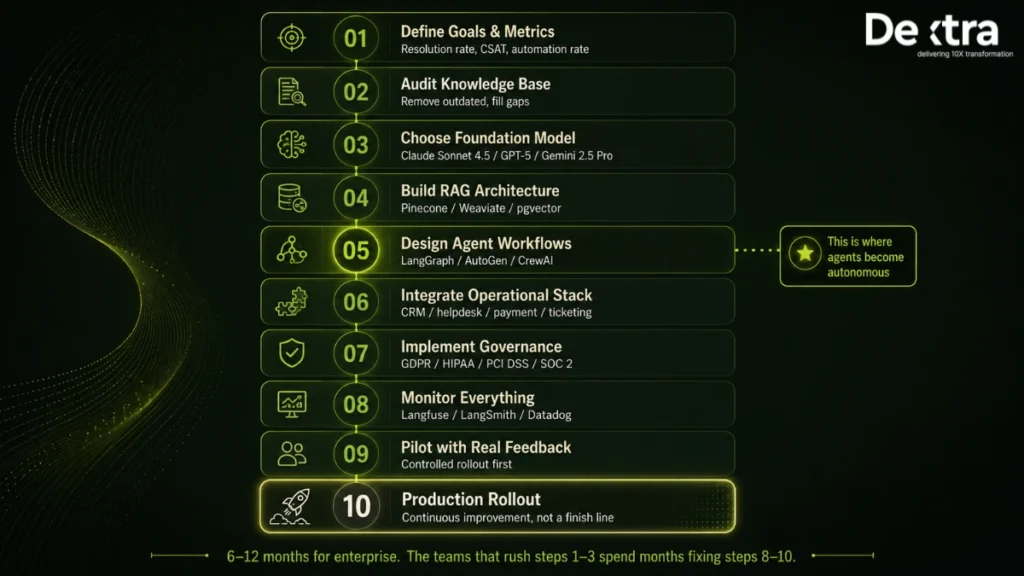
Step 1: Define Your Goals and Success Metrics
Start by identifying the customer service challenges you want to solve. Focus on high-volume, repetitive requests such as order tracking, FAQs, or password resets before expanding into more complex workflows. You should also define clear success metrics from the beginning, including resolution rate, CSAT, first response time, automation rate, cost per conversation, and system uptime. Having measurable goals makes it easier to evaluate performance and demonstrate ROI.
Step 2: Audit Your Knowledge Base
Before deploying AI, you should review the information your customers and support teams rely on every day. This includes help center articles, product documentation, internal knowledge bases, policies, and support guides. Remove all outdated content, resolve conflicting information, and fill any gaps. A well-structured knowledge base gives your AI the context it needs to provide accurate and consistent responses.
Step 3: Choose the Right Foundation Model
The foundation model you choose should match your business priorities rather than current market trends. In 2026, enterprises commonly evaluate Claude Sonnet 4.5, GPT-5, and Gemini 2.5 Pro based on reasoning quality, response speed, context window, compliance requirements, and operating costs. It’s also a good practice to design your architecture with both a primary model and a fallback model to improve reliability.
Step 4: Build RAG Architecture
A Retrieval-Augmented Generation (RAG) architecture allows your AI to answer questions using your organization’s latest documentation rather than relying only on pretrained knowledge. Choose a vector database such as Pinecone, Weaviate, or pgvector, implement semantic search, and optimize retrieval quality with reranking. The better your retrieval system, the more accurate and trustworthy your AI responses will be.
Step 5: Design Your Agent Workflows
This is where an AI agent for customer service automation starts to deliver real business value. Instead of simply generating responses, your AI should follow structured workflows that identify customer intent, retrieve relevant information, apply business rules, complete actions across enterprise systems, and escalate conversations whenever human intervention is needed. Frameworks like LangGraph, AutoGen, and CrewAI make it easier to build and manage these workflows.
Step 6: Integrate with Your Operational Stack
Your AI should be able to work with the same systems your support team uses every day. Integrate your helpdesk, CRM, order management platform, payment gateway, ticketing software, and communication channels so your AI agent for customer service can retrieve customer information, complete transactions, and update records without manual intervention. If your business relies on proprietary or legacy systems, plan for additional custom integration work.
Step 7: Implement Governance and Compliance
Security and compliance should be built into your architecture from day one. Implement role-based access control, audit logging, PII detection, output guardrails, and governance policies that align with standards such as GDPR, HIPAA, PCI DSS, or SOC 2. Addressing these requirements early helps avoid costly changes later and builds greater trust across your organization.
Step 8: Monitor Everything That Matters
Once your AI is live, you need to continuously monitor how it performs in production. Use tools such as Langfuse or LangSmith to trace agent behavior and platforms like Datadog or New Relic to monitor system health. Keep a close eye on metrics such as resolution rate, retrieval accuracy, latency, CSAT, escalation rate, and operational costs so you can quickly identify opportunities for improvement.
Step 9: Pilot and Improve with Real Feedback
Instead of deploying AI across every customer interaction, begin with a controlled rollout. Let your support team review AI-generated responses, identify edge cases, and provide feedback before increasing automation. Production feedback is one of the most valuable resources for improving prompts, retrieval quality, workflows, and overall performance.
Step 10: Production Rollout and Continuous Improvement
As your AI consistently meets performance goals, expand its responsibilities step by step instead of automating everything at once. Introduce new workflows, integrate additional business systems, and regularly update your knowledge base as customer needs evolve. The most successful enterprise AI deployments are built through continuous improvement rather than a single implementation.
If your business requires proprietary integrations, industry-specific workflows, or enterprise-grade governance, our Custom AI Agent Development Services can help you build a scalable solution tailored to your operational and compliance requirements.
8 Measurable Benefits of AI Agents for Customer Service
The value of an AI agent for customer service goes far beyond automating repetitive conversations. Here are some of the biggest benefits enterprises are seeing in 2026.
1. Resolve More Customer Queries Without Human Intervention
AI agents can automatically handle a large share of repetitive customer requests such as order tracking, password resets, account updates, and FAQs, allowing support teams to focus on more complex conversations. For example, Camping World reported a 40% increase in customer engagement after deploying an AI-powered virtual assistant, alongside a 33% improvement in agent efficiency and significantly shorter wait times.
2. Faster Response Times
Customers no longer expect to wait hours for an initial response. An AI customer service agent can acknowledge requests immediately, identify customer intent, and either resolve the issue or begin the appropriate workflow within seconds. This allows businesses to deliver faster, more responsive support while significantly reducing wait times. For example, a B2B SaaS company reduced its average first response time from 6 hours to under 1 minute after deploying an AI-powered support agent.
3. Lower the Cost of Every Customer Conversation
Handling routine support requests manually becomes increasingly expensive as ticket volumes grow. By automating repetitive Tier 1 and Tier 2 interactions, AI agents reduce the workload on support teams, allowing them to focus on more complex customer issues. According to IBM, AI-powered automation is helping enterprises improve productivity, personalize support, and scale customer service more efficiently.
4. Deliver True 24/7 Customer Support
According to Zendesk’s CX Trends 2026 report, 74% of consumers expect customer service to be available 24/7 due to AI. As customer expectations continue to move beyond traditional business hours, businesses need support systems that can respond anytime, across time zones, weekends, and holidays. AI agents provide continuous assistance without requiring additional staffing, overtime, or shift scheduling, helping organizations deliver faster and more consistent support whenever customers need it.
5. Provide Consistent Service Across Every Channel
Whether customers contact your business through live chat, email, WhatsApp, voice, social media, or SMS, AI agents deliver the same policies, knowledge, and brand voice across every touchpoint. This consistency reduces customer confusion and helps maintain a more reliable support experience regardless of the communication channel.
6. Scale Support Without Scaling Your Team
Support volumes can increase dramatically during product launches, holiday shopping seasons, service disruptions, or promotional campaigns. Instead of hiring temporary staff to manage demand, AI agents can absorb large spikes in conversation volume while maintaining response quality and helping your existing support team stay productive.
7. Support Customers in Multiple Languages
Expanding into global markets no longer means building separate support teams for every language. Modern AI agents can communicate in dozens of languages while maintaining consistent policies, tone, and customer experience. This allows businesses to serve international customers more efficiently without significantly increasing operational costs.
8. Turn Every Conversation Into Actionable Insights
Every customer interaction contains valuable information about your products, services, and overall customer experience, but analyzing this data manually at scale is challenging. AI agents can automatically capture structured insights such as common customer intents, sentiment trends, recurring issues, resolution rates, and knowledge gaps. According to Zendesk’s CX Trends 2026 report, 82% of CX leaders believe AI-powered analytics can uncover insights in seconds that previously took analysts weeks. These insights help businesses identify improvement opportunities faster, optimize support operations, and make more informed customer experience decisions.
For more practical use cases, you can explore our one of the case study around “How an Indian D2C Brand Handles 1.2 Million Monthly Support Queries in Four Languages with AI Agents” of a High-Growth D2C Startup from Benglore. And get to learn that how Dextra Labs solved it.
How Dextra Labs Can Help You Build AI Customer Service Agents?
A custom AI customer service solution gives you greater flexibility, control, and long-term scalability as your customer operations evolve. However, the right approach depends on your business requirements. If your customer service processes are relatively standardized, leading platforms such as Sierra AI, Ada CX, Decagon, Intercom Fin, Kore.ai, Zendesk AI Agents, and Salesforce Agentforce can automate a wide range of support workflows with minimal implementation effort. If you want a full vendor comparison, our guide on best AI Customer Service Agents for Enterprise compares the leading platforms to help you choose the right fit.
But if your business depends on complex workflows, proprietary systems, strict compliance requirements, or highly customized customer experiences, pre-built platforms may only take you so far. Dextra Labs helps enterprises overcome those limitations by designing custom AI customer service solutions that align with their business processes, integrate seamlessly with existing technology stacks, and continue to evolve as operational needs change.
When Enterprises Choose Dextra Labs
- Proprietary Systems and Complex Integrations: If your customer service relies on custom CRM platforms, legacy applications, or heavily customized enterprise systems, standard integrations may not be enough. We build AI agents that connect directly with your existing technology stack, enabling seamless data access, workflow automation, and task execution without disrupting your day-to-day operations.
- Enterprise-Grade Compliance Requirements: Every enterprise has unique security, privacy, and compliance standards. Whether you need data residency, sovereign cloud deployment, industry-specific governance, or advanced audit controls, we design AI solutions around your compliance requirements from day one rather than forcing your business into platform limitations.
- Large-Scale Customer Operations: As support volumes grow, your AI solution should scale without compromising performance or flexibility. A custom AI agent for customer service gives you greater control over infrastructure, integrations, and future enhancements, making it easier to support enterprise-scale operations while adapting to evolving business needs.
- Advanced Multi-Agent Workflows: Complex customer service often requires multiple AI agents working together. We build coordinated multi-agent systems where specialized agents handle triage, resolution, compliance checks, and quality monitoring, allowing you to automate sophisticated workflows that go well beyond the capabilities of traditional single-agent platforms.
- Complete Ownership and Long-Term Flexibility: Your customer experience should evolve with your business, not a vendor’s roadmap. With a custom AI customer service agent, you retain ownership of your architecture, workflows, prompts, integrations, and business logic, giving you the flexibility to adopt new AI models and expand capabilities whenever your business requires.
How the engagement works
Here’s what a typical enterprise AI agent implementation journey with Dextra Labs looks like:
- Phase 1: Discovery & Scoping (Weeks 1–4)
We start by understanding your customer service operations, auditing your knowledge base, evaluating integration requirements, and reviewing compliance needs. The outcome is a clear implementation roadmap with a defined go/no-go decision. If an off-the-shelf platform is the better fit, we’ll recommend that instead. - Phase 2: Architecture & Development (Months 2–8)
Once the scope is finalized, we design and build your AI agent for customer service. This includes selecting the right foundation models, building a RAG pipeline, orchestrating intelligent workflows, integrating enterprise systems, and implementing governance, security, and compliance controls. - Phase 3: Production Deployment (Months 5–8)
Instead of launching to everyone at once, we gradually roll out the solution, monitor performance, train your customer support teams, validate compliance, and fine-tune the system based on real customer interactions before expanding deployment across the organization. - Phase 4: Operational Ownership (Months 9–12)
We ensure your internal teams can confidently manage the solution through complete documentation, operational runbooks, knowledge transfer, and governance processes. Even after deployment, we continue supporting model upgrades, new capabilities, and future enhancements as your business evolves.
Total investment: The overall investment depends on the scope of your project, the complexity of integrations, compliance requirements, and the level of customization involved. For most enterprise implementations, the initial investment typically ranges from $500K–$1.5M, with annual operational and optimization costs of approximately $250K–$500K to support continuous improvements, model updates, and capability expansion.
Conclusion
Choosing the right AI customer service solution starts with understanding your business requirements, existing systems, and long term goals. Whether you adopt an off the shelf platform or invest in a custom solution, the right implementation can improve customer experiences, streamline operations, and create lasting business value.
If you’re planning to build an enterprise AI customer service solution, Dextra Labs is ready to help. Our Custom AI Agent Development Services are designed to build secure, scalable AI agents tailored to your business, integrate seamlessly with your existing systems, and automate even the most complex customer service workflows. Connect with our team to discuss your requirements and build an AI solution that grows with your business.
Frequently Asked Questions (FAQs):
Q. How do AI agents for customer service work?
AI agents work by combining several technologies that help them understand, reason, and act. It process customer queries through six layers: foundation model (LLM) to understand customer requests, RAG to retrieve relevant business information, orchestration to manage multi-step workflows, integrations to interact with enterprise systems, governance to maintain security and compliance, and observability to monitor and improve performance. Based on the customer’s request, the agent retrieves the right information, performs the required actions, and either resolves the issue independently or hands it over to a human agent with the full conversation context.
Q. What’s the difference between an AI agent and a chatbot for customer service?
The biggest difference is what they can actually do. Traditional chatbots follow predefined scripts as well as respond based on keywords or fixed conversation flows, making them suitable for answering simple questions. An AI agent customer service solution goes much further by understanding context, remembering previous conversations, connecting with business systems, and completing multi-step tasks such as processing refunds, updating accounts, or creating support tickets. In short, chatbots mainly answer questions, while AI agents are built to resolve customer issues from start to finish.
Q. What are the best AI agents for customer service in 2026?
The best AI agent for customer service depends on your business requirements. If you need deep integrations, complex workflows, or enterprise-specific automation, a custom-built AI agent is often the better choice out of all but for businesses looking for an off-the-shelf platform, leading options in 2026 include Salesforce Agentforce, Zendesk AI Agents, Intercom Fin, Ada CX, Sierra AI, Decagon, Kore.ai, and Cognigy, each offering different strengths based on deployment, integrations, and use cases. For a detailed comparison, explore our Best AI Customer Service Agents for Enterprise guide.
Q. How much do AI customer service agents cost?
The cost of an AI powered customer service agent depends on whether you choose an off-the-shelf platform or a custom solution. Enterprise platforms can range from usage-based pricing, such as around $0.99 per resolved conversation, to $300,000+ per year, depending on features and scale. A custom AI agent typically requires a higher upfront investment but gives you greater control, flexibility, and long-term value, especially if you’re managing large customer support volumes or need complex enterprise integrations.
Q. What use cases can AI customer service agents handle?
AI customer service agents can support every stage of the customer journey. Some of the most common enterprise use cases include:
– Automated ticket triage and routing
– Order status tracking and delivery updates
– End-to-end refund processing
– Account management and subscription changes
– Multilingual customer support
– Product troubleshooting and guided assistance
– Warranty and returns management
– Compliance and identity verification
– Proactive customer outreach and notifications
– Customer sentiment analysis
– Knowledge base maintenance and content recommendations
– Smart escalation with complete context transfer to human agents
Q. Can AI agents replace human customer service agents?
No, AI agents are designed to handle repetitive and routine customer requests, allowing human agents to focus on situations that require empathy, critical thinking, or complex decision-making. It’s designed to work alongside human agents. The most successful customer service teams use AI and human agents together, with AI managing everyday support while people handle high-value conversations and exceptional cases.
Q. What compliance certifications should AI customer service agents have?
At a minimum, enterprise AI customer service solutions should support SOC 2 Type II and ISO 27001 security standards. If you operate in a regulated industry, you may also need compliance with HIPAA for healthcare, PCI DSS for payment data, GDPR for organizations serving EU customers, or CCPA for California residents. Government organizations often require FedRAMP and, in some cases, sovereign cloud or air-gapped deployments. If your compliance requirements go beyond what a platform supports, a custom AI solution usually proves to be the better choice.
Q. When should I build a custom AI customer service agent instead of buying an off-the-shelf platform?
An off-the-shelf platform works well for businesses with standard support needs, common workflows, and limited customization requirements. However, a custom AI customer service agent becomes the better choice when your business depends on proprietary systems, complex integrations, strict compliance requirements, high conversation volumes, advanced multi-agent workflows, or unique customer experiences that standard platforms cannot fully support. Moreover, with a custom approach, you get greater control over your AI architecture, business logic, integrations, and long-term scalability without being restricted by vendor limitations.
Q. How long does it take to deploy an AI agent for customer service?
The deployment timeline depends on the complexity of your requirements and the approach you choose. Off-the-shelf platforms can usually go live within 30 to 90 days, depending on integrations, customization, and testing requirements. A custom AI agent usually takes longer because it involves designing workflows, connecting enterprise systems, implementing security controls, and fine-tuning performance. If you’re exploring how to build an AI customer service agent, the process generally includes planning, architecture design, development, testing, and phased rollout, with enterprise deployments often taking around 6 to 12 months for a fully customized solution.