Here’s the thing most GPT-6 Astra coverage gets wrong: they frame it as if GPT-5.6 was somehow limited, It wasn’t. GPT-5.6 Sol already handled complex reasoning. It could write production code, debug across multi-file repositories, call tools programmatically, operate computer interfaces, and sustain multi-step workflows. For a lot of enterprise AI development, it was, and still is, more than enough.
So when OpenAI released GPT-6 Astra, the obvious question wasn’t “Is it smarter?” (Of course it is. That’s what new models do.) The real question was:
Having spent the past several months building with both models across enterprise engagements, our answer is: it depends entirely on what you’re building. And that “it depends” is actually the most useful thing we can tell you.
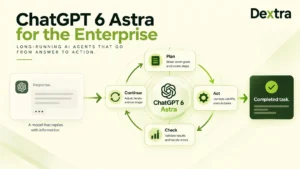
GPT-5.6 improved the quality and efficiency of complex AI development. GPT-6 Astra pushes the ceiling on what developers can delegate to the model, particularly across long, multi-step, tool-using, and computer-operating workflows. OpenAI itself positions Astra as capable of extended workflows across code, browsers, and professional software.
This article breaks down exactly where that ceiling shifted, where it didn’t, and how to make an informed model decision for your own stack.
GPT-5.6 vs GPT-6 Astra: The Short Answer
Before we get into the weeds, let’s give you the decision framework upfront.
GPT-5.6 Sol is still the better choice when:
- Task complexity is moderate and well-defined
- Cost is a primary constraint (it’s 2.5× cheaper per token)
- Latency matters heavily
- Your existing workflows already perform reliably
- You’re running high-volume inference at scale
- The application doesn’t require frontier-level reasoning or computer use
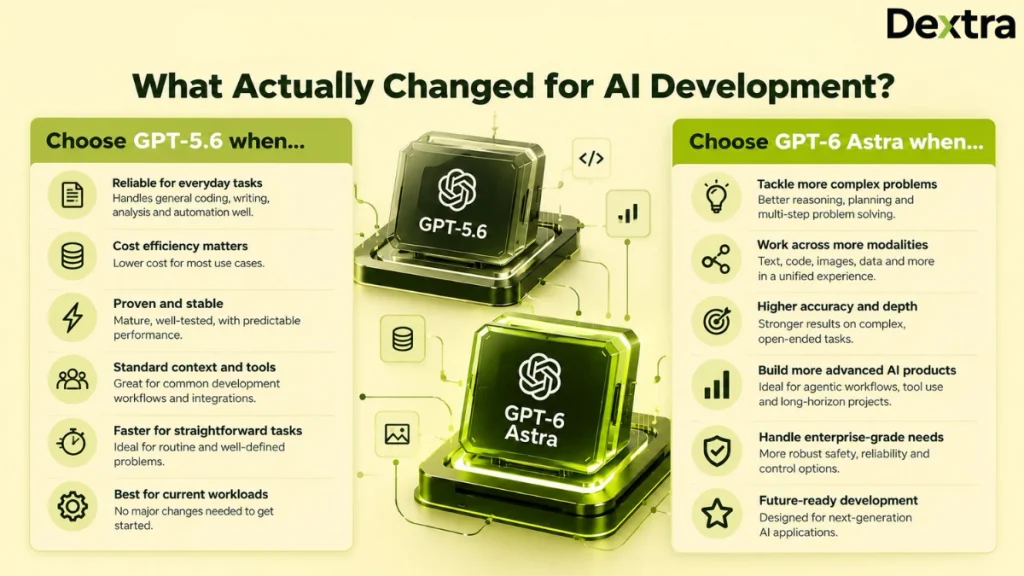
GPT-6 Astra becomes more compelling when:
- Tasks require deeper, multi-step reasoning
- Workflows span many sequential steps with branching logic
- Agents need to operate software through UIs
- Coding tasks demand deeper repository-level understanding
- The cost of task failure is high enough to justify the premium
- The system needs more capable autonomous execution over longer horizons
OpenAI’s own model guidance positions Astra for the most demanding reasoning and coding challenges, while GPT-5.6 variants remain the practical choice when cost and latency matter more than frontier capability.
Neither model “wins.” They serve different points on the intelligence-cost-autonomy curve.
GPT-5.6 vs GPT-6 Astra: What Actually Changed?
This is the section that matters most. And the right way to read it isn’t as a feature list, it’s as a set of development consequences.
Reasoning: From Strong Reasoning to Higher-Ceiling Reasoning
GPT-5.6 Sol was already a strong reasoner. It could plan multi-step solutions, handle ambiguous instructions, select appropriate tools, and recover from intermediate failures. For most production reasoning tasks, it performed well.
What Astra changes isn’t the baseline, it’s the ceiling.
The jump shows up most clearly in tasks that combine multiple cognitive demands simultaneously: problems where the model needs to plan a strategy, execute it across several tools, interpret ambiguous intermediate results, adjust the plan, and verify its own work.
On FrontierMath Tier 4 (a benchmark for hard mathematical reasoning), Astra scores 97.6% versus GPT-5.6 Sol’s 83.0%. That’s not a marginal improvement, that’s a qualitative shift in what kinds of problems the model can reliably handle.
On GPQA Diamond (graduate-level science questions), the gap is narrower: 96.0% versus 94.6%. Both models are excellent at well-defined analytical questions. The gap widens as tasks become more open-ended and multi-step.
The key distinction: Does Astra merely produce a better answer, or does it enable a different class of workflow?
Coding: From Code Generation to More Autonomous Software Engineering
GPT-5.6 Sol was already a capable coding model. It could generate code, debug issues, refactor existing codebases, handle frontend and backend work, and participate meaningfully in the software engineering process.
GPT-6 Astra for enterprises takes a specific step further: it shifts more of the software-engineering workflow from “AI-assisted” to “AI-delegated.”
On Terminal-Bench 4.0 (end-to-end terminal-based software engineering tasks), Astra scores 57.7% versus GPT-5.6 Sol’s 37.3%. On SRE-Bench (site reliability engineering tasks), the gap is even wider: 88.0% versus 55.9%.
The practical difference shows up in tasks like:
- Investigating a large codebase, identifying relevant files, making coordinated changes across modules, running tests, diagnosing failures, and iterating, without requiring developer intervention at each step
- Debugging complex issues that span multiple system layers
- Implementing features that require understanding the broader architectural context
The shift isn’t simply “better code.” It’s that more of the software-engineering workflow becomes something you can delegate.
Computer Use: One of the Biggest Practical Differences
This section deserves special attention because computer use is where Astra’s advantage is most tangible and most consequential for enterprise development.
GPT-6 Astra is explicitly positioned as a frontier computer-use model. On OSWorld 2.0, Astra scores 72.6% versus GPT-5.6 Sol’s 65.7%, and completes tasks in roughly 40 minutes versus 75 minutes. That’s nearly half the time per task.
On ScreenSpot-Pro (identifying and interacting with specific UI elements), Astra hits 92.7% versus 76.9%. That’s the kind of gap that moves computer use from “interesting demo” to “reliable enough to build on.”
Why Does This Matter for Enterprise Development?
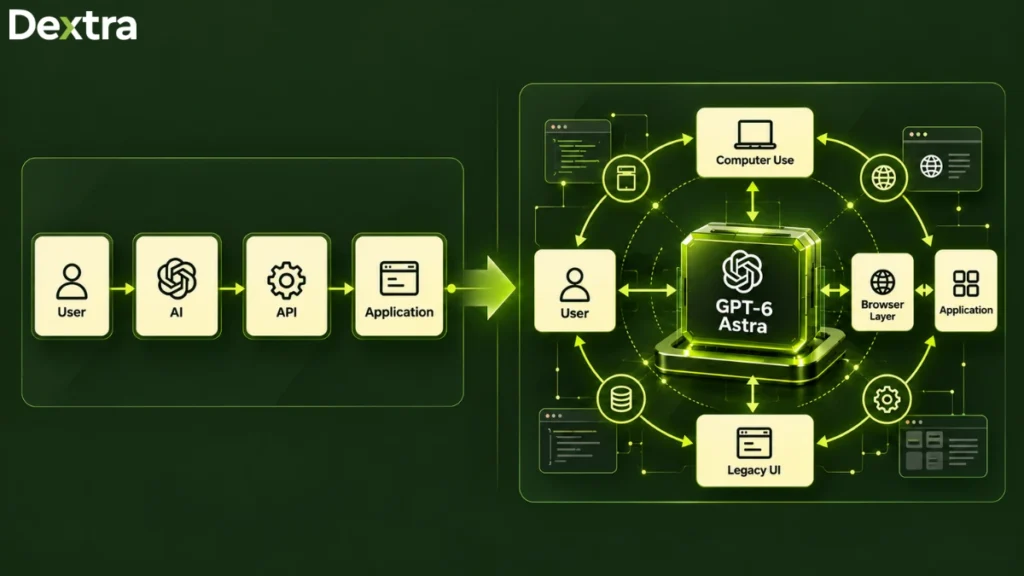
With GPT-5.6, the typical architecture was: User → AI → API → Application. The AI communicated with systems through structured APIs. If a system didn’t have an API, you were stuck.
With Astra-class computer use, an agent can interact with systems the way a human employee would: through the user interface. Legacy applications that were never built for AI integration become accessible.
Enterprise implications:
- Legacy ERP and CRM systems can be automated without API integration
- SaaS interfaces that don’t offer programmatic access can be operated
- Browser-based workflows (research, data entry, form submission) can be delegated
- Software installation, configuration, and troubleshooting become agent-accessible
- QA testing across real UIs becomes more practical
But there’s an equally important caveat: computer use expands the action surface, and therefore expands the security surface. An agent that can click through any application can also click the wrong thing. This is where the surrounding architecture, permissions, guardrails, human approval gates, becomes even more critical than the model capability itself.
Context Window: Same Size, Different Story
Here’s something most comparison articles get wrong: GPT-6 Astra and GPT-5.6 Sol share the same 1,050,000-token context window and 128,000-token maximum output.
Astra doesn’t have a bigger context window. They’re identical.
So what actually changed?
What Matters Isn’t Window Size, It’s What the Model Does With the Context
On MRCR v2 (Multi-Round Context Retrieval, testing the model’s ability to find and use information in 512K–1M token contexts), Astra scores 96.3% versus GPT-5.6 Sol’s 73.8%.
Both models can accept the same amount of context, but Astra is significantly better at actually using information spread across that context. It’s the difference between having a 1,000-page manual open and actually finding the right paragraph.
Development implications:
- Large codebase analysis becomes more reliable
- Long research tasks maintain better coherence
- Multi-document enterprise workflows produce more accurate results
- Longer agent trajectories lose less context along the way
An Important Architectural Distinction
Context window is not memory. These are different concepts:
- Context window: working space for a single request-response cycle
- Persistent memory: state that survives across conversations
- RAG: dynamic retrieval of relevant documents into context
- Task state: tracking where an agent is in a multi-step workflow
- Organizational knowledge: the broader information architecture
A better-utilized context window doesn’t replace any of these. The surrounding architecture still needs to manage what goes into that window and how state persists.
Tool Use: From Tool Calling to More Complex Tool-Oriented Workflows
GPT-5.6 already established a strong production baseline. OpenAI’s documentation highlights programmatic tool calling, the model can write JavaScript to call eligible tools, pass results between calls, and process intermediate outputs in a hosted runtime.
GPT-5.6 wasn’t a basic chatbot that occasionally called a function. It was already capable of orchestrating multi-step tool workflows in production.
What Astra changes is the reasoning complexity surrounding those tools:
- Smarter tool selection: choosing the right tool when multiple could technically work
- Sequential reasoning across many calls: maintaining coherence across 10, 15, 20+ calls
- Error handling and recovery: diagnosing failures and trying alternatives instead of repeating failed calls
- Verification: checking tool outputs before proceeding
- Long-running orchestration: maintaining goal coherence across extended workflows
GPT-5.6 made tool-driven workflows practical. Astra raises the ceiling on how complex and long-running those workflows can be.
Agentic AI: What Becomes Possible With Astra?
Let’s be clear: GPT-5.6 can absolutely support AI agents. We’ve built and deployed agents on GPT-5.6 Sol that handle meaningful enterprise workflows. Saying “GPT-5.6 can’t do agents” would be inaccurate.
Both models can support agents. Astra expands the complexity and reliability envelope of what those agents can handle.
With GPT-5.6, agents work well for AI assistants, copilots, workflow automation, and tool-using agents with moderate complexity.
With GPT-6 Astra, the envelope extends to long-running agents, complex planning, computer-use agents, multi-step research, autonomous software engineering, and professional-work agents handling end-to-end tasks.
The practical question isn’t “Should we use Astra for agents?” It’s: “Does our agent’s workload sit inside GPT-5.6’s reliability envelope, or does it push past it?”
GPT-6 Astra vs GPT-5.6: Developer-Focused Comparison
| Capability | GPT-5.6 Sol | GPT-6 Astra | Developer Impact |
|---|---|---|---|
| Reasoning | Advanced | Frontier | More complex task delegation |
| Coding (Terminal-Bench) | 37.3% | 57.7% | Greater engineering delegation |
| Computer use (OSWorld) | 65.7% | 72.6% | UI-driven workflows practical |
| Context window | 1.05M | 1.05M | Same architecture matters more |
| Long-context retrieval | 73.8% | 96.3% | Better use of large context |
| Tool calling | Advanced | Frontier | More complex tool workflows |
| Agentic workflows | Strong | Stronger | Longer execution chains |
| SRE tasks | 55.9% | 88.0% | Infrastructure work delegation |
| Security (ExploitBench) | 78.5% | 100% | Security analysis and testing |
| Input cost / 1M | $4.00 | $10.00 | 2.5× premium |
| Output cost / 1M | $20.00 | $50.00 | 2.5× premium |
| Knowledge cutoff | Feb 16, 2026 | Apr 30, 2026 | 2.5 months newer |
Benchmark Improvements vs Real Development Improvements
This distinction matters more than most coverage acknowledges.
Benchmark improvement means Astra scores higher on a standardized test. Engineering improvement means a developer can now build a workflow that was previously too unreliable, too complex, or too expensive to delegate.
These are not the same thing.
A 2-percentage-point improvement on a reasoning benchmark might mean nothing for your application. But a 20-percentage-point improvement on Terminal-Bench (37.3% → 57.7%) or a 30-point improvement on SRE-Bench (55.9% → 88.0%) can mean an entire class of workflow goes from “too unreliable to deploy” to “reliable enough to build a product around.”
The question to ask isn’t “Astra scores X% higher.” The question is:
Can the model now reliably investigate a codebase, modify multiple files, run tests, diagnose failures, and iterate, without requiring a developer to manually intervene at every step?
This is the lens we apply to every enterprise model evaluation.
What GPT-6 Astra Changes for AI Application Architecture
A GPT-5.6-era application typically looked like: Application → Prompt → GPT-5.6 → Response. The model was a reasoning engine that received structured input and returned structured output.
A more advanced Astra-oriented architecture looks like: Business Objective → GPT-6 Astra → Planning → Enterprise Context → RAG → Tools/APIs → Computer Use → Task State → Verification → Human Approval → Enterprise Systems.
The model now sits at the center of a much larger loop, with more autonomy and more surface area.
The model upgrade is only valuable when the surrounding architecture can take advantage of it.
If your system passes a simple prompt to GPT-5.6 and returns the response, upgrading to Astra gives you better responses for 2.5× the cost. If your system has the architecture to leverage Astra’s capabilities, tool orchestration, computer use, long-running task management, then Astra enables workflows that weren’t reliable enough to deploy before.
Does GPT-6 Astra Reduce the Amount of Engineering You Need?
Where Astra can reduce engineering effort:
- Less prompt scaffolding needed (the model handles ambiguity better)
- Less manual task decomposition
- Less brittle workflow logic
- Certain complex tasks can be addressed more directly
Where you still need the same (or more) engineering:
- Authentication and authorization
- API integrations
- RAG architecture and data pipelines
- State management, evaluation, and observability
- Guardrails, security, and compliance
- Human approval workflows
More capable models don’t eliminate AI engineering. They change where AI engineering effort is spent.
This is the kind of architectural thinking that defines our generative AI development services, not just plugging in a model, but designing the system that makes it effective.
What GPT-6 Astra Does NOT Automatically Solve
GPT-6 Astra does not automatically provide:
- Enterprise data access : the model doesn’t know your data unless you build the pipeline
- Reliable RAG : a better model doesn’t fix poorly chunked documents
- Business rules : domain-specific logic is your responsibility
- Permissions and security : a more capable model needs more carefully designed access controls
- Observability : you still need to know what the model is doing and why
- Workflow orchestration : state management, checkpointing, retry logic, failure handling
- Evaluation : how do you know the output is correct?
- Compliance : regulatory requirements don’t change because you upgraded
- Human approval gates : a better model doesn’t remove the need for human review
GPT-6 Astra vs GPT-5.6: Cost and Economics
| Model | Input / 1M | Output / 1M | Cached Input |
|---|---|---|---|
| GPT-6 Astra | $10.00 | $50.00 | $1.00 |
| GPT-5.6 Sol | $4.00 (promo) | $20.00 (promo) | $0.40 |
| GPT-5.6 Terra | $2.00 | $12.00 | $0.20 |
| GPT-5.6 Luna | $0.20 | $1.20 | $0.02 |
The right cost metric isn’t price per million tokens. It’s cost per successful task.
When the premium is justified: task value is high, failure cost is high, workflow complexity is high, human labor is expensive, fewer iterations offset higher model cost.
When it isn’t: tasks are simple, volume is enormous, latency dominates, GPT-5.6 already meets quality threshold.
When Should You Choose GPT-5.6 Instead of GPT-6 Astra?
- Your existing workflows already perform reliably with GPT-5.6
- Cost sensitivity is a real constraint
- You’re running high-volume inference where per-token cost dominates
- Task complexity is moderate and well-defined
- Consistent, predictable behavior matters more than occasional brilliance
- Astra’s additional capability wouldn’t change the output quality for your use case
This is where model routing enters the picture. The best enterprise architectures route each task to the most cost-effective model: Luna for simple tasks, Sol for standard work, Astra for complex high-value tasks, and deterministic code for anything that doesn’t need a language model.
When Should You Upgrade to GPT-6 Astra?
A practical decision framework:
- Your agent gets stuck on complex tasks. If your model-powered workflow regularly fails or loses coherence on multi-step problems, Astra may resolve this.
- Your workflow requires deeper reasoning. Not “slightly better”, meaningfully deeper. Planning, tool selection, multi-step verification.
- Your application needs computer use. Astra’s computer-use performance is substantially better.
- Your software engineering tasks need deeper autonomy. Complex codebase investigation, multi-file changes, test-driven iteration.
- Human intervention is the main bottleneck. Astra’s greater reliability per step reduces overhead.
- The value of task completion exceeds the model-cost premium. Run the math.
- Your current architecture has already been optimized. Don’t upgrade the model to compensate for a poorly designed application.
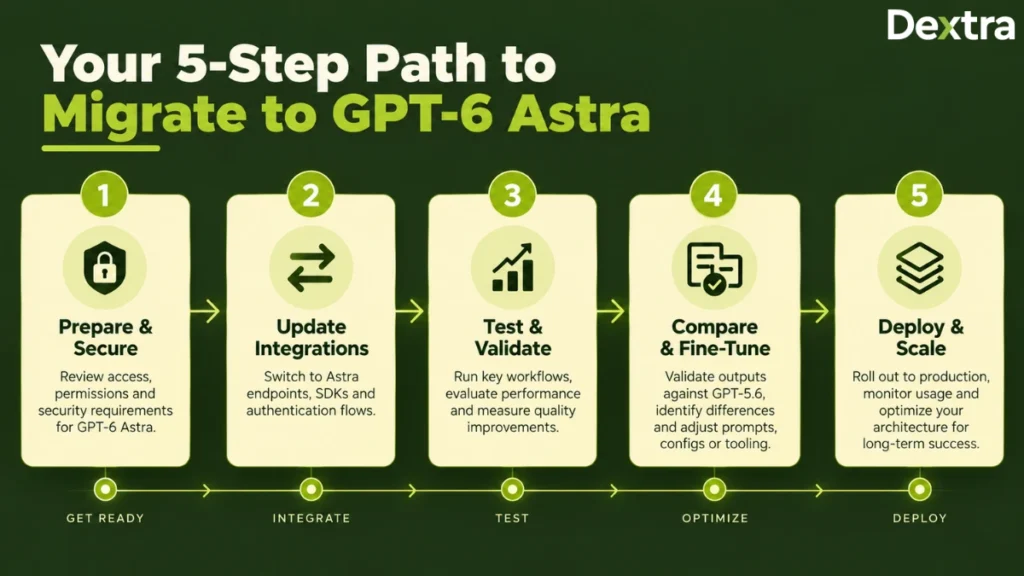
Should You Migrate? A Step-by-Step Guide
Step 1: Freeze the Existing Baseline
Record accuracy, latency, token usage, cost per task, task completion rate, tool call success rate.
Step 2: Swap the Model, Change Nothing Else
Keep prompts, tool definitions, context management, and architecture exactly the same. Isolate the model variable.
Step 3: Run Representative Evaluations
Use production-representative tasks, including the ones where GPT-5.6 currently struggles.
Step 4: Measure Quality vs Cost
Compare task completion rate, output quality, error rates, and total cost. The question isn’t whether Astra is “better”, it’s whether it’s better enough to justify the cost increase.
Step 5: Identify Architecture Changes
Only after the controlled comparison: should you change your architecture to take advantage of Astra’s capabilities?
GPT-6 Astra Migration Checklist
Model Configuration
- Correct model ID configured (gpt-6-astra)
- Reasoning effort levels tested (none through max)
- Output token limits reviewed
- Long-context pricing tier understood (>272K triggers 2× input pricing)
Prompts
- Existing instructions evaluated, does Astra need less scaffolding?
- Redundant decomposition logic identified and removed
- Prompt behavior validated
Context and Retrieval
- RAG pipeline tested with new model
- Context utilization measured
- Long-context tasks specifically benchmarked
Tools and Agents
- Tool schemas tested with Astra
- Tool error handling validated
- Task completion rate evaluated across representative workloads
- Long-running workflows tested
Production Readiness
- Cost monitoring configured (2.5× more per token)
- Security review completed (especially for computer use)
- Audit logging operational
- Human approval gates configured
- Fallback model defined (GPT-5.6 Sol)
- Budget alerts set
GPT-6 Astra + GPT-5.6: Why Model Routing Beats Choosing One
The right architecture for most enterprise teams isn’t “choose one model.” It’s a routing layer:
- GPT-5.6 Luna ($0.20/$1.20) high-volume extraction, classification, summarization
- GPT-5.6 Sol ($4/$20) standard reasoning, coding, and workflow tasks
- GPT-6 Astra ($10/$50) complex reasoning, computer use, long-running agentic workflows
- Deterministic code anything that doesn’t need a language model
This is far more sophisticated than picking one model and running everything through it. And it’s exactly the kind of architecture we help enterprise teams design at ChatGPT development company like Dextra Labs.
GPT-6 Astra vs GPT-5.6: Use Case Decision Table
| Use Case | Recommended Start | Why |
|---|---|---|
| Simple classification | GPT-5.6 Luna/Terra | Astra is overkill |
| Content generation | GPT-5.6 Sol | Cost-efficient for quality needed |
| Document analysis | Sol or Astra | Depends on complexity |
| Complex research | GPT-6 Astra | Higher reasoning ceiling |
| Coding assistant | Sol or Astra | Depends on autonomy level |
| Autonomous engineering | GPT-6 Astra | Complex multi-step work |
| Computer-use agent | GPT-6 Astra | Substantially stronger UI interaction |
| Customer service agent | Sol or Astra | Depends on workflow complexity |
| Enterprise research agent | GPT-6 Astra | Long-running reasoning |
| High-volume extraction | GPT-5.6 Luna | Pure economics at scale |
| Multi-step enterprise agent | GPT-6 Astra | Higher reliability needed |
| SRE / infrastructure | GPT-6 Astra | 88% vs 56% on SRE-Bench |
GPT-6 Astra Doesn’t Replace GPT-5.6, It Changes the Strategy
The real advancement isn’t simply “GPT-6 Astra is better than GPT-5.6.” It’s: Developers now have a wider intelligence–cost–autonomy envelope to design around.
The engineering skill shifts from “getting the most out of one model” to “building an architecture that routes work to the right model based on complexity, cost, and reliability requirements.”
That’s a more interesting and more valuable, engineering challenge.
How Dextra Labs Approaches GPT-6 Astra As a Selected OpenAI Partner
Dextra Labs has been recognized as a Selected OpenAI Partner, a designation within OpenAI’s global Partner Network that pairs our enterprise AI consulting and implementation expertise with OpenAI’s ecosystem of models, tools, and resources. This isn’t a badge we put on a wall. It reflects the work we do daily: helping enterprise teams design, build, and deploy AI systems that work in production.
As a Selected OpenAI Partner and a ChatGPT consulting and implementation company, we approach GPT-6 Astra with engineering rigor:
- Use-case discovery: What business problems are you solving?
- Model selection: Which model (or combination) delivers the right balance?
- Context and RAG architecture: How do you get enterprise data into the model efficiently?
- Agent and workflow design: What should be autonomous, what needs human-in-the-loop?
- Tool and API integration: Which enterprise systems does the agent need?
- Computer-use integration: Where does UI automation add value?
- Evaluation: How do you measure whether the system is working?
- Security and governance: Access controls, audit trails, compliance
- Production deployment: Scaling, monitoring, alerting, fallback strategies
- Model routing and optimization: Ongoing cost optimization
Being a Selected OpenAI Partner means we have direct access to OpenAI’s technical resources and early insights into model capabilities, but the value we deliver comes from the engineering process, not the partner badge. The model is one component. The system around it determines whether your AI investment produces business results.
Frequently Asked Questions
What is the difference between GPT-6 Astra and GPT-5.6?
GPT-6 Astra is OpenAI’s frontier model for demanding reasoning, coding, and computer-use tasks. GPT-5.6 Sol is a capable production model at a lower price point. Both share a 1.05M-token context window and 128K max output. Key differences: Astra’s stronger reasoning (97.6% vs 83.0% on FrontierMath), better coding (57.7% vs 37.3% on Terminal-Bench), stronger computer use (72.6% vs 65.7% on OSWorld), and better long-context retrieval (96.3% vs 73.8% on MRCR). Astra costs 2.5× more per token.
Is GPT-6 Astra better than GPT-5.6 for coding?
For complex, multi-step software engineering, yes, significantly. Astra scores 57.7% on Terminal-Bench versus 37.3%, and 88.0% on SRE-Bench versus 55.9%. For simpler coding tasks, GPT-5.6 Sol is already reliable and costs 2.5× less. Use GPT-5.6 for routine coding, Astra for complex autonomous engineering.
Is GPT-6 Astra better for AI agents?
Both models can power AI agents. GPT-5.6 Sol handles moderate-complexity workflows well. Astra extends the reliability envelope to longer-running agents, computer-use agents, and workflows with more sequential steps. If your agents work reliably on GPT-5.6, switching to Astra costs more without meaningful improvement.
Is GPT-6 Astra worth the higher cost?
It depends on your workload. The right metric is cost per successful task, not cost per token. If Astra completes a task in one attempt that GPT-5.6 needs three for, Astra may be cheaper in total. For high-volume simple tasks, GPT-5.6 variants are almost always the better choice.
Should I migrate my GPT-5.6 application to GPT-6 Astra?
Not automatically. Freeze your current metrics, swap the model while keeping everything else constant, run production-representative evaluations, and measure whether the improvement justifies the cost. Don’t upgrade the model to compensate for a poorly designed application.
Does GPT-6 Astra have a larger context window than GPT-5.6?
No. Both share a 1,050,000-token context window and 128,000-token maximum output. However, Astra is significantly better at using information within that context, 96.3% on MRCR v2 versus 73.8%.
Can GPT-6 Astra use computer interfaces?
Yes, and this is one of Astra’s most significant advantages. Astra scores 72.6% on OSWorld 2.0 (vs 65.7%) and 92.7% on ScreenSpot-Pro (vs 76.9%), completing tasks in roughly half the time.
Can GPT-5.6 still be used for enterprise AI?
Absolutely. GPT-5.6 Sol is suitable for most enterprise AI workloads when cost-effectiveness matters. The best enterprise architectures often use GPT-5.6 for the majority of workloads and route only complex tasks to Astra.
Which model should I use for high-volume applications?
GPT-5.6 Luna ($0.20/$1.20 per 1M tokens) or Terra ($2/$12) for high-volume workloads. At 50× cheaper than Astra, Luna is the clear choice for classification, extraction, and summarization.
Can GPT-5.6 and GPT-6 Astra be used together?
Yes, and this is often optimal. Model routing sends each task to the most cost-effective model: Luna for simple high-volume tasks, Sol for standard work, Astra for complex high-value tasks.
How do I evaluate GPT-6 Astra before migrating?
Run a controlled evaluation: keep your entire system constant except the model, test with production-representative tasks, and measure task completion rate, output quality, latency, and total cost. Pay special attention to tasks where GPT-5.6 currently struggles.