
A polished demo can make almost any AI startup look like a sure thing. The model answers instantly, the dashboard is clean, and the founder has a story about proprietary technology that competitors cannot touch. None of that tells you whether the company is a defensible business or a thin layer sitting on top of someone else’s model.
That gap is exactly why AI startup technical due diligence has become its own discipline. A traditional software review looks at code quality, architecture, and security. Those things still matter, but they were never built to answer the questions that decide an AI deal: Can the model actually do what the founder claims? Does the company own the data and the intellectual property it depends on? Will inference costs eat the margins before the business ever scales?
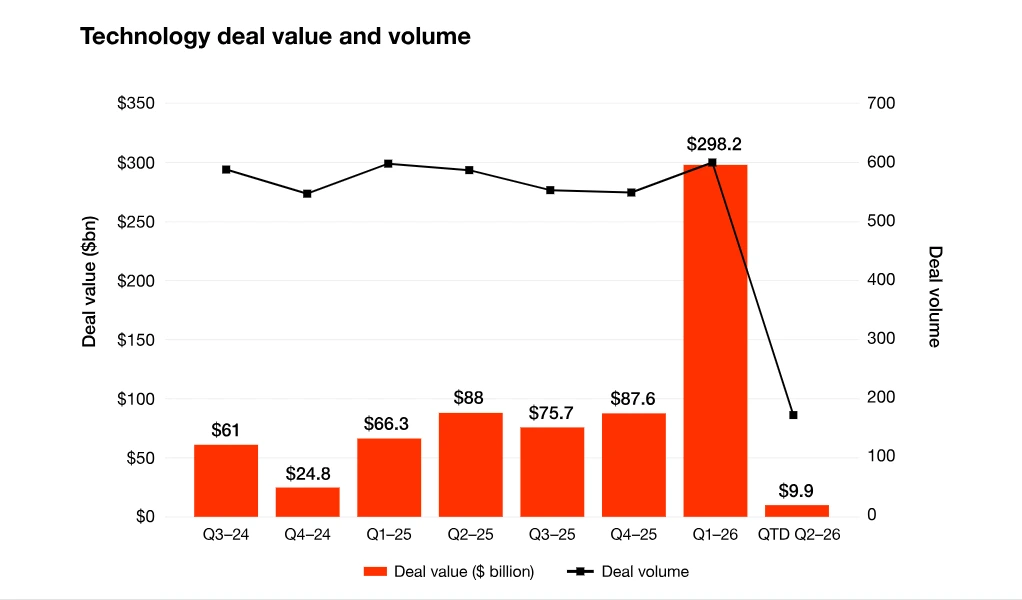
The market has already moved this way. In its 2026 technology deals outlook, PwC describes AI as having shifted from investment thesis to revenue test, with diligence turning toward monetisation, infrastructure access, and defensible workflows rather than the pitch. At the same time, diligence and integration timelines are compressing, which puts a premium on knowing exactly what to test and why.
At Dextra Labs, we provide independent technical due diligence for investors, acquirers, and deal teams evaluating AI businesses. Our work includes tech due diligence for AI companies in India, Singapore, and the USA, helping investors validate technology claims, identify hidden technical liabilities, assess AI defensibility, and understand how technical findings could affect valuation and deal terms. This guide covers the eight critical assessment areas, the red flags that can change an investment decision, and how to translate technical findings into actionable deal decisions.
What Is AI Startup Technical Due Diligence?
AI startup technical due diligence is an independent assessment of a startup’s technology, AI systems, engineering capabilities, and technical risks, carried out before an investment. It gives an investor an evidence-based view of what the company has actually built, how well it works in production, and where the real risks sit.
Think of it as a second opinion that the founder cannot write for you. Instead of taking the pitch deck at face value, a reviewer tests the claims against documentation, live systems, and reproducible results. It is the same rigour we bring to our leading technical due diligence services for AI startups, applied specifically to the questions an AI deal turns on.
How It Differs from Traditional Technical Due Diligence
AI-led businesses carry a set of risks that standard software reviews were never designed to catch. A proper review adds scrutiny on:
- Model selection, deployment, and how the company manages its dependencies on external providers.
- Where training, fine-tuning, and retrieval data comes from, and whether the company has the rights to use it.
- How model performance is measured, and whether those results hold up on real tasks.
- Inference economics and the true cost to serve each customer.
- AI-specific security, governance, and whether the product has any real defensibility.
If you want the ground that a conventional review already covers, our breakdown of the technical due diligence process sets out the standard workstreams that still apply underneath the AI-specific layer.
When Do Investors Need AI Technical Due Diligence?
The need shows up across the funding lifecycle, from seed and Series A cheques to growth rounds and strategic investments. It matters most whenever AI sits at the centre of the company’s valuation story. A seed-stage review might focus on whether the core approach is sound and the team can execute. A growth-round review goes deeper into production reliability, unit economics, and defensibility. Depth should always track the stage, the size of the cheque, and how central AI is to the investment thesis.
Why Investors Must Validate AI Startup Claims Before Investing
Technical uncertainty is not an engineering footnote. It flows directly into valuation, the amount of follow-on capital the company will need, the strength of its competitive position, and whether it can scale commercially at all. When the technology does not hold up, every number in the model built on top of it becomes suspect.
This is now a mainstream concern among dealmakers, not a niche one. In KPMG’s 2026 M&A Pulse, 78 percent of dealmakers said AI is changing their M&A assessment criteria, yet there is little consensus on what actually makes an AI business defensible. KPMG frames the real shift well: the question has moved from has the target adopted AI? to does AI strengthen or erode the drivers of this business? That is exactly the question a technical review exists to answer.
There are four investment risks worth separating out:
- Overstated AI capabilities. A demo that runs smoothly in a controlled setting says nothing about how the model behaves across thousands of messy, real-world inputs.
- Weak defensibility. If the product is mostly a prompt and a workflow wrapped around a widely available foundation model, a competitor with a small engineering team can copy it.
- Unproven economics. Model and infrastructure costs can quietly undermine the gross margins the founder is projecting, especially as usage grows.
- Hidden technical liabilities. Poor data governance, security gaps, or architectural shortcuts can turn into expensive remediation work after the deal closes.
Each of these findings has a consequence beyond the engineering team. They shape what the company is worth, what protections belong in the term sheet, and what the first hundred days after investment should prioritise.
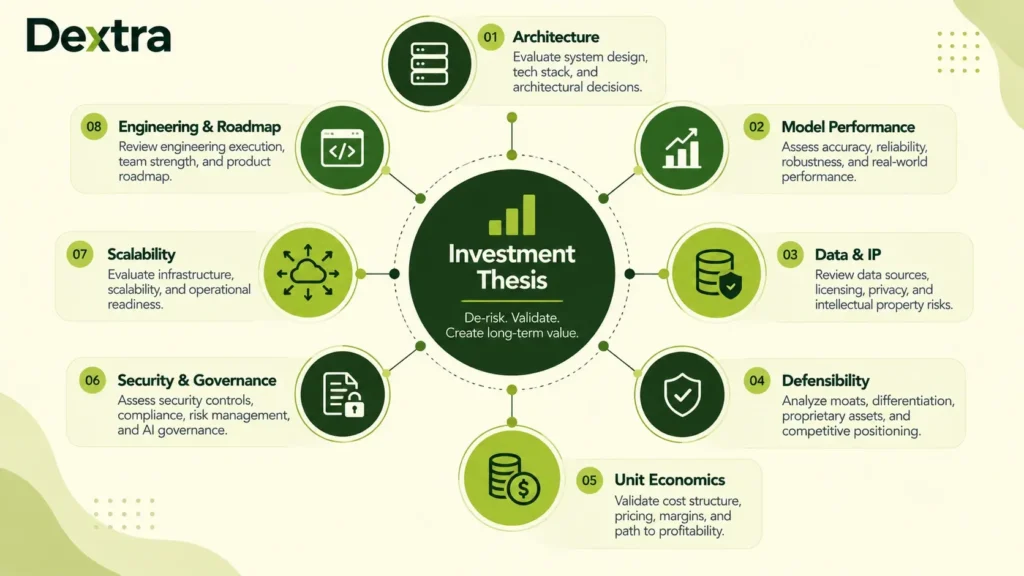
8 Critical Areas to Evaluate During AI Startup Technical Due Diligence
This is where the real work happens. For each area below, you will find what to examine, the evidence worth requesting, and the red flag that should make an investor slow down. The thread running through all eight is the same: what does this finding mean for the investment?
1. AI Architecture and Technology Stack
Start with how the whole system fits together: the model orchestration, any retrieval pipelines, the APIs, the deployment setup, monitoring, and the web of integration dependencies. A clean architecture is easier to scale, cheaper to run, and less likely to break in ways nobody can explain.
Evidence to request: Architecture diagrams, system documentation, deployment configuration, and a full dependency inventory.
Red flag: Critical workflows hang on fragile integrations, undocumented prompts, or manual steps that a person has to run by hand. That is a product held together with tape, and it rarely survives contact with scale.
2. Model Performance and Evaluation Methodology
The question here is whether the product performs reliably on tasks that look like real customer work, not curated examples. Weak evaluation is one of the most common ways a promising AI startup disappoints after the cheque clears, because unreliable output quietly erodes customer adoption and the revenue assumptions that rest on it.
Evidence to request: Evaluation datasets, the testing methodology, baseline comparisons, error analysis, latency metrics, and production monitoring data.
Red flag: Performance claims cannot be reproduced, or they lean on a handful of cherry-picked examples that fall apart under broader testing.
3. Data Ownership, Quality, and Intellectual Property
Dig into where the training, fine-tuning, and retrieval data comes from, who owns it, whether it was collected lawfully, and how clean it actually is. Data rights have become a first meeting topic in AI deals for good reason. Reporting in the Wall Street Journal on how VCs and acquirers now scrutinise data provenance put the risk plainly: as one strategic transactions lawyer framed it, if a court orders a model trained on tainted data to be deleted or retrained, the acquirer is left holding an asset it cannot use. That is why provenance is no longer a box-ticking exercise, and why data-rights review now consumes a large share of the diligence effort on many AI deals.
Evidence to request: Data licences, provenance records, data-processing agreements, model and software licences, and IP assignment documentation.
Red flag: The startup claims an exclusive data advantage but cannot show clear ownership or usage rights to back it up.
4. AI Defensibility and Competitive Differentiation
Assess whether anything about the product is genuinely hard to copy. Proprietary workflows, strong performance in a specific domain, data feedback loops, deep integrations, and real technical IP can all create a durable edge. KPMG’s AI defensibility work is useful here: it suggests testing an AI business against five pressures, the risk of revenue compression, margin erosion, disintermediation, obsolescence, and whether the company has the competitive velocity to keep improving faster than rivals. Notably, the two factors dealmakers most agree create durable differentiation are regulatory or compliance barriers and deep workflow integration, rather than the model itself. The point is to separate a lasting advantage from a head start that any competent team could erase in a quarter.
Evidence to request: Competitor benchmarks, substitution analysis, the product architecture itself, and documented sources of differentiation.
Red flag: The core product can be rebuilt with an off-the-shelf model and a modest amount of engineering effort.
5. AI Unit Economics and Infrastructure Costs
Rebuild the real cost to serve. That means inference costs, token usage, cloud and GPU spend, retrieval costs, and any human review quietly propping up the output. This is where a healthy-looking SaaS margin can turn out to be far thinner than the model suggests, which changes both the valuation and the amount of capital needed to reach profitability.
Evidence to request: Cloud invoices, model-provider bills, usage metrics, gross-margin calculations, and cost projections at scale.
Red flag: Costs are rising faster than revenue, or the projected margins depend on optimisation assumptions nobody has actually proven.
6. Security, Privacy, and AI Governance
Review access controls, the risk of data leakage, exposure to prompt injection, third-party data exposure, logging, and human oversight where it matters. AI systems open up attack surfaces that traditional software does not, and an agent with too much freedom can do real damage.
Evidence to request: Security assessments, access policies, incident records, threat models, and governance documentation.
Red flag: Sensitive data is reachable by systems that should not see it, or AI agents hold far more permission than their job requires.
7. Scalability, Reliability, and Production Readiness
Establish whether the product can handle growing usage without latency, failures, or costs spiralling out of control. A pilot that delights ten users is a different thing from a system that serves ten thousand without falling over.
Evidence to request: Load tests, uptime records, observability tooling, incident reports, recovery procedures, and capacity plans.
Red flag: A successful pilot cannot be translated into dependable production deployment, and nobody can show how it would hold up under load.
8. Engineering Team, Technical Debt, and Roadmap Feasibility
Look at how the team actually builds: engineering practices, testing, deployment processes, documentation, and how much of the knowledge lives in one person’s head. Then test the roadmap against reality. Ambitious plans are fine, as long as they do not quietly assume a rebuild that nobody has budgeted for.
Evidence to request: Code review, development workflows, team structure, the backlog, roadmap assumptions, and technical documentation.
Red flag: Core systems depend on a single engineer, or major roadmap commitments would require a costly rebuild that is not in the plan.
AI Startup Due Diligence Checklist: Questions Investors Should Ask
Everything above condenses into a short set of questions you can keep beside you during a deal. Each one pairs an investment question with the evidence that answers it, so you are never relying on assurances alone.
| Investment question | Evidence to request |
| Can the AI product’s performance be independently validated? | Evaluation results and test datasets |
| Does the startup control the data and IP it relies on? | Data licences, IP records, and contracts |
| Can competitors reproduce the core capability? | Differentiation evidence and substitution analysis |
| Are unit economics sustainable at scale? | Usage costs and margin scenarios |
| Can the product operate reliably in production? | Monitoring, incident, and reliability records |
| Are material security and governance risks controlled? | Security reviews and access policies |
Treat this as a starting point rather than the whole job. The real assessment should be shaped around the startup’s specific architecture and the thesis behind the investment.

Download the AI Company Technical Due Diligence Checklist (PDF)
Use this practical checklist to structure an AI company’s technical review before an investment or acquisition. It brings together key verification questions, the evidence investors should request, common red flags, and the technical risks that may affect valuation or deal terms.
👉 Download the Technical Due Diligence Checklist for AI Deals (PDF)AI Startup Technical Due Diligence Red Flags That Could Change an Investment Decision
Some findings carry more weight than others. A slow test suite or a messy backlog is a note for the hundred-day plan. The red flags below are different. Each one has the power to change the price, the structure, or the decision to proceed at all, because each one strikes at something the valuation quietly assumes is true. It helps to group them by the part of the thesis they threaten.
Red flags about whether the technology actually works
- Model performance claims that cannot be verified: The founder quotes impressive accuracy, but the result cannot be reproduced on a fresh dataset, or it rests on a handful of favourable examples. If the headline number is a demo artefact rather than a production reality, the adoption and revenue assumptions built on it are already shaky.
- Production reliability that falls short of what customers need: The pilot works beautifully for a few friendly users, but nobody can show how it behaves at ten or a hundred times the load. Growth is the whole point of the investment, so a product that degrades under concurrency is a direct threat to the forecast.
Red flags about whether the advantage is real
- No credible evidence of defensible differentiation: The core product turns out to be a prompt and a thin workflow over a public foundation model, with nothing a competent team could not rebuild in a quarter. If there is no moat, the premium an investor pays for defensibility is unsupported.
- Heavy dependence on a single model provider: The product runs on one external model, and the company has no fallback. A price change, a deprecated model, or a shift in that provider’s terms can reset the economics or break the product overnight, and the company does not control any of those levers.
Red flags about whether the economics hold
- Inference costs that do not add up at scale: Cost to serve is climbing faster than revenue, or the promised margin depends on an optimisation nobody has actually delivered. This is the flag most likely to be invisible in the headline financials and most likely to change the valuation once it surfaces.
- Unclear data ownership or shaky IP rights: The company claims an exclusive data advantage but cannot evidence ownership, licensing, or consent. Weak data rights can force an expensive remediation, and in the worst case a legal challenge can force a retrain or leave the asset unusable, which undermines the very moat the price is paying for.
Red flags about whether the risk is contained
- Security gaps or AI agents with uncontrolled permissions: Sensitive data is reachable by systems that should not see it, or an AI agent can act well beyond the scope its job requires. These are liabilities that follow the asset after close and can turn into incidents, regulatory exposure, or customer loss.
- Material technical debt or an unfunded roadmap: The roadmap the valuation depends on quietly assumes a rebuild, a re-platforming, or a key hire that nobody has costed. If delivering the thesis needs capital that is not in the plan, the real entry price is higher than the term sheet says.
A red flag is not an automatic reason to walk away. The disciplined response is to weigh four things: how severe the finding is, how likely it is to actually bite, what it would cost and how long it would take to fix, and how directly it threatens the investment thesis. A serious but cheaply remediated issue is very different from a cheap-looking issue that undermines the whole reason for the deal. Often the right answer is not a pass at all. It is a lower price, a holdback against the remediation cost, a warranty from the founders, or a milestone the company has to hit before the next tranche of capital is released. The point of naming the flag is to turn an uncomfortable surprise into a term you can negotiate.
How AI Technical Due Diligence Findings Affect Valuation and Deal Decisions
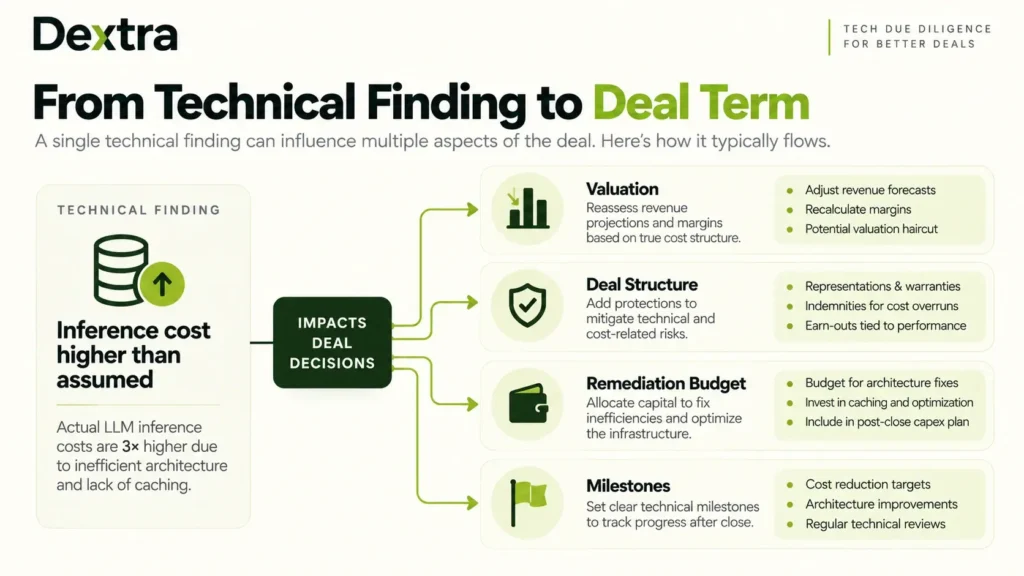
A technical finding is only useful once it is translated into an investment consequence. The job of the review is not to hand an investor a list of engineering observations. It is to answer a sharper question: given what we now know about the technology, is the price right, and what should the deal say? Findings flow into an investment decision through four channels.
1. Valuation and the financial model
The clearest path runs straight into the numbers. If the real cost to serve is higher than the company assumed, gross margin comes down and the path to profitability lengthens, which pulls on the multiple. If a claimed data moat turns out to be replaceable, the premium an investor was paying for defensibility is no longer justified. If performance is weaker than advertised, the adoption and retention curves that drive the revenue forecast need to be rebuilt on honest inputs. In each case the finding does not just colour the investment committee’s judgement, it changes a specific line in the model.
2. Deal structure and protections
Many findings are better handled through structure than through price alone. A material but fixable issue can sit behind a holdback or an escrow, so part of the consideration is only released once the fix is evidenced. Uncertainty about a future outcome, such as whether margins improve as the company scales, can be bridged with an earn-out tied to the metric that matters. A specific legal exposure, such as data rights, can be covered by a representation and warranty from the founders, or by a dedicated indemnity. The review tells the deal team which risks belong in the price and which are better placed in the paper.
3. Capital and the remediation budget
If delivering the thesis requires security uplift, a data clean-up, or a re-platforming, that is real money and real time, and it belongs in the plan before close rather than as a surprise afterwards. A good review estimates the remediation cost and feeds it into the capital the company will actually need, so the investor is not quietly underwriting a bill nobody named.
4. Milestones and post-investment governance
Some findings are best converted into conditions the company has to meet. Releasing capital in tranches against performance, security, or unit-economics milestones keeps the incentive aligned and gives the investor a checkpoint. The review also shapes the first hundred days after the deal: what gets fixed first, who owns it, and what the board should watch.
Here is an illustrative example that shows the four channels working together. An AI SaaS startup reports attractive gross margins, and on paper the business looks efficient. Diligence surfaces two things the headline financials never showed. A meaningful share of the output quietly depends on human reviewers, and the inference cost per task is far higher than the company assumed. The margin story, in other words, is partly a people cost dressed up as software.
The deal does not have to die over this. The investor revises the financial model to reflect the true cost to serve, which lowers the entry valuation to something defensible. A portion of the consideration goes behind a holdback released only when the company evidences a lower cost per task. The next funding tranche is tied to a unit-economics milestone. And the hundred-day plan opens with an inference-cost reduction workstream with a named owner. The same finding that could have been a walk-away becomes a deal that is simply priced and structured honestly.
How to Conduct AI Startup Technical Due Diligence
A focused engagement usually moves through five steps. The sequence matters, because each step narrows the work: the thesis decides what to look at, the evidence decides what can be tested, and the testing decides what ends up in the report.
Step 1: Define the investment thesis and the critical assumptions
Start with the deal, not the technology. What is the investor actually betting on? A proprietary data moat, a performance edge, autonomous agents that cut a cost line, a platform that others will build on? Each thesis rests on a few load-bearing technical assumptions, and those become the questions the review has to answer. This step keeps the work pointed at what changes the decision rather than producing a generic audit that tests everything and concludes nothing.
Step 2: Request the technical artifacts and evidence
With the questions set, gather what is needed to answer them: architecture diagrams, evaluation datasets and results, cloud and model-provider invoices, data licences and provenance records, security assessments, product analytics, and engineering documentation. How readily and how completely a company produces this is itself a signal. A team that can hand over clean evidence usually runs a tighter operation than one that cannot find it.
Step 3: Review the architecture, models, data, security, and economics
This is the core examination across the eight areas set out earlier. The reviewer works through the system as it really is, not as the deck describes it, mapping dependencies, reading the evaluation methodology, rebuilding the cost to serve, and tracing where the data comes from and who owns it. A control-based framework published by Matchpoint Partners for technical diligence on AI targets captures the central discipline well: separate the durable assets, the proprietary data, workflow integration, evaluation capability, and genuine know-how, from the rented capability that any competitor can license too. The output of this step is a structured view of exactly that, what the company owns, what it rents, and where the exposure sits.
Step 4: Validate the material claims and investigate the high-risk findings
Reviewing documents is not the same as proving them. Here the reviewer reproduces the claims that matter, interviews the CTO and engineering team, inspects the model dependencies in practice, and tests the failure scenarios that would hurt. Low-stakes observations are noted and set aside. Effort concentrates on the findings that could move the valuation or the decision, because that is where independent validation earns its keep.
Step 5. Deliver an investment-focused risk assessment
The engagement ends with a report written for a decision, not for an engineering team. Choosing the right technical due diligence partner for an AI company requires more than general software engineering expertise. Investors should look for a team that can independently validate model performance, AI risk matrix, a unit-economics analysis, examine data and intellectual property rights, assess MLOps and production readiness, test security controls, and quantify infrastructure costs and remediation needs. The best-fit partner should also connect technical findings to valuation, deal protections, and post-investment priorities rather than delivering an engineering report without commercial context. Dextra Labs supports investors, VC and PE firms, and acquirers with evidence-based technical assessments tailored to the risks and objectives of each transaction.
Scope and turnaround flex with the deal. A rapid review suits a smaller or early-stage cheque on a tight timetable and concentrates on the few assumptions most likely to change the decision. A deep review suits a material investment, an acquisition, a regulated application, or complex infrastructure, and goes wider and further into validation. Either way, the discipline is the same: test the thesis with evidence, and report in the language of the investment. For investors who want a specialist partner to run this end to end, this is the core of our leading technical due diligence services for AI startups.
Final Words
AI investment decisions cannot rest on a strong demo and a confident founder. Before capital goes in, you want evidence that the technology performs reliably, that the data and IP foundations are legitimate, that the economics work as the company scales, and that the claimed differentiation is real. That evidence is what separates a durable AI business from an impressive-looking wrapper.
Dextra Labs provides independent technical due diligence for AI companies, supporting investors, VC and PE firms, and M&A teams with evidence-backed assessments of AI architecture, model performance, data and IP ownership, security, defensibility, and unit economics. Our findings help deal teams make better-informed valuation, transaction, and post-investment decisions. We work with clients evaluating AI businesses across India, Singapore, and the USA.
| Planning an investment in an AI company? Talk to Dextra Labs about an independent AI technical due diligence review before you commit. Explore our leading technical due diligence services for AI startups. |
Frequently Asked Questions on Technical Due Diligence for AI Deals:
How is AI technical due diligence different from traditional tech due diligence?
On top of the usual architecture and security review, it scrutinises model behaviour, the way performance is evaluated, where the data came from, how dependent the product is on external model providers, and the true unit economics of running the AI.
What should investors check before investing in an AI startup?
The essentials are architecture, reproducible performance evidence, IP and data rights, defensibility, security and governance, production scalability, and sustainable unit economics. Each one connects back to valuation and risk.
How long does AI startup technical due diligence take?
It depends on the depth of the review, how complex the transaction is, how readily the company shares evidence, and how much claim validation is required. A rapid review is far quicker than a deep assessment of a complex platform.
Can technical due diligence determine whether an AI startup has a competitive advantage?
It can assess the evidence of differentiation and how easily the core product could be replicated. It cannot guarantee long-term defensibility, but it gives a grounded view of how durable the advantage looks today.
How much does AI technical due diligence cost?
Cost tracks the scope, the technical complexity of the target, the deal timeline, and the level of independent validation needed. A focused review for a small early-stage deal sits at a very different level from a deep review ahead of a major investment.