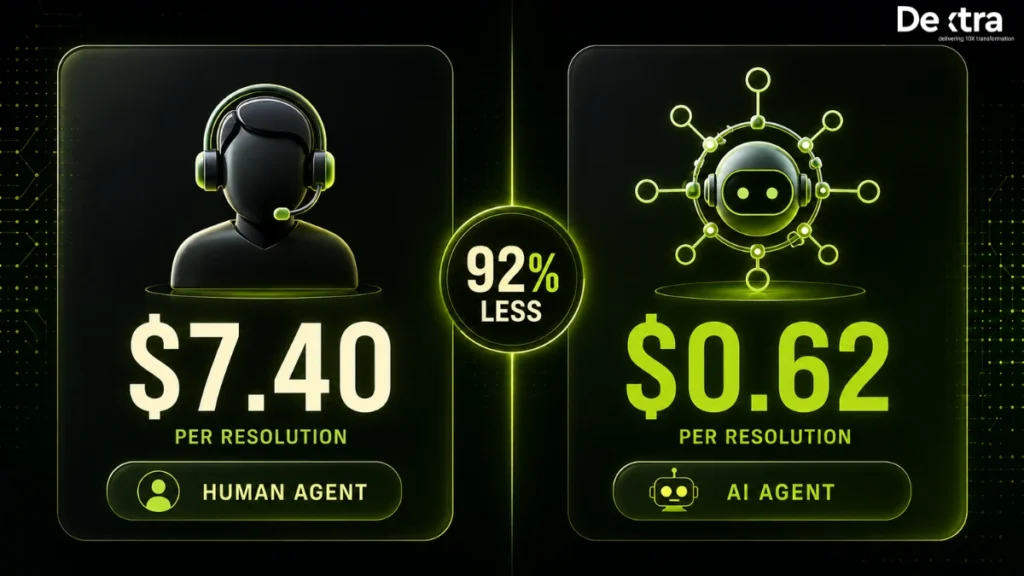
As per Dextra Labs’s study a human agent costs about $7.40 to resolve a customer issue, while an AI agent can do it only for $0.62. That’s roughly a 92% difference in cost per resolution, and it changes the conversation around AI customer service quite quickly. When every support interaction has a price attached to it, that gap can add up to serious savings as your ticket volume grows.
So, if you’re considering investing in an AI customer service agent, the question isn’t about “Can AI save us money?” The numbers already make a strong case.
Instead, the questions that actually matters are:
- How much can you actually save at your volume?
- How quickly will the investment pay for itself?
- What happens to economics as you scale?
This is where the real ROI of AI customer service agents starts to matter.
This guide covers the numbers behind the AI customer service agent ROI, that includes cost per resolution, deflection and containment rates, payback periods, and total cost of ownership (TCO). More importantly, it looks at where the economics change with scale, and why custom AI agent development can deliver stronger long-term returns when deeper integrations, higher resolution rates, and owned infrastructure start to matter.
AI vs Human Cost Per Resolution: The Full Breakdown
The $0.62 vs. $7.40 headline might be a helpful insight, but it can hide several important details. AI customer service cost per resolution varies by channel and the complexity of the interaction. Chat, email, in-app support, and voice all have different economics and the cost of an AI customer service agent changes with the complexity of the channel.
The table created below breaks the benchmark down so you can see where the savings are strongest:
| Channel | AI Cost | Human Cost | Hybrid Blended | AI Savings |
| Chat | $0.41 | $5.90 | $1.62 | 93% |
| In-app help | $0.36 | $5.40 | $1.41 | 93% |
| $0.74 | $9.20 | $2.43 | 92% | |
| Voice | $1.18 | $11.40 | $3.21 | 90% |
| Blended weighted avg | $0.62 | $7.40 | $2.10 | 92% |
Here’s what the numbers actually tell:
The savings are substantial across every channel. Even voice, the most expensive AI channel at $1.18 per resolution, is still about 90% cheaper than human handling at $11.40.
But $0.62 isn’t necessarily your real-world cost. The $2.10 hybrid figure is closer to how many support teams actually operate because it accounts for AI handling most interactions while escalating more complex cases to humans. Even with those escalations, hybrid handling still comes in well below the $7.40 all-human cost.
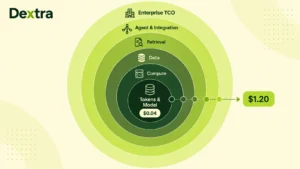
There is also total cost of ownership (TCO) to consider. Integration, knowledge-base preparation, monitoring, tuning, and maintenance can push your AI customer service cost per resolution above the headline AI rate. So when you’re doing the math, you need to look beyond the $0.62 figure and calculate what the technology will actually cost your business to run at scale.
The Full ROI Picture: Deflection, Speed, Quality, and Payback
The ROI of AI customer service agents goes well beyond the cost of handling one resolution. The numbers below show how deflection, speed, quality, and payback come together to shape the overall return.
Deflection (the volume multiplier):
Deflection is where AI customer service agents can start creating serious savings. Every ticket resolved without human involvement means less pressure on your support team and more volume handled without adding headcount at the same rate.
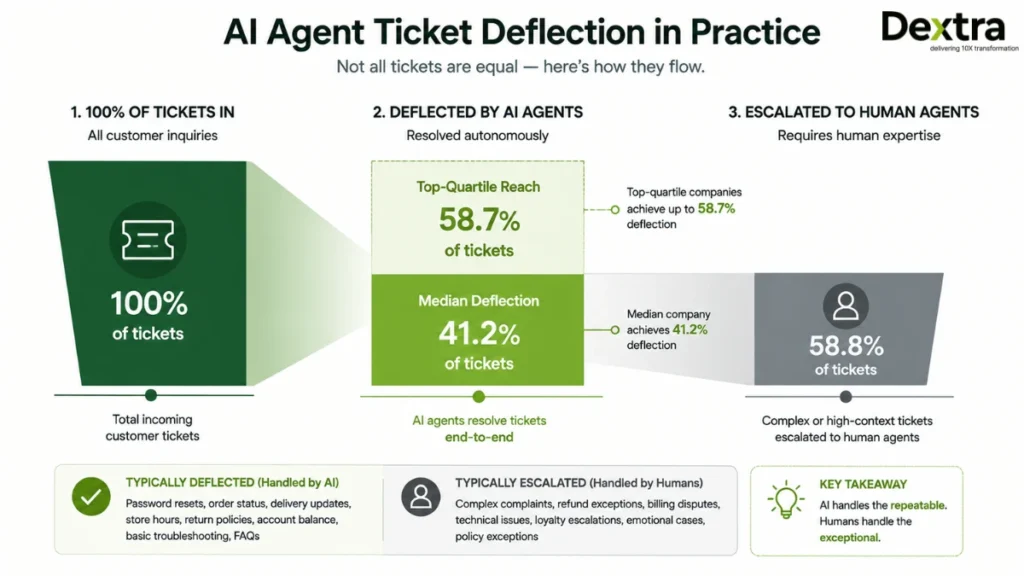
Zendesk CX Trends and Salesforce State of Service put median Tier-1 deflection at 41.2% across enterprise CX programs in 2026, with the top quartile reaching 58.7%. The rate varies significantly by request type: straightforward intents such as refunds and password resets can exceed 70%, while more nuanced customer complaints rarely reach 25%.
So what really affects how many tickets an AI agent can handle on its own? What it can access and what it can actually do. If it can only search your knowledge base, its reach is limited. Connect it with your CRM, billing, orders, and other systems, and it can solve many more customer issues without passing them to a human. For businesses with complex workflows, building the agent around their own systems and processes can take this even further by reducing the workload on support teams and increasing the savings they can capture.
Speed:
AI customer service agents also change the economics by reducing the time customers spend waiting and the time agents spend handling routine issues. That matters when you’re dealing with thousands of conversations every month.
According to the research mentioned, AI resolves an interaction in about 1.9 minutes, compared with 11.4 minutes for a human agent. First response time is even much faster, at around 4 seconds for AI chat versus 9+ minutes for human chat, while the SLA breach rate is 4.1% compared with 17.6% for human handling.
For a high-volume support operation, those minutes add up to hours of capacity. Faster responses can mean shorter queues, fewer abandoned conversations, and more customers served without increasing the size of the support team.
Quality:
Saving money only matters if the customer experience holds up. That’s why CSAT is just as important to the AI business case as cost per resolution.
Hybrid support brings the CSAT gap down to just 0.05 points, with a score of around 4.25/5 compared with 4.30/5 for human-only support. Pure-AI handling scores 4.1/5, showing that combining AI with human escalation can deliver a customer experience much closer to fully human support.
The takeaway is not that humans are becoming unnecessary. AI customer service agents can handle repetitive, predictable work while human agents focus on conversations that need judgment, empathy, or more complex problem-solving. That combination can capture much of the cost reduction without sacrificing on service quality.
Payback and ROI:
The table below shows how quickly AI customer service investments can pay back and how returns grow over the first few years:
| Metric | Median | Top Quartile |
| Payback period | 5.4 months | 2.9 months |
| Year-1 ROI | 2.6x | 4.4x |
| Year-2 ROI | 4.1x | 6.7x |
| 3-yr net benefit (enterprise) | 14M-58M | — |
How Custom Development Maximizes AI Customer Service ROI?
Once support volume crosses the point where per-conversation pricing starts adding up, custom AI agent development can create much stronger long-term return. Below are the four key ways custom development can improve your AI customer service ROI:
- Higher Deflection Through Deeper Integration: Custom AI agents can connect with your knowledge base, CRM, order and billing systems, and proprietary tools. That lets them resolve more issues instead of just answering questions.
- Lower Marginal Cost at Scale: With owned infrastructure, you do not have to pay a vendor for every conversation. As volume grows, the cost of each additional resolution can fall closer to the underlying model and infrastructure cost.
- Less Vendor Lock-In: You own the AI agent and its underlying workflows, so you’re less exposed to sudden pricing changes, product limitations, or a vendor deciding to sunset a capability you rely on.
- Compounding Returns: The median ROI rises from 2.6x in Year 1 to 4.1x in Year 2 as integration costs are spread across more volume and the agent handles more intents. Custom systems can capture more of this upside because they can keep expanding with your business.
The impact becomes easier to see when you look at a real world example. A fast-growing Indian D2C brand with ₹250 crore in ARR and 1.2 million monthly support queries across Hindi, English, Tamil, and Bengali used a purpose-built multi-agent system which delivered exactly the ROI curve this data predicts:
| Metric | Before (BPO) | After (Custom AI Agents) |
| Cost per resolved query | ₹40 | ₹4.70 (agent-resolved) / ₹18.40 (blended) |
| Queries resolved without humans | — | 71% |
| First-response time | 14 hours | 90 seconds |
| CSAT | 3.1 / 5 | 4.4 / 5 |
| Annual support cost | ₹4.8 crore | ₹1.7 crore (₹3.1 crore saved) |
The blended cost per query dropped to less than half of the human-only cost. This was achieved while handling 1.2 million queries every month and is in line with the cost savings shown in the McKinsey benchmark. The custom build achieved this through deeper integration: intent accuracy on code-mixed queries improved, while direct connections to order, logistics, and payment systems. This also meant it could solve customer issues from start to finish instead of just giving an answer. That level of integration is one of the key advantages of custom development. Read the full D2C multilingual AI support case study to see the results in detail.
This is the kind of ROI curve we help SMEs, startups, and enterprise teams unlock through our AI agent development services which are custom-built around your support workflows, integrations, and compliance needs, whether you’re a fast-growing D2C brand or a multinational support operation. Dextra Labs works with support teams across the USA, UK, Singapore, and India, and if you’re weighing whether a custom build makes sense at your volume, our guide on how to build a 24/7 AI customer service agent walks through what that implementation actually looks like in practice.
Conclusion
The 2026 AI customer service statistics leave little doubt about the business case: AI customer service agents can cut cost per resolution by 92%, pay back the investment in under six months, and deliver 2.6x ROI in the first year. The real opportunity now is choosing an approach that keeps those savings growing as your support volume increases.
For smaller teams, an off-the-shelf platform may be enough to capture those savings. But as support volume grows, custom AI agent development can help you push ROI further through deeper integrations, higher deflection, owned infrastructure, and lower costs at scale. Our custom AI agent development services are designed around your support workflows and systems so the agent can handle more of your customer queries as you grow. Talk to us about your AI customer service ROI and see what a custom approach could deliver for your business.
Frequently Asked Questions:
Q1. What is the ROI of AI customer service agents?
The median Year-1 ROI is 2.6x, reaching 4.4x for top-performing implementations. It rises to 4.1x in Year 2, with a median payback period of 5.4 months. In other words, the AI Agent ROI can improve as the system handles more support volume and its implementation costs are spread over time.
Q2. How much does an AI customer service resolution cost?
An AI customer service resolution costs about $0.62 on average and a human resolution costs around $7.40. Chat is the least expensive AI channel at $0.41 per resolution. Voice AI costs about $1.18 per resolution. This gives you a useful benchmark for the cost of an AI customer service agent.
Q3. What deflection rate should I expect?
You should expect a 41.2% median Tier-1 deflection rate across enterprise CX programs in 2026. Top-performing programs reach 58.7%. The rate can go above 70% for simple requests such as password resets and refund status while more complex complaints usually stay below 25%.
Q4. How fast does AI customer service pay back?
The payback period depends on your support volume and implementation costs. It also depends on how many conversations the agent can resolve without human help. Higher AI customer service cost savings can shorten the time it takes to recover your initial investment.
Q5. When does custom development beat off-the-shelf on ROI?
Custom development becomes more valuable as your support volume and workflows become more complex. If you are handling a large number of conversations every single month, then deeper integrations and owned infrastructure can make custom AI agent development services more cost-effective over time.
Q6. What is the real cost of an AI customer service agent?
The cost of an AI customer service agent is more than the price shown by a vendor. You also need to consider integration work and knowledge-base preparation. Ongoing monitoring as well as maintenance also add to the AI customer service agent cost. Therefore, looking at the full total cost of ownership gives you a more realistic idea of what you will actually spend. For higher support volumes, custom development can make these costs more predictable by giving you greater control over the infrastructure and reducing reliance on ongoing per-conversation fees.