Research from Intercom shows that while 88% of support teams offer service in more than one language, only 28% of customers actually receive support in their native language. That’s quite a significant gap in the customer experience. When customers can’t communicate in the language they’re most comfortable with, they often feel misunderstood, stuck, and unable to fully explain their problem. Even the simplest queries become frustrating. As businesses expand into new markets, multilingual customer support AI agents are becoming essential to deliver the native-language support customers expect.
For years, businesses relied on bilingual support teams to serve customers across different markets. While that approach works, it’s expensive, difficult to scale, and almost impossible to maintain across dozens of languages and time zones. A multilingual AI agent makes it much easier to deliver consistent, native-language support 24/7 without building separate support teams for every region.
Not every multilingual AI solution delivers the same experience, though. Some generate responses directly in the customer’s language, while others create an English response first and then translate it. That difference has a direct impact on accuracy, cultural nuance, and how natural the conversation feels. Language is ultimately one dimension of a much bigger decision, how you architect an AI agent for customer services in the first place. This guide explains how multilingual customer support AI agents work, the difference between native language generation and translation-based systems, the architecture behind them, their most valuable use cases, implementation costs, and when it makes more sense to buy a solution or build one.
What Are Multilingual Customer Support AI Agents?
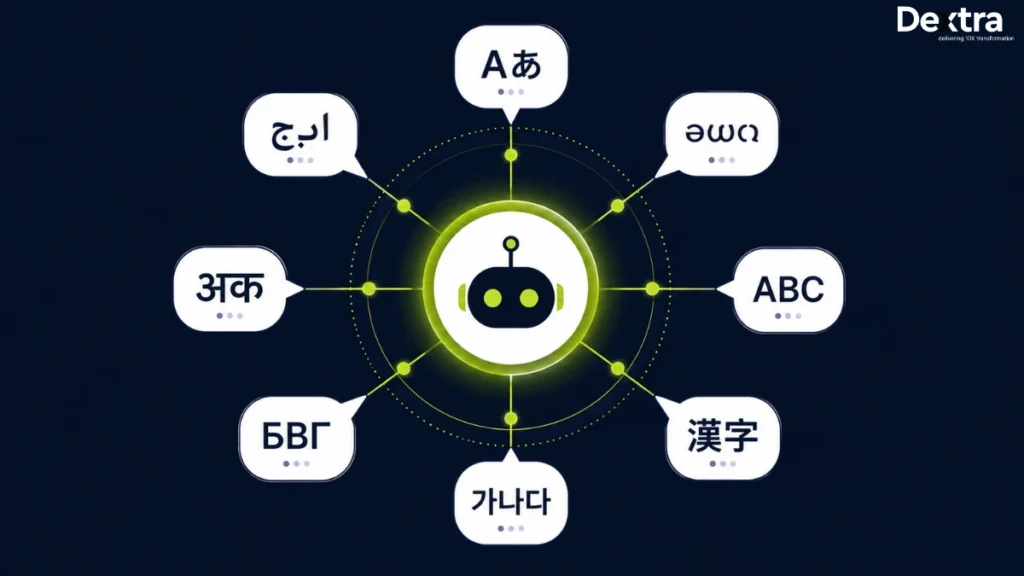
A multilingual customer support AI agent is an AI system that can understand customer questions and provide support in multiple languages. Instead of simply translating words from one language to another, it understands what the customer is trying to say and responds naturally in their language while keeping the conversation accurate and relevant. This helps businesses deliver faster, more natural support and create a better experience for customers across different countries and languages.
What separates multilingual customer support AI agents from Google Translate or a basic chatbot:
Here are the capabilities that make multilingual AI agents far more effective than translation tools and basic chatbots:
- Automatic language detection: Identifies the customer’s language from the first few words, so they don’t have to manually select a language before starting the conversation.
- Code-switching: Handles customers who naturally switch between languages during the same conversation, which is common in multilingual regions like India, the UAE, and Singapore.
- Intent understanding across languages: The best multilingual AI customer service agents recognize that “Passwort zurücksetzen,” “réinitialiser le mot de passe,” and “reset password” all mean the same thing and respond accordingly.
- Context retention across languages: Remembers previous conversations even if a customer starts in English one day and follows up in Spanish or another language later.
- Action execution in any language: An AI customer service agent that handles multiple languages doesn’t just answer questions. It can process refunds, update accounts, check orders, and trigger business workflows while communicating naturally in the customer’s preferred language.
The three-tier evolution:
Multilingual AI has evolved through three distinct stages:
| Tier | Approach | Key Limitation |
| Tier 1: Machine Translation | Translates text word-for-word (Google Translate or DeepL) | Often loses context, mistranslates technical terms, and misses cultural nuances. |
| Tier 2: Translate- Reason-Translate | Translates the customer’s message into English, reasons in English, then translates the response back. | Adds latency and can introduce meaning drift or culturally awkward responses. |
| Tier 3: Native Multilingual Generation | Understands, reasons, and generates responses directly in the customer’s language. | Delivers the most natural, accurate, and culturally relevant customer experience and is becoming the standard for enterprise AI in 2026. |
The next section discusses why multilingual customer support is becoming the preferred approach for global customer support.
Why Multilingual Customer Support Matters for Enterprise Growth
As discussed earlier, Intercom’s research shows a clear gap between offering multilingual support and actually delivering it to customers. As per Dextra Labs internal study, we also found that 35% of customers would switch to a competitor that offers support in their preferred language.
Here’s why multilingual customer support AI agents matter for enterprise growth and the seven ways they create business value:
1. Native-language support improves customer retention
Customers are far more likely to stay loyal when they can get help in the language they speak every day. They can explain their issue more clearly, understand solutions faster, and feel confident that they’ve been understood. Removing language barriers at critical support moments can have a direct impact on customer satisfaction and long-term retention.
2. Expand into new markets faster
Launching in a new country no longer has to depend on building a local support team first. Multilingual AI customer service agents let businesses provide native-language support from day one, helping them serve customers much sooner. For enterprises evaluating AI agent tools for multilingual customer service in the USA alongside global markets, this can significantly reduce the time and cost of international expansion.
3. Scale support without scaling headcount
Traditionally, adding a new language meant hiring more bilingual agents for that region and time zone. As the business grew, support costs grew with it. Multilingual AI changes that by allowing the same support operation to handle dozens of languages without building separate teams for each one.
4. Deliver a consistent customer experience everywhere
Different regional teams or outsourced support partners often create different customer experiences. AI agents help maintain the same brand voice, support quality, and company policies across every language that gives customers much more consistent experience no matter where they are.
5. Provide support around the clock
Customers don’t stop needing help outside business hours. Whether someone reaches out from London, Dubai, Singapore, or New York, multilingual AI agents can provide instant support in their preferred language without having to wait for another regional team to come online.
6. Support multilingual regions more naturally
Many customers naturally switch between languages during the same conversation, especially in regions like India, the UAE, and Southeast Asia. Modern multilingual AI agents can understand these mixed-language conversations, thereby making interactions feel much more natural than systems designed for only one language at a time.
7. Turn every conversation into business insights
Every customer interaction provides valuable information. By analyzing conversations across multiple languages, businesses can identify common issues, customer preferences, and knowledge gaps across different markets. These insights help teams improve products, support processes, and customer experiences on a global scale.
Native Language Generation vs Translation Layer: Why the Architecture Matters
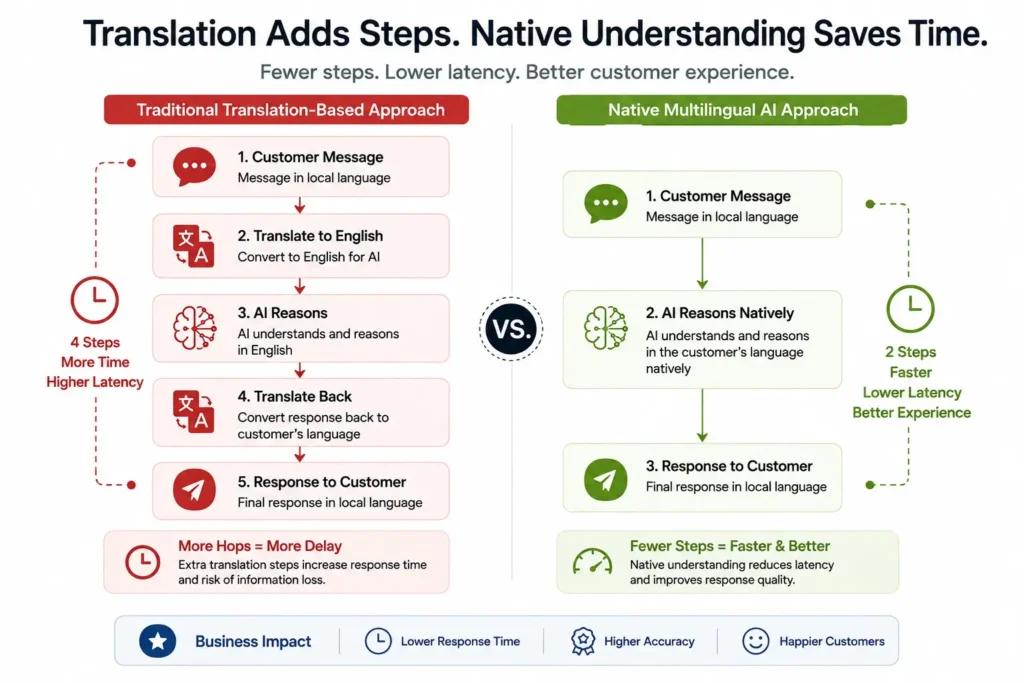
When you’re evaluating multilingual customer support AI agents, don’t start by asking how many languages they support. Instead, ask one question: Does the AI understand and reason in your customer’s language, or does it think in English first and translate the response? The answer can make a noticeable difference in response quality, accuracy, and the overall customer experience.
Translation Layer vs Native Language Generation
| Translation Layer | Native Language Generation |
| Your customer’s message is translated into English, the AI reasons in English, and the response is translated back. | A multilingual AI agent detects your customer’s language, reasons directly in it, and responds naturally. |
| Extra translation steps increase response time. | No translation round trips, so responses are comparatively much faster. |
| Meaning, context, and technical terms can get lost in translation. | Context, product names, and industry terminology are all preserved. |
| Responses may sound translated or culturally awkward. | Responses feel natural, fluent, and culturally appropriate. |
Don’t Overlook Your Knowledge Base
Even the best AI can only answer as well as the information it can access, so it’s worth asking how your knowledge base is designed.
- Single-language knowledge base: Your content stays in one language (often English), and the AI retrieves it before generating an answer in the customer’s language.
- Multilingual knowledge base: Your content is available in multiple languages, improving accuracy but requiring more effort to maintain.
- Cross-lingual RAG: The AI can retrieve information from documents in any language and answer customers in their preferred language. This is often the best choice if your business has technical documentation, region-specific policies, or regulated content.
For enterprises with technical products, regulated content, or region-specific policies, the knowledge base often becomes the biggest differentiator. While off-the-shelf platforms work well for standard use cases, custom AI agent development gives you the flexibility to build multilingual retrieval, region-specific knowledge bases, and compliance-aware workflows that are specifically customized to your business.
Top 8 High-Value Use Cases for Multilingual Customer Support AI Agents
If you’re planning to expand globally or improve customer experience across multiple regions, these are the use cases where multilingual customer support AI agents deliver the greatest business value:
1. Deliver 24/7 Support Across Global Time Zones
Your customers expect help whenever they need it, regardless of where they’re located. Instead of making them wait for a regional support team to come online, AI can resolve issues instantly in their native language, improving response times and customer satisfaction around the clock.
2. Reduce Ticket Volume with Native-Language Self-Service
Many support requests, such as password resets, order tracking, billing questions, and account updates, don’t require a human agent. AI can resolve these routine queries in the customer’s preferred language which reduces ticket volume while allowing your support team to focus on higher-value conversations.
3. Offer Multilingual Voice Support
Voice remains one of the most challenging support channels because customers speak with different accents, dialects as well as pronunciation styles. Modern AI can understand spoken conversations across multiple languages and provide natural responses, helping you deliver a consistent experience across both voice and digital channels. Voice adds its own layer of complexity on top of the language challenge, our guide to AI Voice Agents for Customer Service covers the architecture and rollout considerations specific to that channel.
4. Handle Code-Switching Conversations Naturally
In multilingual markets like India, the UAE, and Singapore, customers often switch between two languages within the same conversation. So, instead of breaking when languages change, AI can understand mixed-language conversations naturally, making interactions feel much more human and reducing customer frustration.
5. Enter New Markets Without Building Local Support Teams
Expanding internationally usually means recruiting, training, and managing support teams before you can launch. Today, AI agent tools for multilingual customer service in the USA and other global markets are helping businesses provide native-language support from day one. This allows you to test new markets, serve customers confidently, and scale much faster without significantly increasing operational costs.
6. Automate Multilingual Email and Ticket Support
Customer support isn’t limited to live chat. AI can also draft accurate email responses, resolve support tickets, and follow up with customers in their preferred language while integrating with your existing helpdesk. This creates a consistent experience across every support channel.
7. Deliver Better Cross-Border E-commerce Support
International shoppers expect the same experience as local customers. Whether they’re asking about product availability, shipping, returns, refunds, or order status, AI can provide quick and accurate answers in their native language, helping increase customer confidence and repeat purchases.
8. Maintain a Consistent Global Brand Experience
As businesses grow, support quality often varies between regions or outsourced teams. AI helps standardize your brand voice, policies, and support processes across every market while still adapting responses to local languages and cultural expectations. Customers receive the same level of service whether they’re reaching out from London, Singapore, Dubai, or São Paulo.
Common Challenges in Implementing Multilingual Customer Support
While multilingual customer support AI agents can really help transform global support, building them isn’t as simple as adding more languages. Below are some common challenges that can affect performance if they aren’t addressed early:
1. Your Knowledge Base Wasn’t Built for Multiple Languages
Most businesses have a knowledge base that’s written in a single language; in most cases, it’s usually English. As you expand globally, you need to decide whether to maintain separate knowledge bases for each market or let AI retrieve information across languages. Both approaches have trade-offs in terms of cost, maintenance, and accuracy.
How to address it: Choose your knowledge architecture from the start. Depending on your business, a single-language knowledge base with cross-lingual RAG, multilingual knowledge bases, or a hybrid approach may be the best fit.
2. Translation Doesn’t Capture Cultural Nuance
Customers don’t just expect responses in their language; rather, they expect them to sound natural. Literal translation often misses cultural context, local expressions, and the right level of formality which makes conversations feel robotic or awkward even when the information is technically correct.
How to address it: Prioritize native language generation over translation-based systems, and configure tone, terminology, and communication styles for each language you support.
3. Customers Don’t Always Stick to One Language
In countries like India, Singapore, and the UAE, customers often switch between languages within the same conversation. Many multilingual AI customer service agents still struggle with these mixed-language interactions which then leads to misunderstandings and incomplete conversations.
How to address it: Build and test your AI for real-world conversations that include code-switching, using data from the markets you actually serve instead of relying on generic language datasets.
4. Every Region Has Different Compliance Requirements
Expanding globally also means complying with different regulations, from GDPR in Europe to country-specific data residency and privacy requirements in other regions. A single deployment may need to meet several regulatory frameworks at the same time.
How to address it: Plan compliance, data residency, and security into your architecture from day one. This is exactly where custom AI agent development earns its keep, region-specific compliance, governance, and deployment requirements get built into the agent from the start instead of bolted on later through costly rework.
5. Voice Support Is More Complex Than Chat
Supporting multiple languages through chat is challenging enough. Voice adds another layer of complexity with accents, pronunciation, background noise, real-time processing, and natural conversation flow, all while keeping latency low.
How to address it: Start by perfecting multilingual text support before expanding to voice. Once the AI consistently performs well across written channels, extending it to voice becomes much more manageable.
6. Maintaining Quality Across Every Language
Launching support in 30 languages means very little if only a handful deliver a great experience. Customers immediately notice when responses in one language are natural while others feel inaccurate or poorly translated.
How to address it: Measure performance separately for every language using native speakers and real customer conversations. It’s often better to provide excellent support in fewer languages than average support across many.
7. Change Management Across Distributed Teams
Technology is only part of the implementation. Regional support teams may worry that AI will replace their expertise or overlook local customer expectations, making adoption slower than expected. This kind of organizational friction is one of several reasons pilots stall, our analysis of why 78% of AI support pilots never reach production covers the broader pattern.
How to address it: Introduce AI as an assistant rather than a replacement. Let it handle repetitive multilingual requests while your support teams continue managing complex cases, building confidence before expanding automation further.
How Multilingual AI Agents Outperform Traditional Translation Tools and IVRs
Before investing in multilingual support, it’s important to understand why older approaches struggle to deliver a great customer experience. While they may support multiple languages, they weren’t designed to understand customers, retain context, or resolve issues the way modern multilingual customer support AI agents can.
Here’s how the three approaches compare in real customer support scenarios:
Legacy Approach 1: Machine Translation Tools (Google Translate, DeepL)
Tools like Google Translate and DeepL are excellent for translating text, but customer support requires much more than translation. So, below are the areas where they fall short:
- No intent understanding: They can translate a request but can’t understand what the customer wants, their intent or complete actions like resetting a password.
- No conversation memory: Every conversation is treated as a new interaction because they don’t remember previous conversations or retain context.
- Terminology errors: Product names, technical terminology, and industry-specific language can be translated incorrectly, leading to confusion.
- No action capability: They can’t perform actions such as processing refunds, updating customer accounts, checking order status, or triggering business workflows.
Legacy Approach 2: Traditional IVR Phone Systems
Traditional IVR systems are designed to route calls, not resolve customer issues. Here are some of their biggest limitations:
- They route instead of resolving: They direct customers to the appropriate support queue, but customers still have to wait for a human agent to resolve their issue.
- Rigid menu options: Customers are forced to choose from predefined menu options, which often don’t accurately reflect the problem they’re trying to solve.
- No natural conversations: They don’t allow customers to explain their issue naturally and instead rely on menu selections or limited voice commands.
- Limited multilingual support: Offering multiple language options simply changes the menu language and it doesn’t mean the system understands or reasons in that language.
Legacy Approach 3: Translate-Reason-Translate AI (The “Fake Multilingual” Middle Ground)
This is the middle ground that often appears multilingual but isn’t. A multilingual AI agent translates the customer’s message into English, generates a response, and then translates it back into the customer’s language. While this is an improvement over basic translation tools, it still has several limitations:
- Higher latency: Every translation step adds extra processing time, resulting in slower responses.
- Meaning can change: Small translation errors can accumulate throughout the conversation, changing the original meaning.
- Less natural responses: Responses can lose cultural context, appropriate tone, and the level of formality expected by native speakers.
- Technical content suffers: Product names, technical terminology, and other specialized content may not be translated accurately, reducing the quality of support.
Each approach solves part of the problem, but none can deliver the end-to-end support experience global customers expect today. A true AI customer service agent that handles multiple languages understands, reasons, and responds directly in the customer’s language.
How Multilingual AI Agents Outperform All Three
Unlike legacy approaches that only translate text or route calls, multilingual AI combines language understanding, business logic, and workflow automation into a single customer experience.
The table below shows how each approach performs across key customer support capabilities:
| Capability | Machine Translation | Traditional IVR | Multilingual AI Agent |
| Understands intent | ❌ Word-swap only | ⚠️ Menu selection only | ✅ Full contextual reasoning |
| Resolves issues end-to-end | ❌ | ❌ Routes to human | ✅ Autonomous resolution |
| Retains context across sessions | ❌ | ❌ | ✅ Persistent memory |
| Natural conversation | ❌ | ❌ Rigid menus | ✅ Free-form dialogue |
| Native-language fluency | ⚠️ Literal translation | ⚠️ Menu translation | ✅ Native generation |
| Handles code-switching | ❌ | ❌ | ✅ Mid-conversation switching |
| Executes actions (refunds, updates) | ❌ | ❌ | ✅ Full system integration |
| Cultural nuance and tone | ❌ | ❌ | ✅ Preserved per language |
Translation tools help customers communicate and IVRs help route calls. Multilingual AI agents do what both can’t, they understand the conversation, make decisions in the customer’s language, and complete the task without unnecessary handoffs.
How Multilingual AI Agents Actually Work?
Here’s how the different layers work together to deliver accurate, natural multilingual customer support:
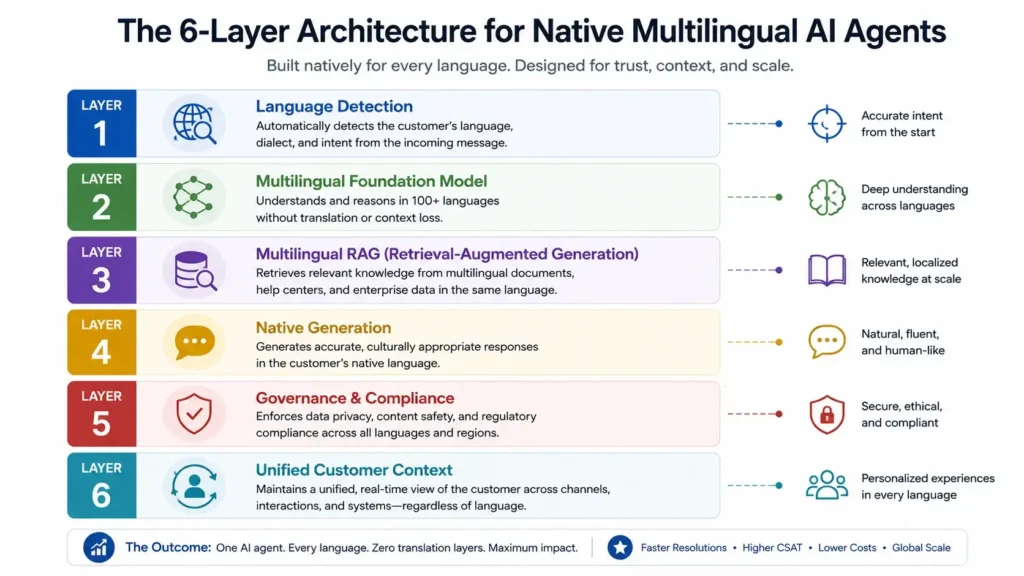
1. Language Detection Layer
The language detection layer identifies the customer’s language from the very first message without asking them to select it manually. It can accurately recognize short messages like “¿ya está?” as well as detect when customers switch languages midway through a conversation. This allows the AI to seamlessly continue the interaction in the right language, even in multilingual markets where code-switching is common.
2. Multilingual Foundation Model
The multilingual foundation model is the AI’s reasoning engine. Instead of translating every message into English first, it understands and reasons directly in the customer’s language. Modern models like Claude Sonnet, GPT-5, and Gemini can support over 100 languages through native multilingual reasoning. Since different models perform better for different language families, many enterprise deployments use multi-model routing to send each query to the model best suited for that language.
3. Multilingual RAG
Multilingual RAG gives the AI access to the right information before it generates a response. There are three common approaches:
- With cross-lingual retrieval, the AI can retrieve information from a knowledge base in one language and answer the customer in another.
- Per-language knowledge bases keep separate documentation for each language, offering higher accuracy but requiring more maintenance.
- A hybrid approach combines a central knowledge base with localized content for individual markets.
The right choice depends on your content complexity, regulatory requirements, and how much information varies from one region to another.
4. Native Generation Layer
The native generation layer generates responses directly in the customer’s language instead of being translated from English. This helps preserve product names, technical terminology, cultural nuance, brand voice, and the appropriate level of formality. For example, it understands when to use tú instead of usted in Spanish or the correct honorifics in Japanese, this way responses feel more natural rather than translated.
5. Governance and Compliance Layer
The governance and compliance layer ensures your AI follows the rules of every region where it operates. It manages data residency, protects personally identifiable information (PII), applies market-specific compliance policies, and also enforces language-specific content moderation. Whether your business needs to comply with GDPR in Europe, the DPDP Act in India, or UAE data regulations, this layer helps make sure every customer interaction meets regional requirements.
6. Unified Customer Context Layer
The unified customer context layer connects every interaction into a single customer history, even when customers switch languages or channels. For example, a customer might begin a conversation on live chat in English, continue it on WhatsApp in Hindi, and later send an email in Spanish. Instead of treating each interaction as a new request, the AI remembers the entire conversation which allows it to provide faster, more personalized support without asking customers to repeat themselves. This context layer is one of several pieces covered in our guide on how to build a 24/7 AI customer service agent, which walks through the full architecture beyond just the language layer.
The Cross-Lingual Knowledge Challenge
The hardest architectural challenge is making knowledge written in one language available to customers who speak another. For example, if your Japanese support team documents a solution, a Spanish-speaking customer should automatically receive the same solution in Spanish. Solving this global knowledge silo requires a strong cross-lingual retrieval architecture, which generic platforms often struggle to handle effectively, and in which custom AI agent development offers much greater flexibility.
Build vs Buy: Choosing the Right Path for Multilingual Support
Choosing between building and buying isn’t about which option is better overall but more about which one is better for your specific business. Your language coverage, regional compliance, integrations, and customer experience goals all should guide that decision.
To help you decide, here’s when buying makes sense and when building delivers more value:
When Off-the-Shelf Works
If your multilingual support needs are relatively standard, an off-the-shelf platform is often the most cost-effective option. Commercial platforms work well when you need:
- Support for common languages such as Spanish, French, German, Portuguese, or Italian, where language models are already highly optimized.
- Standard support channels like chat and email without complex workflows or voice automation.
- A single knowledge base where the AI can retrieve information and generate responses across multiple languages.
- Standard compliance requirements such as SOC 2 or GDPR that are already covered by the vendor.
For many enterprises serving common language markets through chat and email, platforms like Intercom Fin, Ada, Aisera, and Zendesk can deliver strong multilingual support. However, if your requirements are otherwise, a custom multilingual AI agent is likely to be the better long-term investment.
When Custom Development Wins
As your language, compliance, and operational requirements become more complex, generic platforms start reaching their limits. This is where custom AI development gives you much greater control over how your multilingual agent works. A custom approach is usually the better choice when you need:
- Support for rare languages, regional dialects, or complex language combinations that commercial platforms don’t handle consistently.
- Industry-specific terminology across healthcare, legal, financial, manufacturing, or highly technical industries where every translation must remain accurate.
- Market-specific knowledge bases because products, pricing, policies, or regulations vary from one country to another.
- Regional compliance and data residency that requires customer data to remain within specific countries or regions while meeting regulations such as GDPR, the India DPDP Act, or UAE data protection laws.
- Advanced code-switching support for multilingual markets where customers naturally switch between languages, such as Hinglish in India, Singlish in Singapore, or Arabic-English conversations across the UAE and the Middle East.
- Deep integrations with regional business systems, including different CRMs, payment gateways, ERPs, and operational workflows used across global markets.
These requirements go far beyond language support; they require an AI architecture that’s designed around your business. This is where experienced AI Agent developers like Dextra Labs have a clear advantage. If you’re evaluating your options, our Build vs Buy AI Customer Service Agent guide explains when custom development is the better choice.
How Dextra Labs Builds Multilingual Customer Support AI Agents?
Multilingual support isn’t a checkbox feature for us, it’s shaped by actually operating across the USA, Singapore, India, UK, and UAE, markets where code-switching, regional dialects, and market-specific compliance are the daily reality rather than an edge case. That’s the lens Dextra Labs brings to how we build multilingual AI agents: long-term scalability, regional compliance, and native customer experiences designed in from day one, not layered on after the fact.
Here’s the approach we follow to build enterprise-grade multilingual AI agents:
- Native generation over translation layers: We build AI agents that reason directly in the customer’s language instead of translating every conversation through English. This helps preserve cultural nuance, technical terminology, product names, and your brand voice across every market.
- Built for real multilingual conversations: Customers don’t always stick to one language. Whether it’s Hinglish in India, Singlish in Singapore, or Arabic-English in the UAE, we design AI agents that understand code-switching naturally instead of breaking when languages change mid-conversation.
- Compliance built into the architecture: Every deployment is designed around the regulations of the markets you operate in. From GDPR in Europe and the UK to India’s DPDP Act and UAE data protection requirements, we build data residency, governance, and security into the solution from day one.
- Cross-lingual knowledge architecture: We build multilingual RAG systems that connect knowledge across languages, allowing documentation created in one market to be accurately surfaced and delivered to customers in another without maintaining duplicate knowledge bases wherever possible.
Our engagement model
Here’s how we take multilingual AI agents from strategy to deployment:
- Phase 1: Discovery & Scoping (4 weeks): We evaluate your language requirements, regional compliance needs, existing knowledge base, customer support channels, and overall business goals before defining the right multilingual AI strategy.
- Phase 2: Architecture & Development (4–8 months): We design and build the complete multilingual architecture, including language detection, native language generation, multilingual RAG, compliance controls, integrations, and unified customer context.
- Phase 3: Deployment & Ownership Transition: We roll out the solution market by market, monitor performance, optimize where needed, and help your team take full operational ownership with confidence.
This same process underpins our broader ai agent development services in USA, multilingual support is one of the more complex applications of it, but the discovery-to-ownership-transition model stays consistent across every engagement.
The Cost and ROI of Multilingual Customer Support
Traditional multilingual support becomes expensive as your business grows. Every new language means hiring more bilingual agents across different time zones, so costs increase with every market you enter. Multilingual customer support AI agents change that model by supporting additional languages without requiring an entirely new team, making global expansion far more scalable.
Here’s how the economics compare:
| Cost Factor | Bilingual Staffing | Off-the-Shelf AI | Custom AI Agent |
| Cost per additional language | High (new team required) | Marginal | Marginal |
| Scaling to 20+ languages | Prohibitive | Feasible | Feasible |
| Upfront investment | Low | Low to moderate | Higher ($500K-$1.5M) |
| Ongoing cost at scale | Very high | Moderate (per conversation) | Lower (owned infrastructure) |
| Best fit | Few languages, high-touch support | Common language support | High-volume, multilingual enterprises with complex requirements |
The biggest ROI comes from four areas:
- Lower support costs: Automating routine multilingual conversations reduces cost per interaction while allowing support teams to focus on complex customer issues.
- Higher customer retention: Customers are more likely to stay loyal when they receive fast, natural support in their preferred language, making even small retention gains valuable at enterprise scale.
- Faster global expansion: Instead of waiting to recruit local language teams, businesses can launch in new markets with day-one multilingual support and start generating revenue sooner.
- Reduced hiring requirements: Every language your AI supports is one less dedicated language team you need to build and manage.
For enterprises handling high conversation volumes across multiple markets, custom multilingual AI customer service agents often deliver stronger long-term economics. While commercial platforms work well for many businesses, usage-based pricing can increase significantly at scale. Our breakdown of The Real ROI of AI Customer Service Agents covers the deflection, payback, and cost-per-resolution math behind these numbers in more detail.
Conclusion
Expanding into global markets is much easier when language is no longer a barrier. The right multilingual AI agent doesn’t just translate conversations but also understands customer intent, responds naturally in every language, and adapts to regional nuances while working seamlessly with your existing systems. And when your business spans multiple markets, a custom-built AI agent gives you the flexibility to scale without compromising on customer experience or compliance.
If you’re ready to build a multilingual AI agent tailored to your business, a free consultation is usually the fastest way to find out what that would actually look like, your languages, markets, compliance requirements, and existing workflows mapped against a real architecture before you commit to anything.
Frequently Asked Questions (FAQs):
Q. What are multilingual customer support AI agents?
Multilingual customer support AI agents are AI systems that understand and respond to customers in multiple languages. They can understand intent, keep conversation context, and resolve issues or take actions in the customer’s language instead of just translating messages.
Q. How is a multilingual AI agent different from Google Translate?
A multilingual AI agent understands, reasons, and takes action across different languages, while Google Translate primarily converts text or speech from one language to another.
You can see the difference more clearly when you compare what each one can actually do beyond language conversion:
- Intent: Google Translate translates the request; a multilingual AI agent understands what the customer actually wants.
- Context: Google Translate focuses on the content being translated; an AI agent remembers the conversation and keeps context across interactions.
- Conversation: Google Translate converts individual messages; an AI agent can hold a natural, multi-turn conversation.
- Actions: Google Translate provides translated output; an AI agent can check orders, process refunds, reset passwords, or trigger workflows.
- Multilingual handling: Google Translate translates between languages; an AI agent can handle code-switching, regional language patterns, and customer intent across languages.
Q. What is the difference between native language generation and a translation layer?
The main difference is where the AI does its reasoning. Native language generation lets the AI understand and respond directly in the customer’s language, while a translation layer converts the conversation into another language first and then translates the response back.
- Native language generation: The AI reasons and responds directly in the target language which makes responses more natural and better suited to local expressions, tone, and terminology.
- Translation layer: The AI reasons in a source language first and relies on another system to translate the input and output.
- Accuracy: Native generation is less likely to lose cultural nuance, technical terms, or customer context during translation.
- Speed: Native generation avoids extra translation steps, which can reduce response time.
- Custom advantage: For businesses with complex products, regional policies, or industry-specific terminology, custom AI agent development services give more control over how the AI agent handles language, context, and market-specific requirements.
Q. How do you create multilingual AI agents for customer service?
At Dextra Labs, we focus on how to create multilingual AI agents for customer service around the languages, markets, and workflows your business actually needs. We start with automatic language detection and a multilingual model that can reason natively in each target language, then add multilingual RAG, system integrations, unified customer context, and regional compliance. This approach helps the AI agent understand customers, find the right information, and resolve issues across languages instead of just translating messages.
Q. How many languages can AI customer support agents handle?
AI customer support agents can typically handle 30 to 100+ languages, depending on the model, platform, and support channel. The top multilingual AI agents for global customer service can support broad language coverage but the real challenge is maintaining quality, context, and accurate terminology across every single language. For businesses with less common languages, regional dialects, or market-specific requirements, custom AI agent development offers better control over which languages are supported and how the agent performs in each one.
Q. Can multilingual AI agents handle voice calls in different languages?
Yes, advanced multilingual AI agents can handle voice calls in many different types of languages, including language detection, speech recognition, natural responses, and real-time conversation. However, voice is more complex than text because accents, pronunciation, latency, and regional speech patterns all affect the experience. While AI agent tools multilingual customer service USA businesses use can offer multilingual voice capabilities, custom AI agent development gives more advantage when you need specific languages, regional accents, code-switching, or integrations with your existing phone systems.
Q. How do multilingual AI agents handle code-switching (mixing languages)?
Multilingual AI agents can recognize when a customer switches between languages in the same conversation, such as Hinglish, Spanglish, or Arabic-English. They process the mixed-language input together, understand the overall intent and context, and respond naturally without forcing the customer to choose one language first. This is very useful in markets where code-switching is part of everyday communication.
Q. Which AI agent tools support multilingual customer service in the USA?
If you need multilingual support that fits your specific languages, workflows, and regional requirements, Dextra Labs can build a custom AI agent rather than limiting you to a fixed platform. However, several established platforms already offer strong multilingual capabilities for businesses in the USA:
- Intercom Fin: Supports conversations in 45 languages and automatically detects the customer’s language.
- Ada: Offers multilingual customer service capabilities designed for businesses handling conversations across multiple languages.
- Fini: Provides multilingual AI support across customer service channels and is designed for global support use cases.
- Zendesk AI Agents: Supports 80 languages at native fluency, with AI agents available across messaging, email, and voice.
For standard languages and common support workflows, these platforms can be a practical choice. Custom development becomes more valuable when you need deeper control over regional language patterns, code-switching, multilingual RAG, compliance, or market-specific integrations.
Q. What compliance issues apply to multilingual AI agents across regions?
Multilingual AI agents need to follow the privacy, AI, and data-handling rules of every market they operate in. This can include GDPR in Europe and the UK, CCPA in California, India’s DPDP Act, and local data residency requirements. You also need to consider how customer data is stored and processed, whether sensitive information is handled safely, and whether responses meet local consumer protection and content requirements. For global deployments, planning these requirements into the AI architecture from the start is much safer than trying to add compliance later after deployment.
Q. Should we build a custom multilingual AI agent or buy an off-the-shelf platform?
It depends on your requirements, but custom development is often the better choice for enterprises with complex multilingual needs. Off-the-shelf platforms work well for common languages and basic support workflows, while a custom AI agent gives you control over language handling, code-switching, multilingual RAG, regional compliance, integrations, and market-specific workflows. If your business operates across multiple regions or needs the AI to work deeply with your existing systems, building custom can offer better flexibility, scalability, and long-term control.