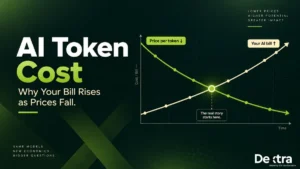
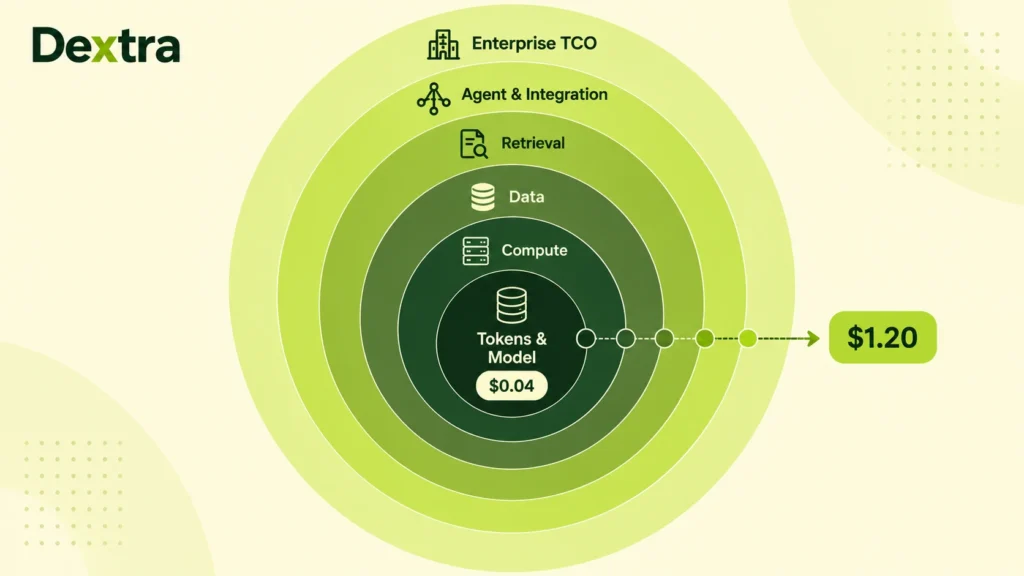
Your token bill is the number everyone quotes. It is almost never the number that decides whether your AI program makes money. This is the map of the other four layers, and how to read the whole bill before you sign it.
Ask a finance leader what enterprise AI costs and you will get a per-million-token figure quoted back within seconds. Ask them what it actually cost to get one agent into production and running reliably for a year, and the room goes quiet.
That gap, between the rate card everyone can recite and the bill nobody modelled, is where AI budgets go to die.
The token price is real, but it is the tip of the iceberg. Underneath it sit compute and inference infrastructure, the data pipelines that feed each prompt, the orchestration layer that turns a model call into a multi-step agent, and the governance and change-management overhead that only shows up once you are live. Miss any of these at the planning stage and the project does not just run over budget, it becomes one of the more than 40% of agentic AI projects Gartner expects to be scrapped or scaled back by the end of 2027, largely because the economics never closed.
This guide maps all five cost layers that make up enterprise AI spend, explains where the money actually leaks in each one, and shows why the biggest savings come from engineering the architecture, not from negotiating a better rate card.
Enterprise AI cost is not a rate you negotiate, it is a system you engineer. The token line moves a few percent. The architecture around it moves the bill by multiples. Saving is not bought, it is built.
The Enterprise AI Cost Stack, in Five Layers
Every dollar an AI system spends falls into one of five layers. They stack on top of each other, and cost compounds as you move upward. Most enterprise buyers only budget for the bottom layer, the one with a public price tag. The other four are where the real bill lives.
| Layer | What It Covers | Why It Is Underestimated |
|---|---|---|
| L1 – Token & Model | The per-token price of prompts and completions across your model mix. | It is the only number vendors publish, so it becomes the entire conversation. |
| L2 – Compute & Inference | GPUs, serving infrastructure, latency headroom, autoscaling, idle capacity. | Priced as ‘cloud compute,’ not ‘AI,’ so it lands on a different budget line entirely. |
| L3 – Data & Retrieval | Vector stores, embeddings, RAG pipelines, data refresh cycles, data cleaning. | Treated as a one-off build. In reality, it is a recurring operational cost. |
| L4 – Agent & Integration | Orchestration, tool/API calls, multi-step retries, human-in-the-loop, monitoring. | Every additional step multiplies token and compute cost, invisibly. |
| L5 – Enterprise AI TCO | Governance, security, change management, failure recovery, regulatory overhead. | Does not appear until production. Then it dominates. |
Go deeper on this layer:- AI Token Cost for Enterprises: Guide to Understanding and Managing AI Spend
Layer 1: Token & Model Cost
This is the layer everyone starts with, because it is the only one with a public price tag. You pay per million tokens in, per million tokens out, and output tokens typically cost three to five times more than input. In 2026, the frontier tier has settled into a familiar band, flagship models from Anthropic, OpenAI, and Google cluster around low-single-digit dollar input prices and low-double-digit output prices per million tokens.
But the exact figure on the rate card matters far less than the three multipliers sitting around it.
What Actually Moves This Layer
- Output-to-input ratio: A verbose agent that returns long completions can cost 4–5x a terse one for the identical task. Output discipline is a cost lever, not a style preference.
- Model routing: Sending every request to your most capable model is the single most common overspend in enterprise AI. Routing simple calls to smaller or cached models can cut this layer by 60–80% with no measurable quality loss on the easy majority of your traffic.
- Caching: Prompt caching can make repeated context roughly an order of magnitude cheaper. In 2026, several providers cut cached read prices by 75% while keeping base rates unchanged, proof that the headline price and the price you actually pay have quietly decoupled.
| The Trap Renegotiating your token rate saves a few percent. Re-architecting how you spend tokens, routing, caching, output control, saves multiples. Teams that only chase the rate card are optimising the smallest lever on the board. |
If you are running Claude Code or any coding agent, token consumption can spike quickly during sustained sessions. Understanding how those tokens accumulate, and where to reduce waste, is the difference between a manageable bill and a surprising one. We covered the specific mechanics in our guide to Claude Code token optimization.
Layer 2: Compute & Inference Cost
Underneath the token price sits the machinery that serves it. If you self-host or fine-tune, this is GPU time, serving infrastructure, and the autoscaling headroom you keep on standby so latency does not spike at peak. Even on a pure API model, inference economics reach you indirectly, through rate limits, through the latency budget that forces you to over-provision, and through the retries that a slow or overloaded endpoint generates.
Where the Money Leaks
- Idle capacity: GPUs and reserved throughput you pay for around the clock to cover a few hours of peak demand. Utilisation rate, not sticker price, determines this layer.
- Latency over-provisioning: Buying more compute than the workload needs so the 99th-percentile response stays fast. Often the fix is architectural, batching, async processing, streaming, not more hardware.
- The build-versus-buy line: Self-hosting looks cheaper per token and is frequently more expensive per outcome once you factor in MLOps headcount, redundancy, and hardware depreciation. This is a modelling decision, not a gut call.
For organisations evaluating whether self-hosted or API-based inference delivers better economics, the right answer almost always depends on volume, latency requirements, and the true cost of the engineering team needed to run the infrastructure. At moderate scale, most enterprises come out ahead on API-based models. At very high sustained volume, self-hosting starts to make sense, but only if you have the operational maturity to run it.
Go deeper on this layer:- AI ROI & the Economics of Cloud Compute: How Enterprises Are Recalculating Cloud Costs and Custom Silicon Strategies
Layer 3: Data & Retrieval Cost
A model with no access to your data is a very expensive autocomplete. The layer that makes it useful, embeddings, vector storage, the retrieval-augmented generation pipeline that pulls the right context into each prompt, is also the layer most often mis-budgeted. It gets priced as a one-time build. In reality, it is a recurring operating cost that scales with your knowledge base.
The Recurring Costs Teams Forget
- Embedding and re-embedding: Every document you index costs tokens to embed, and every refresh cycle re-incurs that cost. A knowledge base that changes daily is a standing bill, not a project line item.
- Retrieval bloat: Stuffing large context windows with loosely relevant chunks inflates Layer 1 cost on every single call. Better retrieval is a token-cost lever disguised as a quality lever.
- Data cleaning and governance: The unglamorous pipeline work, deduplication, permissions management, freshness checks, that determines whether retrieval helps or quietly poisons your outputs.
| Why Bigger Context Windows Did Not Fix This 2026’s million-token context windows tempt teams to skip retrieval and ‘just send everything.’ That trades a one-time engineering cost for a per-call token cost that recurs on every request forever. Long context is a tool, not a substitute for retrieval architecture. |
The teams getting this layer right are the ones that invested in proper data foundations before they built anything on top. Retrieval quality, indexing frequency, and chunk design are not afterthoughts, they are the infrastructure that determines whether Layers 1 through 4 run efficiently or burn money on every call.
Layer 4: Agent & Integration Cost
This is where a model becomes a system, and where costs start multiplying instead of adding. An agent does not make one call. It plans, calls a tool, reads the result, calls another tool, retries the ones that fail, and sometimes loops back for a human to approve a step. Each of those steps re-incurs Layer 1 and Layer 2 costs. A task that looks like “one query” on the rate card can easily become fifteen model calls in production.
The Multipliers Hiding in Orchestration
- Step count: Every additional reasoning or tool-use step multiplies token and compute spend. Agent design is cost design, and a well-architected agent can differ 5–10x in running cost from a naive one performing the same task.
- Retries and failure loops: A brittle tool integration or a flaky API does not just cause errors, it causes repeated model calls. Reliability engineering shows up directly on the AI bill.
- Integration surface. Connectors, authentication, middleware, and the monitoring layer to keep it all observable, the plumbing that never appears in a token estimate but always appears in the invoice.
- Human-in-the-loop: Review and approval steps are a real cost, and frequently the correct one. But they belong in the cost model from day one, not as a surprise discovered in production.
This is the layer where the difference between a thoughtfully designed AI agent and a hastily assembled one becomes a direct financial gap. When Dextra Labs builds AI agent systems, the architecture starts with step-count discipline and failure handling, because those two decisions determine more of the ongoing cost than the choice of model.
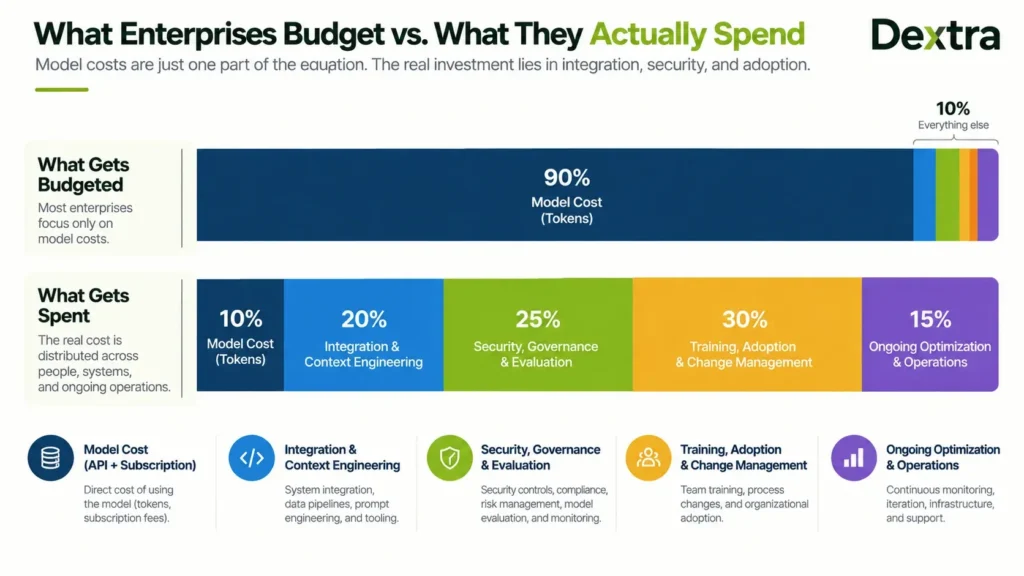
Layer 5: Enterprise AI TCO: The Costs That Only Appear in Production
The top layer is the one that separates a demo from a deployment, and it is almost entirely invisible until you are live. This is governance, security review, change management, failure recovery, and the regulatory overhead that regulated industries carry on every AI system.
EY frames this precisely in its “Total Cost of Agents” analysis. The true cost of an enterprise agent spans seven cost types, of which the token/API charge is only one. The other six, subscriptions and licences, platform infrastructure, governance burden, organisational change, expected failure and recovery, and potential “AI taxes” from regulatory and compliance requirements, are the ones that make or break the business case.
| EY estimates the fully-loaded cost of a single agent interaction at roughly $1.20 once all seven cost types are counted. Against a raw token/compute cost near $0.04. The rate card shows you four cents. The enterprise pays over a dollar. Everything between those two numbers is Layer 5. |
The Seven Costs EY Identifies
| EY Cost Type | TCO Layer | In Plain Terms |
|---|---|---|
| Tokens / API | L1 | The published per-token price everyone starts with. |
| Subscriptions & licences | L5 | Platform seats, tooling contracts, vendor fees. |
| Platform infrastructure | L2 | Serving, hosting, the compute that runs the model. |
| Governance burden | L5 | Review cycles, audit, risk assessment, policy sign-off. |
| Organisational change | L5 | Training, adoption programs, workflow redesign. |
| Expected failure & recovery | L4/L5 | Retries, incidents, rollback, rework. |
| Potential AI taxes | L5 | Regulatory compliance, legal review, audit overhead. |
This is why EY and others now talk about “agentic FinOps”, treating AI spend the way mature organisations treated cloud spend a decade ago. Something you instrument, attribute, and govern continuously. Not a line item you approve once and forget. If you cannot see all five layers, you cannot manage the only bill that actually matters: the total one.
Go deeper on the full-program view:- AI Development Cost: What Enterprise Projects Really Run
The Takeaway: Saving Is Not Bought, It Is Built
Read all five layers together and one pattern is clear. The token price, the only number most buyers optimise, is the layer with the least room to move. The real leverage is architectural:
- Model routing and output discipline drive Layer 1.
- Utilisation and right-sizing drive Layer 2.
- Retrieval precision and data hygiene drive Layer 3.
- Step-count discipline and reliability drive Layer 4.
- Governance-by-design drives Layer 5.
None of those are things you negotiate with a vendor. They are things you engineer into the system.
That is the core philosophy behind every engagement at Dextra Labs. We do not help enterprises find a cheaper rate card. We help them build AI systems where the bill is low by design, the right model for each job, retrieval that sends only what is needed, agents with the fewest reliable steps, and governance baked in so Layer 5 never ambushes the business case.
| How Dextra Labs Reads Your AI Bill→ We model all five cost layers before a line of production code, so the TCO is a decision, not a surprise. → We engineer the architecture to reduce cost at each layer: routing, caching, retrieval design, agent architecture, governance-by-design. → We instrument for agentic FinOps, so spend stays visible and attributable as you scale. If your AI budget is being written against a single per-token number, you are pricing one layer of a five-layer system. Talk to Dextra Labs about a TCO-first architecture review. |
Frequently Asked Questions:
What is the total cost of ownership (TCO) of enterprise AI?
Enterprise AI TCO is the fully-loaded cost of running an AI system in production, covering five layers: token and model cost, compute and inference, data and retrieval, agent orchestration and integration, and the enterprise overhead of governance, change management, and failure recovery. EY’s analysis puts the fully-loaded cost of a single agent interaction near $1.20, compared to a raw token cost around $0.04, roughly 30x more than the rate card suggests.
Why is enterprise AI more expensive than the token price implies?
Because the token price is one of five cost layers, and usually the smallest. Compute infrastructure, retrieval pipelines, agent orchestration, and governance each add cost that never appears on a per-token rate card. An agent task that looks like one query can generate a dozen model calls plus retrieval, retries, and human review once it is running in production.
What are the hidden costs of AI agents?
The hidden costs sit primarily in Layers 4 and 5: multi-step orchestration and retries that multiply token spend, integration middleware and monitoring, plus governance, compliance, organisational change, and failure recovery. EY groups these into seven cost types, of which the token/API charge is only one, and calls managing them “agentic FinOps.”
How can enterprises reduce AI costs without losing quality?
By engineering the architecture, not just negotiating the rate. Model routing, sending straightforward calls to smaller models, can cut token cost by 60–80%. Prompt caching can reduce repeated context cost by up to 90%. Better retrieval trims context bloat. Tighter agent design eliminates redundant steps. These architectural levers move the bill by multiples, where rate negotiation moves it by a few percent.
What is agentic FinOps?
Agentic FinOps is the practice of treating AI agent spend the way mature teams treat cloud spend, instrumenting it, attributing it to specific workflows, and governing it continuously rather than approving a budget once. It exists because agent cost is dynamic: it scales with usage, step count, and failure rates, so it must be observed and managed in production.
Is a bigger context window cheaper than building RAG?
Usually not. Sending everything inside a million-token window trades a one-time engineering cost for a per-call token cost that recurs on every request. Long context is valuable for genuinely large single inputs, but for a knowledge base that gets queried repeatedly, a well-designed retrieval architecture is almost always cheaper at scale.